OEM / ODM Cosmetic Bag RFQ Guide
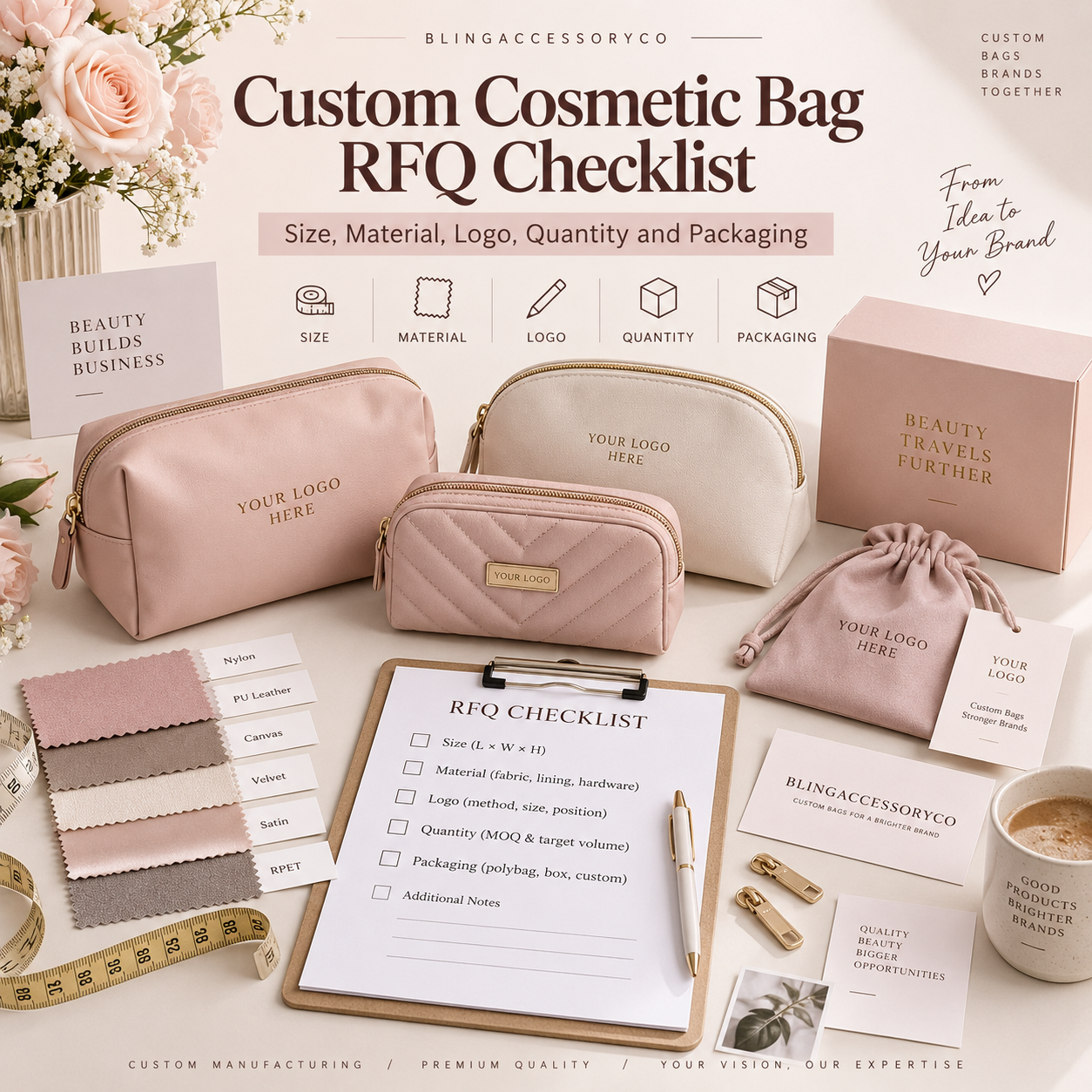
Custom Cosmetic Bag RFQ Checklist: Size, Material, Logo, Quantity and Packaging
A clear custom cosmetic bag RFQ checklist helps beauty brands, skincare companies, retailers, wholesalers, subscription box buyers, promotional teams, and private label sellers receive faster and more accurate quotations from a cosmetic bag manufacturer. RFQ means Request for Quotation. In custom bag manufacturing, an RFQ is the buyer’s written product brief that tells the factory what to quote, how to quote it, and what commercial details must be confirmed before sampling or bulk production.
Many buyers send a simple message such as “Please quote cosmetic bags with our logo.” This is not enough for an accurate factory quote. A custom cosmetic bag price can change based on finished size, material, lining, zipper, structure, logo method, quantity, color split, packaging, sample requirement, quality standard, delivery timeline, and shipping destination. A flat polyester makeup pouch with screen printing and polybag packaging has a very different cost structure from a PU leather vanity case with custom zipper puller, printed lining, metal logo plate, dust bag, barcode label, and gift box.
This guide gives you a practical RFQ checklist for custom cosmetic bags, including size, material, logo, quantity, packaging, quality control, sample approval, production lead time, and shipping terms. If you are preparing a custom project, you can explore Custom Bag Manufacturing Services, browse the Cosmetic Bag Collection, or send your requirements through Contact Us.
What Is a Custom Cosmetic Bag RFQ?
A custom cosmetic bag RFQ is a structured request sent to a manufacturer to ask for pricing, MOQ, sample cost, sample time, production lead time, packaging options, and shipping terms. It should describe the exact product you want to make and the commercial conditions you need the supplier to quote.
For custom cosmetic bags, an RFQ should include product style, finished size, material, lining, zipper, pockets, logo, quantity, color split, packaging, quality standard, sample requirement, delivery date, destination, and target price if available. These details help the manufacturer calculate material consumption, labor time, logo setup, packaging cost, carton size, shipping volume, and production feasibility.
RFQ quality matters because cosmetic bags are not one standard product. A custom makeup pouch, mini pouch, brush bag, toiletry bag, clear PVC bag, travel cosmetic bag, drawstring pouch, cosmetic case, vanity case, and cosmetic bag set all require different materials, patterns, sewing steps, branding methods, and packaging plans. If the RFQ is vague, the quote may be inaccurate or incomplete.
Why a Detailed RFQ Helps You Get a Better Quote
A detailed RFQ saves time and reduces misunderstanding. When a buyer sends clear specifications, the factory can check material availability, confirm logo feasibility, calculate MOQ, estimate production time, and recommend practical cost-saving options. When a buyer sends incomplete information, the factory must ask many follow-up questions or give a rough quote that may change later.
A strong RFQ also makes supplier comparison easier. If you send the same RFQ to several manufacturers, you can compare unit price, MOQ, material, logo method, packaging, sample cost, lead time, and shipping terms on a more equal basis. Without a consistent RFQ, one supplier may quote a basic pouch while another quotes a lined, retail-ready cosmetic bag with premium packaging.
For beauty brands and private label sellers, a good RFQ protects margins. It helps prevent hidden costs such as custom logo setup, mold fees, packaging MOQ, barcode labeling, carton marks, sample revision, inspection fees, or freight. It also helps the manufacturer suggest a better material or construction if your target price and quality expectations are clear.
If you need more background on pricing and supplier quotation logic, review How Much Do Custom Cosmetic Bags Cost? and How to Get an Accurate Quote From a Cosmetic Bag Manufacturer.
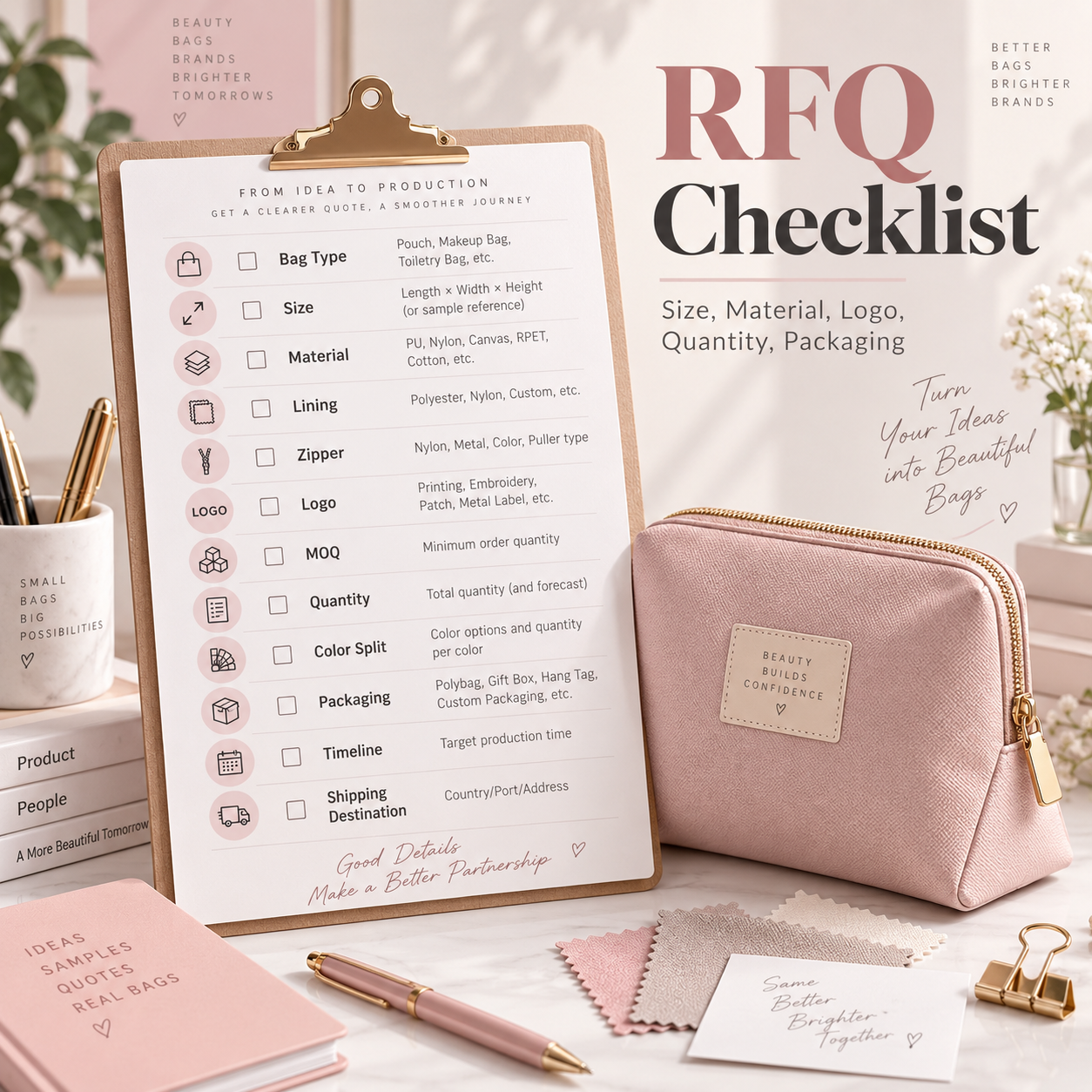
Quick RFQ Checklist for Buyers
Before contacting a cosmetic bag factory, prepare the following information. You do not need to have every technical detail perfect, but the more complete your brief is, the more useful the quotation will be.
| RFQ Item | What to Include | Why It Matters |
|---|---|---|
| Bag Type | Makeup pouch, mini pouch, toiletry bag, brush bag, clear bag, vanity case, set | Different styles have different patterns, labor, and costs. |
| Size | Length, height, depth, and what products must fit inside | Size affects material, zipper, packaging, and shipping volume. |
| Material | PU leather, polyester, nylon, canvas, PVC, TPU, satin, velvet, RPET | Material affects cost, MOQ, appearance, logo method, and quality. |
| Logo | Artwork file, size, placement, color, and branding method | Logo method affects setup cost, sample time, and MOQ. |
| Quantity | Total order, quantity per color, MOQ goal, and reorder forecast | Quantity affects unit price, production planning, and color split feasibility. |
| Packaging | Polybag, hangtag, belly band, insert card, barcode, dust bag, gift box | Packaging affects unit cost, MOQ, lead time, and retail presentation. |
1. Size, Dimensions, and Product Capacity
Size is one of the most important parts of a custom cosmetic bag RFQ. A small change in length, height, or depth can change material usage, zipper length, lining, packaging size, carton volume, and shipping cost. Always provide finished dimensions if available.
Use a clear format such as 20 cm L x 12 cm H x 7 cm D. If you work in inches, include inch dimensions. If you do not know the exact size, explain what the bag needs to hold. For example, a skincare gift pouch may need to fit a 100 ml cleanser, 50 ml cream jar, 30 ml serum bottle, and several sample sachets. A brush bag may need to fit ten brushes of specific length. A toiletry bag may need to fit travel bottles and grooming products.
Capacity matters because photos can be misleading. A bag may look large in a reference image but be too small for your actual products. If the bag will hold beauty products, send product dimensions or photos. If the bag is for retail, mention whether it should look structured, slim, full, foldable, or wide-opening.
For product style comparison, review Cosmetic Case vs Cosmetic Bag, Mini Pouch Buying Guide, and Custom Vanity Cases.
2. Material, Lining, and Surface Finish
Material has a major impact on quotation accuracy. Common cosmetic bag materials include polyester, nylon, PU leather, canvas, cotton, PVC, TPU, satin, velvet, terry cloth, mesh, recycled polyester, and specialty fabrics. Each material affects cost, MOQ, logo compatibility, handfeel, durability, and retail value.
If you already know the material, describe it clearly. Examples include pebbled PU leather, smooth vegan leather, clear TPU, transparent PVC, cotton canvas, quilted satin, recycled polyester, soft velvet, or wipe-clean fabric. If you do not know the exact material, describe the product direction: premium, natural, transparent, lightweight, water-resistant, washable, travel-friendly, giftable, or cost-effective.
Lining should also be included. A bag with no lining is different from a bag with polyester lining, printed lining, satin lining, wipe-clean lining, mesh lining, or branded lining. Lining affects cost and customer experience. For skincare and travel bags, wipe-clean lining may matter more. For premium gift bags, soft lining or printed lining may improve perceived value.
If the project needs a custom Pantone color, exclusive print, special recycled material, unusual texture, or exact brand color match, mention this early. Custom materials can increase MOQ and lead time. For material decisions, review the Cosmetic Bag Materials Guide, PU Leather Cosmetic Bags Guide, and Clear Cosmetic Bags Guide.
3. Structure, Pockets, Zippers, and Hardware
Structure affects labor cost and production complexity. A basic one-compartment makeup pouch is easier to quote than a brush bag with elastic slots, a toiletry bag with multiple compartments, or a structured vanity case with padding and handle reinforcement. Your RFQ should explain the functional details clearly.
Include details such as inner pockets, zipper pockets, mesh compartments, elastic loops, brush slots, divider panels, clear windows, side handles, wrist straps, hanging hooks, reinforced bottoms, padding, wide-opening structure, or removable pouches. If you do not know the technical word, describe the function. For example: “The bag should open wide,” “I need a clear front panel,” or “The inside should hold makeup brushes separately.”
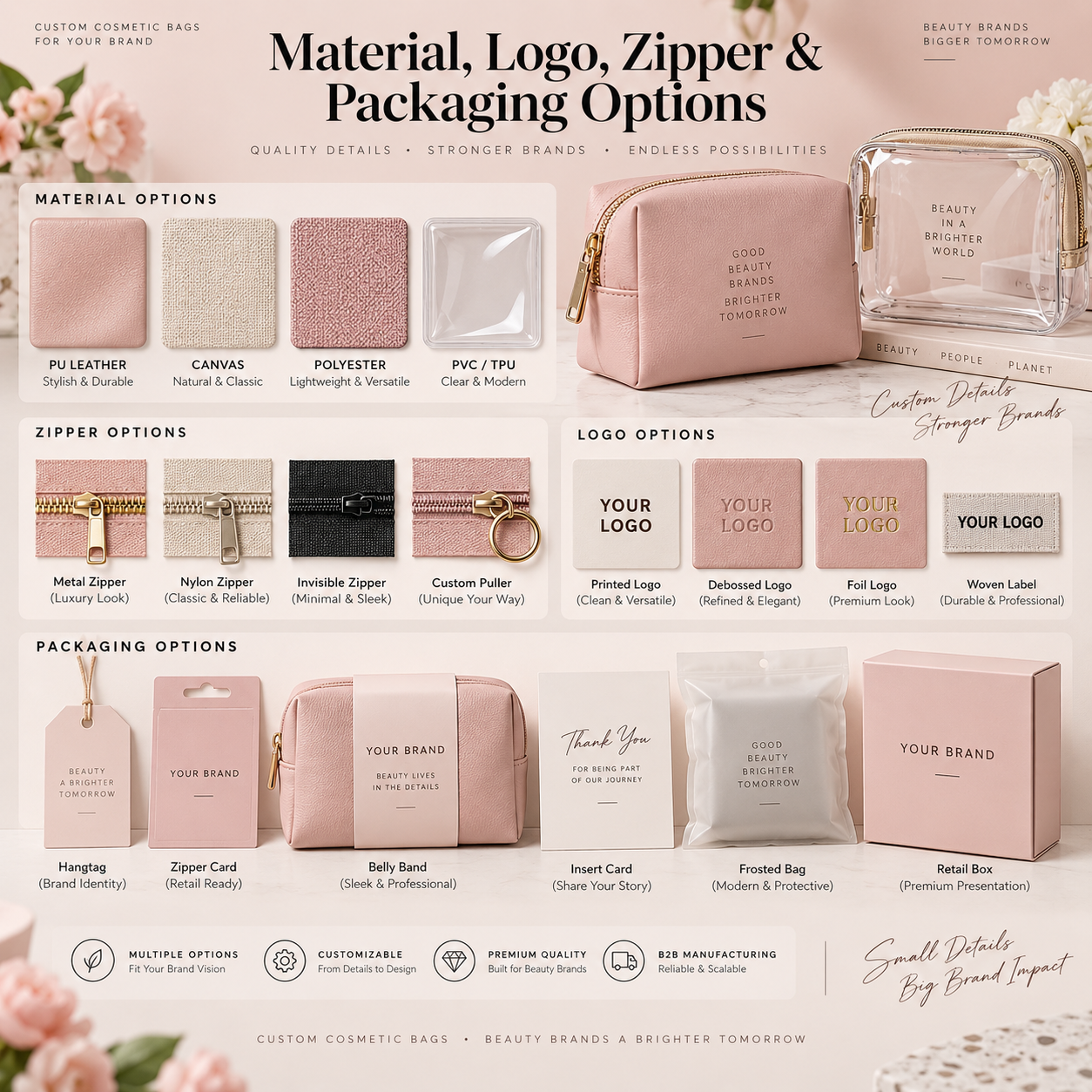
Zipper and hardware details should not be ignored. Nylon zipper, metal zipper, resin zipper, double zipper, waterproof-style zipper, custom zipper puller, special zipper tape color, D-ring, hook, buckle, snap, chain handle, and metal logo plate can all affect pricing and production time.
If the zipper is important to your design, review the Best Zipper for Custom Cosmetic Bags Guide. If your bag is a toiletry or travel product, review the Toiletry Bag Manufacturer Guide and Travel Cosmetic Bag Guide.
4. Logo Artwork and Branding Method
Logo details are essential for an accurate RFQ. Send your logo file in AI, EPS, SVG, PDF, or high-resolution PNG format. Vector files are best because they help the factory prepare printing, embroidery, debossing, patches, metal plates, or custom pullers more accurately.
Include logo size, placement, color, and method if known. Common cosmetic bag logo methods include screen printing, heat transfer, embroidery, woven label, PU patch, rubber patch, silicone patch, debossing, embossing, foil stamping, metal logo plate, custom zipper puller, printed lining, and branded packaging.
Logo method affects cost and MOQ. A simple screen print may be practical for polyester pouches and promotional bags. Debossing can work well for PU leather cosmetic bags. Embroidery can add texture to canvas or fabric pouches. Rubber patches, metal plates, and custom zipper pullers can improve perceived value but may require setup, tooling, or higher MOQ.
If you are unsure which logo method fits your product, ask the supplier to recommend options based on material, budget, quantity, and brand style. For detailed comparison, review the Cosmetic Bag Logo Printing Guide and Patch Cosmetic Bags Guide.
5. Quantity, MOQ, Color Split, and SKU Plan
Quantity is central to any custom cosmetic bag quotation. Tell the factory whether you need 500 pieces, 1,000 pieces, 3,000 pieces, 5,000 pieces, 10,000 pieces, or another quantity. Unit price can change by quantity because setup costs, material sourcing, cutting, sewing, logo application, inspection, and packaging are spread across different volumes.
If you want multiple colors, send the quantity per color. A request for 1,000 pieces total is different from 1,000 pieces split into five colors. Each color may require separate material preparation, cutting, sewing, labels, packaging, carton marks, and inspection. The same logic applies to multiple logo versions, packaging versions, or sizes.
MOQ may apply per style, per color, per material, per logo version, or per packaging version. Ask the factory to confirm the MOQ rule clearly. If you are a new beauty brand and want to test the market, explain your low MOQ goal and possible reorder plan.
For deeper quantity planning, review What Is the MOQ for Custom Cosmetic Bags?, Low MOQ Cosmetic Bag Manufacturer, and How Many Custom Cosmetic Bags Should a New Beauty Brand Order?.
6. Packaging, Labels, Barcodes, and Retail Needs
Packaging should be included in the first RFQ, not added after the quote. Packaging can affect unit cost, MOQ, lead time, carton size, shipping volume, and retail presentation. Common options include individual polybags, hangtags, belly bands, insert cards, barcode labels, care labels, dust bags, paper sleeves, kraft boxes, drawer boxes, rigid gift boxes, tissue paper, and retail display packaging.
If the product is for retail, include barcode requirements, SKU labels, care labels, country-of-origin labels, packaging language, retailer instructions, carton marks, and shelf presentation needs. If the bag is for e-commerce, explain how it should arrive to customers. If it is for a gift-with-purchase campaign, tell the supplier whether products will be packed inside the bag.
Packaging also affects shipping. A flat pouch in a polybag packs differently from a structured vanity case in a gift box. Gift packaging can improve perceived value, but it may also increase freight volume. A cost-effective RFQ should include packaging style and sales channel so the supplier can recommend practical options.
For packaging planning, review the Cosmetic Bag Packaging Guide and Cosmetic Bags with Belly Bands.
7. Quality Control and Sample Requirements
Your RFQ should explain sample and quality expectations. A sample helps confirm size, material, zipper, lining, logo, stitching, packaging, and overall appearance before bulk production. Without sample approval, buyers risk discovering problems too late.
Ask for sample cost, sample lead time, revision process, pre-production sample approval, and whether the sample fee can be deducted from bulk production under certain conditions. If your project includes custom materials, special hardware, printed packaging, or multiple colors, sampling becomes even more important.
Quality control requirements should cover material appearance, size tolerance, stitching, loose threads, zipper smoothness, logo accuracy, lining cleanliness, pocket placement, packaging condition, barcode label, carton mark, SKU separation, and final quantity. For clear PVC or TPU bags, also check scratches, odor, transparency, and pressure marks. For PU leather bags, check surface marks and edge finishing.
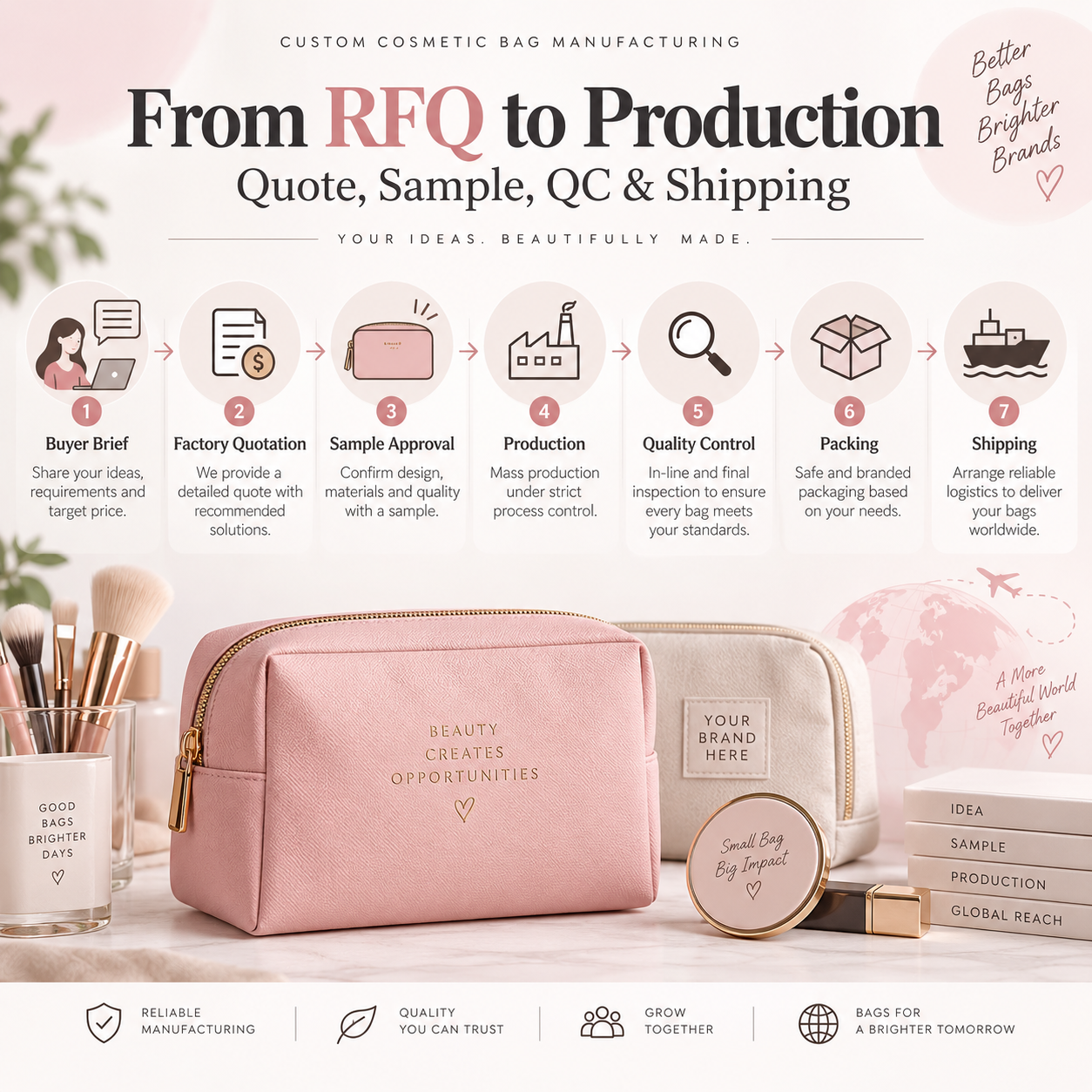
For inspection planning, review the Cosmetic Bag Quality Control Guide and How to Customize Cosmetic Bags for Your Beauty Brand.
8. Timeline, Shipping Destination, and Quote Terms
Timeline and shipping terms should be part of the RFQ. Tell the supplier when you need samples, when bulk goods must be ready, and when the final products must arrive. If the project is tied to a retail launch, subscription box deadline, holiday campaign, trade show, or gift-with-purchase event, the factory needs to know early.
Also provide the shipping destination. Include country, city, postal code, warehouse address, fulfillment center, or destination port if available. Ask whether the quote is EXW, FOB, CIF, DDP, or another trade term. A factory unit price is not the same as landed cost.
Shipping cost depends on carton size, gross weight, product volume, packaging, destination, shipping method, and delivery speed. Ask the supplier to include carton size, packing quantity, gross weight, and estimated shipping options if possible. This helps you calculate real cost more accurately.
If you have a target price, include it with quality expectations. A target price can help the supplier suggest suitable materials, structure, logo method, and packaging. For cost-saving ideas, review How to Reduce Custom Cosmetic Bag Manufacturing Costs Without Sacrificing Quality.
Custom Cosmetic Bag RFQ Template
You can copy and adjust the template below when contacting a cosmetic bag manufacturer.
Subject: RFQ – Custom Cosmetic Bags with Logo
Hello,
We are preparing a custom cosmetic bag project and would like to request a quotation. Please review the details below and advise MOQ, unit price, sample cost, sample time, production lead time, packaging options, and shipping estimate.
Bag type: [makeup pouch / mini pouch / toiletry bag / brush bag / clear cosmetic bag / vanity case / cosmetic bag set]
End use: [retail / e-commerce / GWP / subscription box / wholesale / private label / promotional campaign]
Reference style: [attach images, drawings, or product links]
Finished size: [L x H x D, or products the bag must hold]
Outer material: [PU leather / polyester / canvas / PVC / TPU / satin / velvet / other]
Lining: [polyester / wipe-clean / printed lining / no lining / other]
Structure: [pockets, zipper, handle, compartments, brush slots, padding, clear panel, hardware]
Logo: [attach vector file, method, size, placement, color]
Color plan: [one color / multiple colors / Pantone / quantity per color]
Quantity: [target order quantity, MOQ goal, reorder forecast]
Packaging: [polybag / hangtag / belly band / insert card / barcode / dust bag / gift box]
Quality requirements: [sample approval, inspection points, tolerance, special requirements]
Timeline: [sample deadline, production deadline, final delivery date]
Shipping destination: [country, city, postal code, port, or warehouse]
Quote terms requested: [EXW / FOB / CIF / DDP / supplier recommendation]
Target price: [optional but helpful]
Please also recommend any material, structure, logo, packaging, or quantity changes that could improve quality, reduce cost, or make production more efficient.
Thank you.
Common RFQ Mistakes to Avoid
The first mistake is sending only a photo and asking for a price. A photo shows style direction, but it does not define size, material, lining, zipper, logo, packaging, quantity, or shipping terms.
The second mistake is comparing supplier quotes with different specifications. One manufacturer may quote a basic polyester pouch, while another quotes a PU leather bag with lining and retail packaging. Compare full specifications, not only unit price.
The third mistake is forgetting packaging. Packaging can change cost, MOQ, lead time, carton size, and retail presentation. Include packaging in the first RFQ.
The fourth mistake is not giving quantity or color split. A total order quantity is useful, but the factory also needs quantity per color, SKU count, and packaging version.
The fifth mistake is hiding the deadline. If your delivery date is fixed, tell the supplier early. Urgent projects may require available materials, existing styles, simple logo methods, and practical packaging.
The sixth mistake is asking for the lowest price without defining quality. A lower quote may use thinner material, weaker zipper, simpler lining, basic packaging, or limited inspection. A good RFQ asks for the best value for a specific product standard.
FAQ: Custom Cosmetic Bag RFQ Checklist
What should be included in a custom cosmetic bag RFQ?
A custom cosmetic bag RFQ should include bag type, size, product use, material, lining, structure, zipper, logo artwork, logo method, quantity, color split, packaging, quality requirements, timeline, shipping destination, and quote terms.
Why is size important for a cosmetic bag quotation?
Size affects material usage, zipper length, lining, packaging, carton volume, and shipping cost. It also determines whether the bag can hold the intended beauty products.
What material information should I send?
Send the preferred outer material, lining, color, texture, finish, and any special requirements. Common options include PU leather, polyester, nylon, canvas, PVC, TPU, satin, velvet, and recycled polyester.
What logo file should I send to a cosmetic bag manufacturer?
Vector files such as AI, EPS, SVG, or PDF are preferred. High-resolution PNG files can also help, but vector artwork is better for production accuracy.
Does quantity affect the custom cosmetic bag quote?
Yes. Quantity affects unit price, material sourcing, production efficiency, MOQ, logo setup, packaging, and inspection. Always provide target quantity and quantity per color.
Should packaging be included in the RFQ?
Yes. Polybags, hangtags, belly bands, insert cards, barcode labels, dust bags, paper sleeves, and gift boxes can all affect cost, MOQ, lead time, and shipping volume.
Can I request a quote if I do not know all technical details?
Yes. You can describe the product goal, reference images, target customer, budget, quantity, and launch plan. A professional manufacturer can recommend practical materials, structures, and logo methods.
How can I compare different cosmetic bag factory quotes?
Compare material, size, lining, zipper, logo method, packaging, MOQ, sample cost, lead time, shipping terms, carton details, and quality control standard.
Should I approve a sample before bulk production?
Yes. Sample approval helps confirm size, material, zipper, lining, logo, stitching, packaging, and overall quality before mass production begins.
Where can I send a custom cosmetic bag RFQ?
You can contact Bling Accessory Co. through the Contact Us page and send your bag type, size, material, logo, quantity, packaging, timeline, and destination.
Send a Clear RFQ for Your Custom Cosmetic Bag Project
A complete custom cosmetic bag RFQ helps your manufacturer quote more accurately, recommend better materials, avoid hidden costs, plan samples properly, and prepare a smoother bulk production process. The more clearly you explain size, material, logo, quantity, packaging, quality, timeline, and shipping details, the easier it is to receive a useful quotation.
Whether you need custom makeup pouches, mini pouches, toiletry bags, brush bags, clear cosmetic bags, PU leather vanity cases, drawstring bags, cosmetic bag sets, private label cosmetic bags, or wholesale beauty packaging, a structured RFQ can help turn your product idea into a realistic manufacturing plan.