How Do I Launch a Private Label Cosmetic Bag From Idea to Bulk Production?
Launch a private label cosmetic bag by turning your idea into a written product brief, selecting a suitable manufacturing route, approving a representative sample, and releasing production against an agreed specification. The key is deciding what must be confirmed before each commitment, rather than treating a logo mockup or quotation as a production-ready plan.
For beauty brands, DTC founders, retailers, and wholesale buyers, the difficult handoffs often involve material substitutions, conflicting sample comments, unfinished packaging, or a launch date that assumes manufacturing and delivery are the same milestone. This guide explains how to organize those decisions, assign approval responsibility, and connect sampling, purchasing, QC, and delivery so the factory and brand work from the same requirements.
Quick Answer
Start with the cosmetic bag's intended use, contents, target customer, quantity plan, and destination market. Choose an existing supplier design or a new development scope, then obtain a quote based on the same written specifications. Review samples for fit, materials, logo, construction, and packaging. Before bulk production, approve the final specification, sample revision, quantity split, inspection criteria, commercial terms, and responsibilities. Confirm any remaining testing or documentation requirements. During production, control substitutions and review agreed checkpoints. Release shipment only after the agreed checks, then verify received stock before treating the product as ready to launch.


Key Facts: Buyer Snapshot
| Decision factor | What to establish |
|---|---|
| Product purpose | What the pouch carries, how it is used, and why it fits the brand. |
| Development route | Which design elements can be reused and which require development. |
| Commercial scope | Quantity split, MOQ conditions, included costs, and delivery basis. |
| Sample approval | The exact version and features approved, including any unresolved items. |
| Packaging readiness | Packing method, artwork, labels, identifiers, and carton requirements. |
| Production control | Specifications, tolerances, inspection criteria, and substitution approval. |
| Launch readiness | Delivery, receiving checks, sellable inventory, and accurate product content. |
Table of Contents
What Should I Define Before Developing a Private Label Cosmetic Bag?
Define the job the bag must perform before choosing decorative details. Private label describes a product sold under your brand; it does not, by itself, specify how much design or manufacturing development is required.
Write a brief covering intended contents, target customer, sales channel, approximate dimensions, opening style, cleaning expectations, and desired appearance. Separate essential requirements from preferences that can change if sourcing or sampling reveals a problem.
For example, a pouch intended to hold a skincare set must close comfortably around those containers. A reference photograph cannot establish usable internal space or opening clearance.
Buyer action: Supply the actual contents or their dimensions, reference images, and a ranked list of priorities. Use the cosmetic bag collection to identify relevant formats, then explain what your version must achieve.
Should I Start With an Existing Design or Develop a New One?
Start with an existing design when it meets the functional brief; request new development when essential requirements remain unmet. Ask the supplier to identify the actual work involved instead of relying only on the terms OEM and ODM.
An existing design may still need material sourcing, branding trials, or revised construction. A fully developed new design may need pattern revisions and repeated fit checks. Neither route guarantees a particular MOQ or completion time.
For example, adding a brand label to a suitable pouch is different from changing its opening and internal compartments. The latter affects more than surface decoration.
Buyer action: Request a written list of reused elements, proposed changes, development deliverables, and approval responsibilities. Review the OEM vs ODM cosmetic bag guide when deciding which starting point fits the project.
How Do I Choose a Supplier and Request a Comparable Quote?
Evaluate the supplier against your product requirements, then compare quotations using the same specification. A low unit price is difficult to interpret when the assumed lining, logo, packaging, or quantity split differs.
Confirm who will manufacture the bag, who manages sampling, and how technical questions are resolved. Ask for relevant sample work and explanations of how the proposed construction will be made and inspected.
The quotation should identify materials, dimensions, branding, quantity by variant, packaging, development charges, and exclusions. MOQ may depend on upstream fabric, dyeing, hardware, or packaging minimums rather than sewing alone.
For example, an offer based on a standard zipper and available fabric should not be compared directly with one including custom hardware and a specially developed color.
Buyer action: Send a consistent custom cosmetic bag RFQ checklist. Require suppliers to state assumptions and quote optional changes separately.
What Must Be Approved During Sampling?
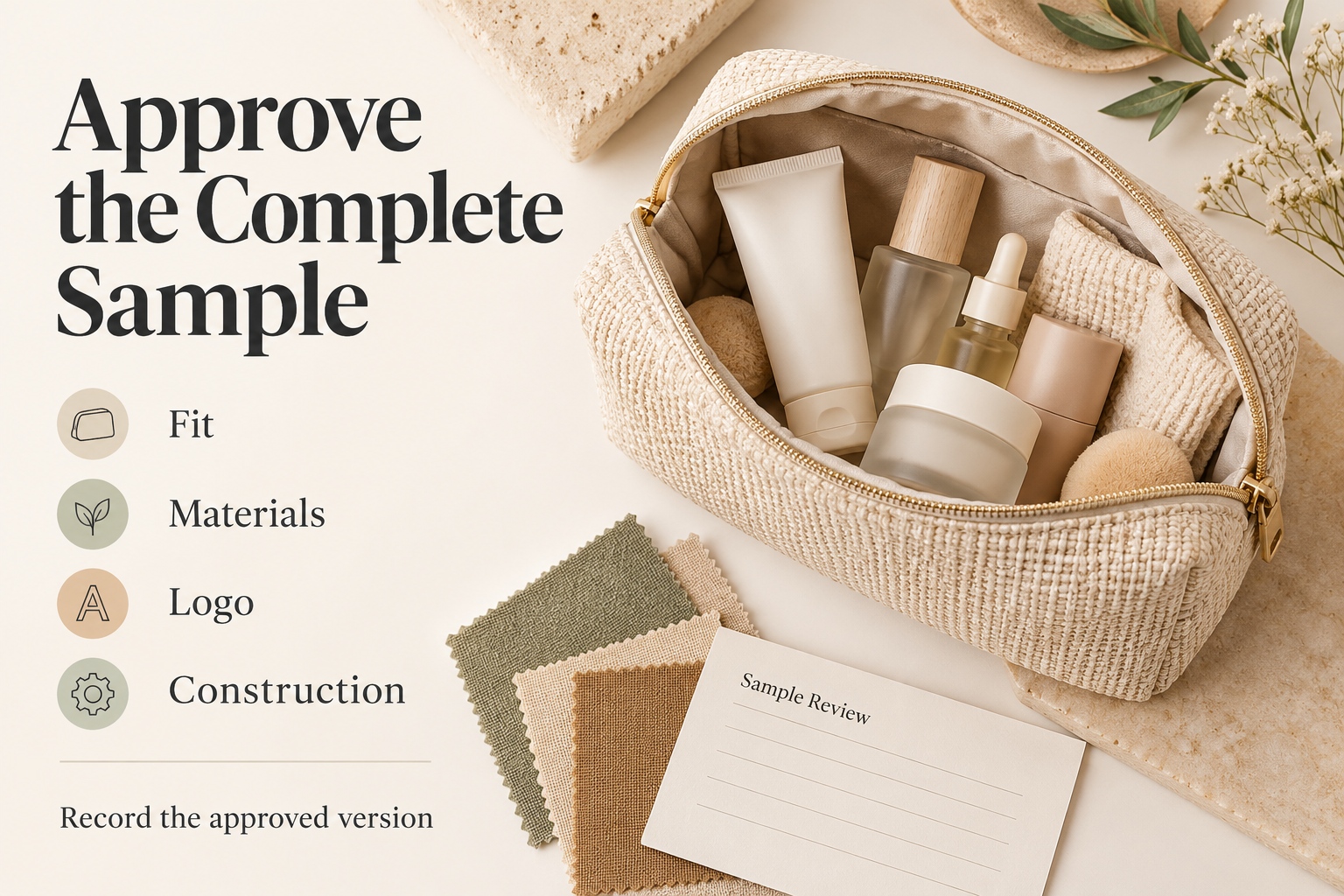
Approve a defined sample version against written criteria, not a general impression. A prototype may establish shape while using temporary fabric or hardware. Record those limitations before treating it as a production reference.
Check usable capacity, zipper access, lining, seams, logo placement, appearance, and relevant care requirements. A pre-production sample should represent the agreed production specification closely enough to support the decisions it is intended to settle.
Manufacturing insight: the assembled bag changes the result
Panel shaping, seam allowances, lining, and reinforcement all affect usable space. A decoration that appears centered on a flat panel can look different after the panel is sewn into a curved pouch. Inspect branding on the assembled sample as well as on artwork.
For example, if a filled sample strains at the zipper, clarify whether the pattern, opening, or contents arrangement needs revision. Approving the exterior appearance alone leaves that functional issue unresolved.
Buyer action: Consolidate comments into a revision log, name the approval owner, and retain matching reference samples where practical. Use the cosmetic bag sample timing guide to identify sourcing and approval dependencies.
When Should I Finalize Packaging and Product Information?
Develop packaging alongside the bag and approve final fit after the product specification is stable. Waiting until sewing is complete can leave labels, artwork, or packing materials blocking shipment.
Specify whether the pouch ships empty, folded, supported with inserts, or packed around products. Confirm the intended fulfillment workflow: the factory, a separate packing partner, or your warehouse may handle different steps.
A belly band sized around an empty pouch may not fit the same pouch when filled. A tight retail box can compress the bag or mark a decorative surface. Review the actual packing arrangement before authorizing printed packaging.
Buyer action: Approve packaging dimensions, artwork version, item identifiers, variant labels, and carton instructions. Draft product descriptions from the final specification, and verify any material, performance, or certification claims before publication.
What Must Be Ready Before Bulk Production Starts?
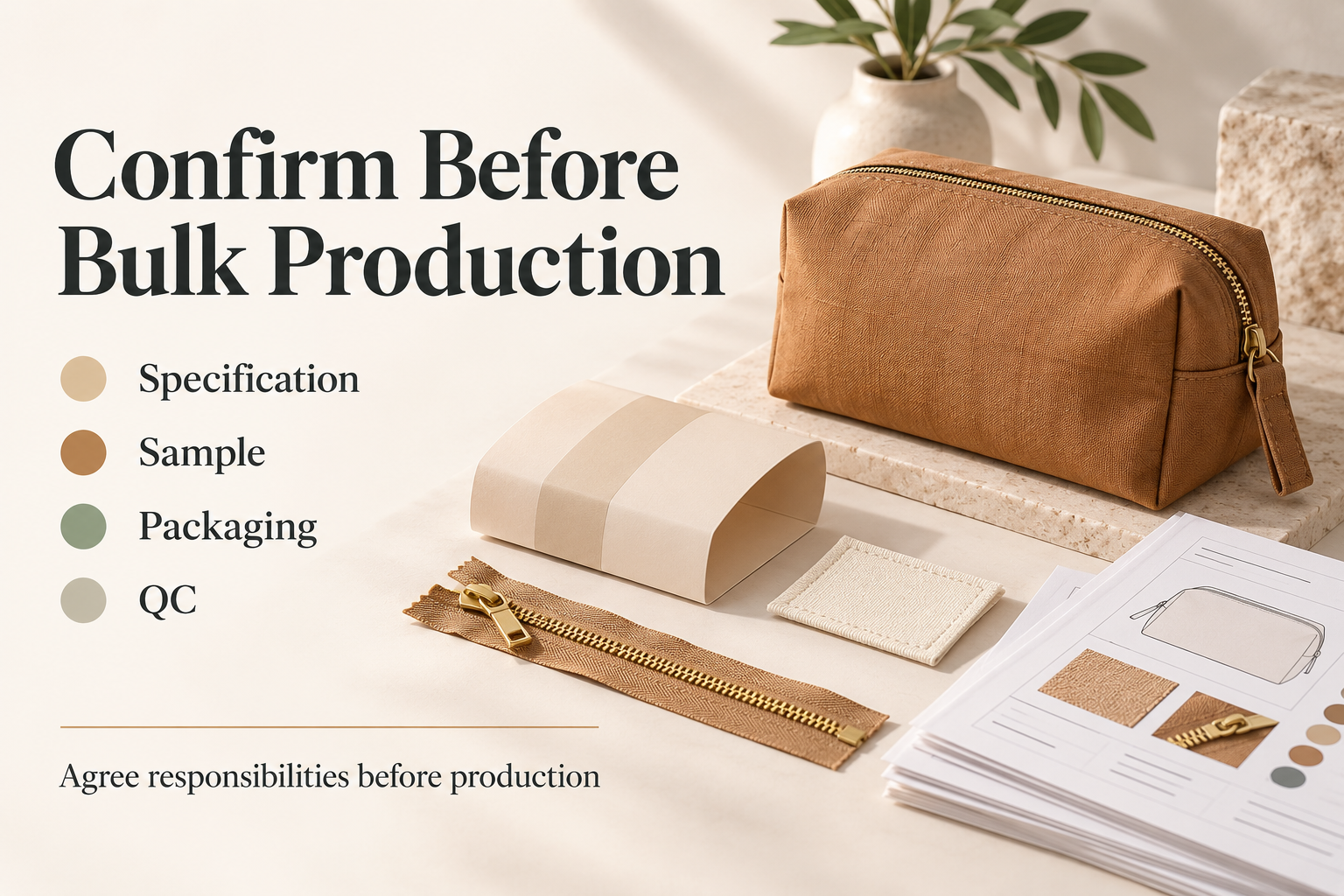
Issue a written production release that identifies the approved specification and remaining conditions. A sample approval should not be left open to interpretation as permission to purchase every material, print packaging, or begin the full run.
Use separate approvals where commitments occur at different times. If materials must be reserved before final sampling, agree the scope, cost exposure, and what happens if the design changes.
| Decision point | Evidence to confirm | Suggested approval owner |
|---|---|---|
| Product direction | Brief, intended contents, and required features. | Brand or product lead. |
| Material commitment | Material references, quantities, and authorized purchasing scope. | Sourcing lead with product input. |
| Sample approval | Sample revision, accepted features, and closed corrections. | Product lead with QC input. |
| Packaging approval | Packing fit, final artwork, labels, and carton instructions. | Brand and operations leads. |
| Bulk production release | Final specification, order terms, inspection plan, and required documentation. | Authorized purchasing representative. |
| Shipment release | Agreed inspection outcome, issue disposition, and shipping readiness. | Authorized buyer and logistics contact. |
For example, a sample approved for construction may still have an unapproved lining color. The release should state what must be resolved before the relevant materials or production steps are committed.
Buyer action: Attach the final specification, bill of materials, artwork, quantity split, approved references, and QC requirements to the order. A small brand may assign several roles to the same person, but the decisions should remain explicit.
How Do I Control Quality During Production?
Agree checks at the stages where problems can still be corrected efficiently. Final inspection is useful, but it cannot undo all consequences of an incorrect material purchase or decoration run.
Ask how incoming materials will be matched to approved references, how early production will be checked, and how completed goods will be assessed. Define the defect categories, measurement tolerances, sampling approach, and response to a failed inspection with the responsible QC team.
For example, noticing incorrect logo placement before the affected panels are assembled can prevent the same error from spreading through the order. A final inspection finding should trigger an agreed disposition, such as correction and reinspection, rather than automatic shipment.
Buyer action: Require approval for changes to materials, components, decoration, or production arrangements. Keep inspection records connected to the relevant order and variant. Sampling inspection helps assess a lot; it does not guarantee that every unit is defect-free.
How Should I Plan Delivery and Launch Readiness?
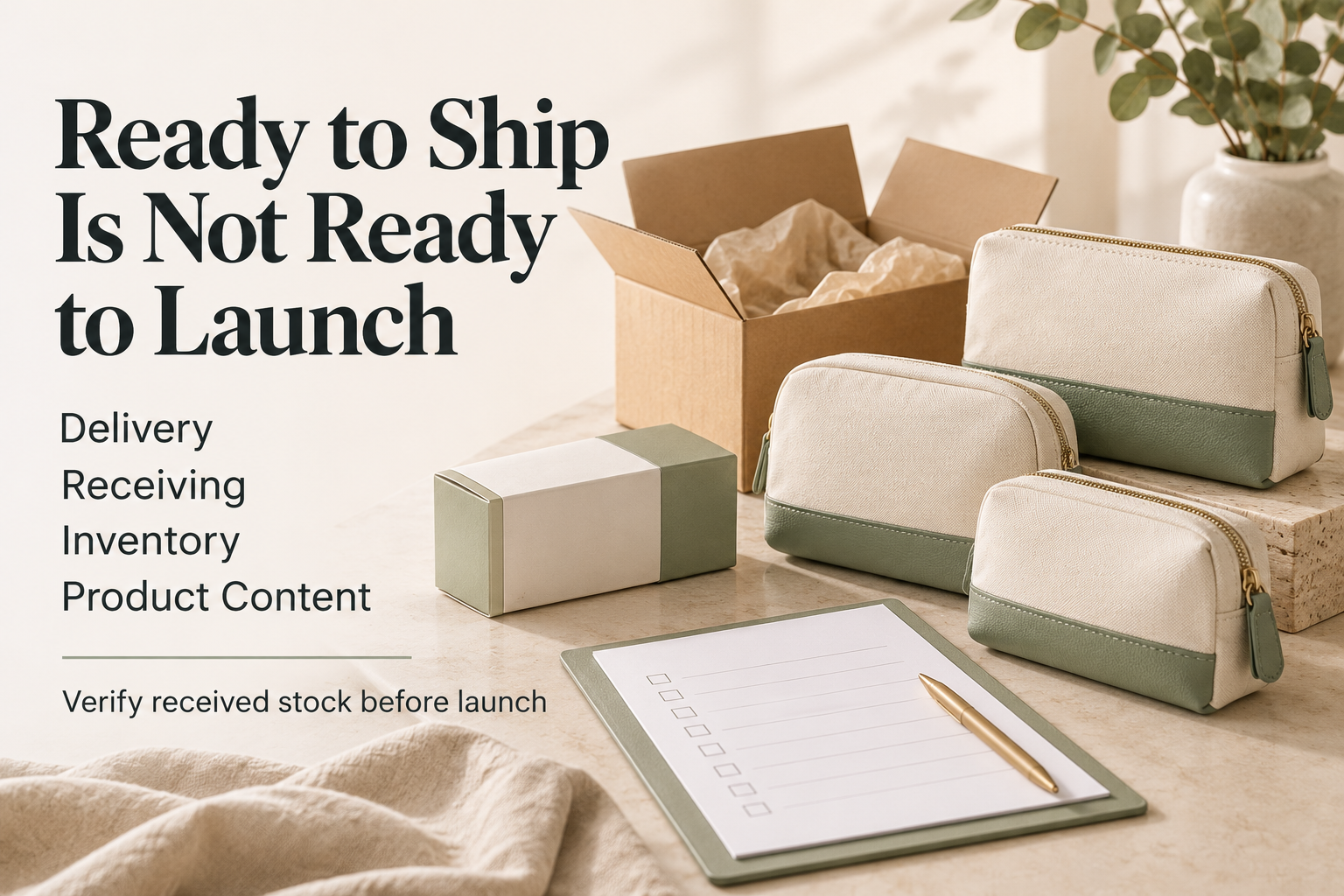
Plan backward from the date you need sellable inventory, not just the factory's completion date. Include approvals, material procurement, manufacturing, inspection, potential correction, transport, clearance where applicable, and receiving checks.
Ask what event starts each quoted lead time. A production estimate may begin after sample approval, material availability, and an agreed payment milestone. It should not be assumed to begin with the first inquiry.
Confirm the delivery basis and named location. ICC's Incoterms rules explain how specified delivery terms allocate tasks, costs, and risks. Record payment, inspection, and other order terms separately.
For example, goods ready at the factory are not necessarily available for a retail campaign. Warehouse receiving, sorting by variant, and gift-set assembly may still remain.
Buyer action: Maintain a schedule with dependencies and contingency time. Before launch, reconcile received quantities, inspect condition, verify labels, and check that product images and descriptions match the version available for sale.
Example Scenario: A Beauty Brand Prepares Its First Pouch
This is a hypothetical planning example, not a customer case study. A skincare brand wants a private label pouch that holds its gift set and remains useful after the original products are removed.
The buyer starts with an existing pouch design and provides the intended containers. A reference sample suggests that the shape is suitable, but the assembled branded sample reveals that the opening is awkward when the pouch is filled.
The team records the fit problem and requests a revised opening. Because that change affects the finished shape, it delays final approval of the belly band until the revised pouch can be packed correctly.
The buyer then approves the product revision, logo placement, lining, and packaging together, and issues a production release identifying those references. The schedule distinguishes factory completion from delivery and warehouse readiness.
The purpose of this workflow is to prevent unresolved sample decisions from becoming bulk-order assumptions. It does not guarantee a particular cost, lead time, or commercial result.
Buyer Checklist Before Production Approval
- The intended use, contents, customer, and sales market are documented.
- The development scope and supplier responsibilities are agreed.
- The quotation identifies materials, quantity split, packaging, charges, and exclusions.
- The approved sample and specification use matching revision references.
- Materials, logo artwork, hardware, and proposed substitutions have clear approval rules.
- Packaging fit, labels, artwork, and carton instructions are confirmed.
- Applicable testing, documentation, and product claims have assigned owners.
- Inspection criteria and the process for resolving failed checks are agreed.
- Production, delivery, and receiving milestones are distinguished in the schedule.
- An authorized person has issued the written production release.
Frequently Asked Questions
Can I start without a technical drawing?
Yes. You can begin with reference images, intended contents, approximate dimensions, and a clear description of the required function. The supplier still needs to translate that brief into measurable specifications before production. Confirm who prepares the drawings or specification sheet, who approves them, and which details remain provisional while the sample is being developed.
What is a realistic MOQ for a first private label order?
There is no universal MOQ for a first order. The feasible quantity depends on the design, available materials, color split, logo method, custom components, and packaging. Ask which upstream minimums drive the proposal and whether available alternatives change the requirement. Compare total inventory commitment as well as unit price before choosing the quantity.
How long does a private label cosmetic bag launch take?
The schedule depends on unresolved design work, material availability, sample revisions, branding, packaging, testing, production capacity, and delivery arrangements. Ask for a milestone plan showing what must happen before each stage can start. Confirm whether quoted times cover manufacturing only or also include transport and receiving. Update the plan whenever approvals or specifications change.
Can I approve a sample using photos alone?
Photos can help review visible details, but they cannot fully establish hand feel, usable capacity, zipper operation, or the response to packing and cleaning. For a new construction or material, evaluate a physical sample where practical. If you use remote approval for a limited change, state exactly what is being approved and which checks remain outstanding.
Can I change the logo or packaging after production starts?
You can request a change, but its feasibility depends on which materials, decorations, and packaging have already been committed or completed. Ask the supplier to identify affected work, additional costs, and schedule implications before approving the revision. Record which version applies to which units so old and new artwork are not mixed unintentionally.
What should I keep for a repeat order?
Keep the approved sample reference, final specification, bill of materials, artwork files, packaging details, inspection criteria, and records of approved changes. Also retain feedback from receiving and customer use. Before reordering, reconfirm material availability, quotation terms, and any revised requirements. A previous successful order does not establish that every component remains available unchanged.
Accuracy and Project Confirmation
Pricing, MOQ, sample time, production lead time, testing, and documentation must be confirmed for the actual materials, quantities, packaging, destination market, and current requirements. This workflow is a procurement planning framework, not a fixed production promise. Product claims and compliance obligations require project-specific review. No customer result, certification, or standard delivery period is implied.
Start With a Clear Private Label Project Brief
Share your intended use, reference style, contents, material preferences, logo, quantity split, packaging needs, destination, and desired launch window with Bling Accessory Co. Identify which decisions are settled and which still need development.
Author: Website Operations & Digital Marketing Manager
Last updated: October 21, 2026