OEM vs ODM Cosmetic Bags: Which Model Is Better for My Brand?
Choose OEM when your cosmetic bag needs a brand-defined structure or function that an existing design cannot deliver. Choose ODM when a supplier-developed design already meets your needs and the remaining changes can stay within an agreed scope. For beauty brands, private label sellers, retail buyers, and promotional sourcing teams, the decision should follow the product brief rather than the business label.
Comparing OEM vs ODM cosmetic bags means comparing development work, approval responsibilities, material commitments, and the changes needed before production. Neither model automatically guarantees a lower price, smaller MOQ, faster delivery, or exclusive design. This guide explains how to assess both routes, recognize when a simple adaptation becomes a development project, and prepare a useful brief for your manufacturer.
Quick Answer
OEM is usually the better starting point when your brand requires a specific bag shape, internal layout, fit, or construction that must be developed to your brief. ODM can be suitable when a supplier's existing design already satisfies the essential requirements and needs limited adaptation. Decide by comparing the actual changes, available materials, sampling work, quantity split, packaging, and approval schedule. Ask the supplier to explain what it will reuse and what it must develop. Confirm design-use rights separately: the terms OEM and ODM do not, by themselves, establish exclusivity, ownership, or permission to reproduce a third party's design.
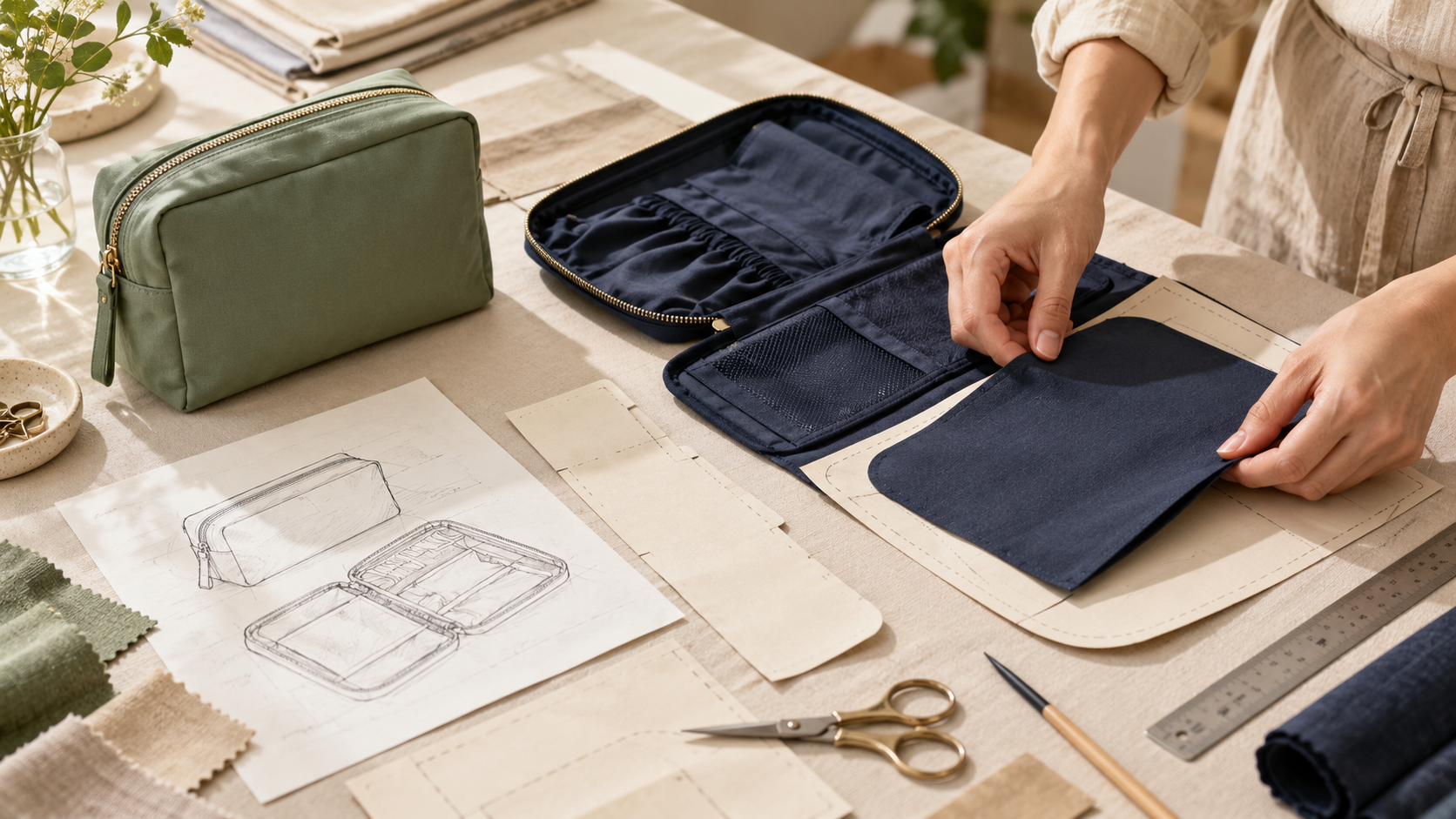
Buyer Snapshot: OEM vs ODM Cosmetic Bags
| Decision factor | What to compare |
|---|---|
| Design starting point | OEM: brand-defined requirements. ODM: a supplier-developed starting design. |
| Structural freedom | Whether the required shape, opening, pockets, and fit need new development. |
| Development cost | Pattern work, prototypes, revisions, artwork preparation, and custom components. |
| MOQ conditions | Material availability, color split, component minimums, and packaging requirements. |
| Schedule | Unresolved approvals, material sourcing, sampling, production, and delivery. |
| Differentiation | Whether branding alone is sufficient or the product needs distinctive function. |
| Rights and continuity | Agreed design use, access to development files, substitutions, and reorder support. |
Table of Contents
- What do OEM and ODM mean?
- When should my brand choose OEM?
- When should my brand choose ODM?
- Which changes create more development work?
- Which route costs less or takes less time?
- What must be agreed before production?
- How can I make the final choice?
- Example scenario
- Buyer checklist
- Frequently asked questions
What Do OEM and ODM Mean for Cosmetic Bags?
For this buying decision, OEM means production developed around the buyer's design requirements, while ODM starts with a supplier-developed design. OEM stands for original equipment manufacturer; ODM stands for original design manufacturer. Suppliers may use these terms differently, so the written scope matters more than the label.
With OEM, the buyer may provide drawings, a technical pack, or a functional brief and work with the factory to resolve production details. With ODM, the buyer evaluates an existing design and agrees which materials, branding, or other features can change.
For example, a new compartment arrangement developed around a beauty kit suggests an OEM route. Selecting an existing pouch and approving a compatible logo application suggests an ODM route.
Buyer action: Ask who provides the base design and which parts require new development. For broader sourcing context, see the OEM cosmetic bag manufacturing guide.
When Should My Brand Choose OEM?
Choose OEM when an essential product requirement cannot be met by adapting an available design within acceptable limits. The reason might be a specific opening, a stable base, a distinctive silhouette, or compartments that hold your products securely.
This route makes more sense when your team can define priorities and review prototypes. A custom brief creates decisions about fit, seams, reinforcement, and assembly that still need approval; a drawing alone does not settle them.
For example, a brush organizer with defined handle clearances and a removable section may need coordinated pattern and construction development. Simply adding a logo to a general-purpose pouch would not solve that use case.
Buyer action: Separate essential functions from optional appearance details. Send intended contents, fit requirements, and acceptance criteria before asking the manufacturer to develop a sample.
When Should My Brand Choose ODM?
Choose ODM when an existing design meets your essential fit and function requirements, leaving a manageable adaptation scope. It can suit a brand that wants to evaluate a new product category without developing every construction detail from the beginning.
The benefit depends on the supplier actually being able to reuse the relevant design and production information. A catalog photograph does not confirm current material availability, completed testing, stock inventory, or production readiness.
For example, an existing zip pouch may suit a gifting project if it holds the intended contents and accepts the proposed branding. The cosmetic bag collection can provide style references for that discussion.
Buyer action: Request the reference sample and ask which features, materials, and components the quote assumes will remain unchanged.

Which Changes Turn a Simple Adaptation into Development Work?
Changes that affect pattern geometry, material behavior, assembly access, or component sourcing can create new development work. An ODM starting point does not prevent a heavily modified project from needing substantial sampling.
Manufacturing insight: a material swap can alter construction
Replacing a thin flexible fabric with a thicker padded construction can affect seam bulk, corner turning, zipper installation, and usable interior space. Keeping the same outside dimensions does not necessarily preserve fit.
A logo change can also reach beyond artwork. Embroidery backing may need to be covered by the lining, and a metal plate may require a suitable attachment area. Ask the factory how the proposed method affects assembly and inspection.
| Requested change | What the factory should check |
|---|---|
| Different exterior material | Thickness, stiffness, seam behavior, logo compatibility, and sourcing. |
| New pocket or divider | Pattern pieces, usable capacity, assembly sequence, and fit. |
| New opening or zipper path | Panel geometry, zipper specification, access, and closure function. |
| Custom puller or logo plate | Attachment, component availability, tooling, and component MOQ. |
| Retail box or fitted insert | Packed dimensions, protection, assembly, and packaging supply. |
For example, adding a padded divider to an existing travel bag can change how bottles fit and how the bag closes. The change should be evaluated on a revised sample.
Buyer action: Request a change list identifying what can be retained, what needs revision, and which approvals must be repeated.
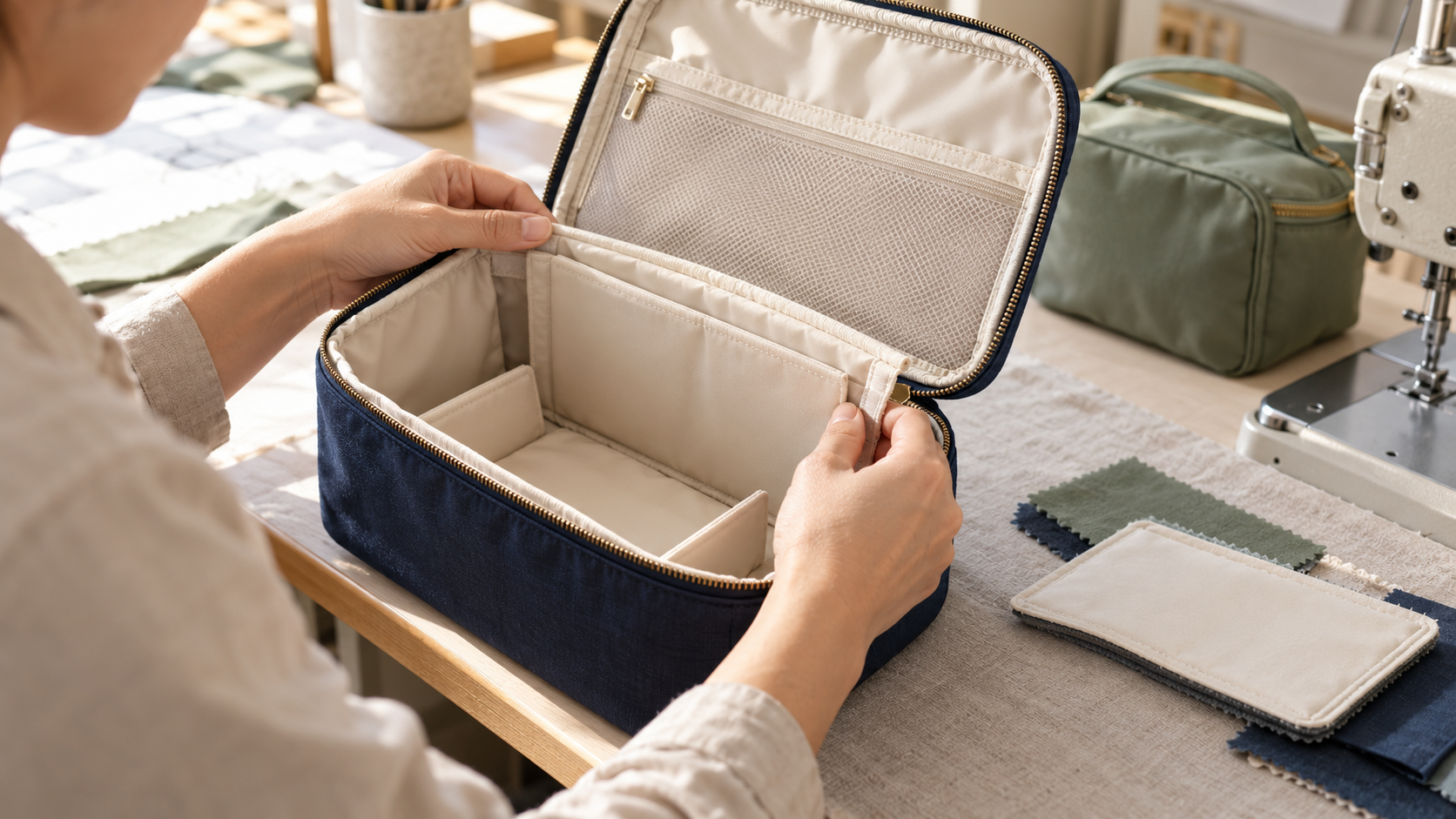
Is ODM Always Cheaper, Faster, or Available at a Lower MOQ?
No. Compare the actual specification and remaining work before making a cost or schedule assumption. Reusing a suitable design can reduce development tasks, but custom materials, hardware, color splits, and packaging can introduce new commitments under either model.
Ask for separate treatment of development charges, per-unit production price, packaging, and delivery scope. A simple OEM pouch may involve fewer operations than a complex ODM organizer; the model name does not rank their cost.
MOQ may be constrained by an upstream component rather than sewing capacity. A custom-dyed fabric or printed box can carry purchasing conditions even when the bag pattern is already available. The custom cosmetic bag cost factors guide explains related specification choices.
For example, an existing design with a custom puller and new packaging may need sourcing and approvals before bulk production can start.
Buyer action: Request a milestone schedule with its dependencies. Confirm whether the quoted lead time starts after sample approval, material confirmation, payment, or another agreed event.
What Should I Agree Before Approving Production?
Agree on the final specification, acceptance checks, permitted substitutions, and design-use arrangements for either model. OEM and ODM describe development approaches; they are not quality grades or substitutes for written commercial terms.
Connect the approved sample to a dated specification. Check fit with intended contents, closure operation, seams, logo placement, surface condition, and packing. An existing ODM sample does not validate a revised material or new construction.
Ask the supplier to document its permission to offer the base design and explain any limits on your use. If exclusivity matters, define the requested scope and have the agreement reviewed by a qualified adviser. The WIPO overview of industrial designs provides background on protection of product appearance; it does not verify rights in a particular bag.
For example, paying for a custom logo tool should prompt a separate discussion about access, storage, reuse, and return of that tool. It should not be treated as evidence that the whole bag design is exclusive.
Buyer action: Document who retains patterns, artwork, and tooling, and what can be supplied if you reorder or change manufacturing arrangements.
How Can I Choose the Right Model for My Order?
Start with the non-negotiable requirements, then choose the route that meets them with a clear development scope. Brand age alone is not a useful deciding factor: an established brand can use ODM, and a new brand may need OEM for a specific function.
| Your situation | Route to investigate |
|---|---|
| An existing sample meets fit and function requirements. | ODM, with a written list of permitted adaptations. |
| A distinctive structure is essential to the product offer. | OEM, supported by a functional brief and prototype reviews. |
| An existing design is close, but several structural changes are needed. | Compare an adapted-design proposal with a new-development proposal. |
| The launch deadline leaves little approval time. | Prioritize confirmed materials and limited unresolved changes; verify the schedule. |
| Exclusivity is essential. | Evaluate documented rights and agreed restrictions under either model. |
For example, a recognizable silhouette might be optional while bottle fit is essential. That distinction can prevent unnecessary development without weakening the intended use.
Buyer action: Prepare the same requirements for both proposals using the cosmetic bag RFQ checklist. Ask suppliers to identify deviations rather than silently simplify your brief.

Example Scenario: A Beauty Brand Compares Both Routes
This is a hypothetical example, not a customer case. A skincare brand wants a pouch for a gift set. An existing supplier design appears suitable, so the buyer first checks its opening and capacity using the intended contents.
If that sample fits and the proposed branding is compatible, an ODM adaptation may address the brief. If the contents need a stable upright arrangement and a removable divider, the supplier must assess whether adapting the design remains practical or a new OEM structure is more appropriate.
The buyer requests separate proposals that identify sample work, material assumptions, packaging, and approvals. The decision follows verified fit and the remaining development tasks. No price saving, MOQ advantage, or delivery result is assumed.
Buyer Checklist Before Choosing OEM or ODM
- Define the intended contents and essential user functions.
- Separate mandatory features from optional styling.
- Identify who provides the starting design and what can be reused.
- List changes requiring a revised pattern, component, or sample.
- Confirm quantities by style, color, logo, and packaging version.
- Compare development charges and production scope separately.
- Agree on approval milestones, QC criteria, and substitution controls.
- Document design use, requested exclusivity, and access to development assets.
- Confirm reorder assumptions and the final written quotation.
Frequently Asked Questions
Is private label the same as ODM?
No. Private label describes a product sold under your brand, while ODM describes a supplier-developed design starting point. A private label cosmetic bag can come from an existing design or a project developed to your requirements. Explain the actual work needed, including structure, materials, logo, and packaging, rather than relying on the private label term to define the production scope.
Can a new beauty brand choose OEM?
Yes, if a specific function or design requirement justifies development and the brand can support the approval process. Being new does not make ODM compulsory. Before choosing OEM, clarify the product's purpose, available budget, quantity plan, and who will evaluate samples. If the main requirement is branding an otherwise suitable pouch, an existing design may also deserve evaluation.
Can I add my own logo to an ODM cosmetic bag?
Often you can, subject to the supplier's offering and the design's material and construction. The method must suit the surface, placement, artwork, and assembly sequence. A logo near a seam or on a padded panel may require different preparation from a print on a flat panel. Confirm a sample, any setup charges, and MOQ conditions before approving the branded version.
Does OEM mean the bag will be exclusive to my brand?
No. Do not infer exclusivity from the OEM label. Ask for written terms that address the relevant design, permitted use, development assets, and any requested limits on supply to others. Distinguish your artwork from the supplier's existing construction or components. Where exclusivity is commercially important, obtain qualified advice on the proposed agreement and the markets in which you need protection.
Does ODM mean the bags are ready to ship?
No. An ODM design can still be made to order. Materials may need sourcing, branding needs approval, and packaging may require preparation before production. Ask whether the supplier is offering available inventory, an existing production design, or a sample concept that still needs development. These starting points involve different remaining tasks even if each is described as ODM.
Can I move from ODM to OEM after testing the market?
Yes. Feedback from an initial design can help you write a more specific brief for a later product. Treat the new version as a separate development scope and verify your rights to reuse any supplier-provided design elements. Record requested improvements, reassess fit and materials, and obtain updated sampling, MOQ, packaging, and production terms instead of assuming the earlier conditions remain unchanged.
Accuracy and Project Confirmation
MOQ, pricing, sample time, production lead time, testing, and documentation must be confirmed for the chosen materials, quantities, packaging, destination market, and current requirements. Neither OEM nor ODM establishes product compliance or certification. Design rights and contractual obligations require project-specific review; this guide is a procurement framework, not legal advice.
Discuss the Right Development Route for Your Brand
Send Bling Accessory Co. your reference style, intended contents, required changes, quantity split, branding, and packaging needs. Ask for a proposal that explains which design elements can be reused and which require development.
Author: Website Operations & Digital Marketing Manager
Last updated: October 8, 2026