Cosmetic Bag Quality Control: The Complete Guide for Brands, Wholesalers, and Private Label Buyers
Cosmetic bag quality control is one of the most important steps in building a reliable beauty accessory line. A cosmetic bag may look simple, but a successful product depends on many small details working together: material stability, cutting accuracy, stitching strength, zipper smoothness, lining cleanliness, logo precision, color consistency, odor control, packaging quality, and final shipment inspection.
For beauty brands, wholesalers, retailers, subscription box companies, promotional gift buyers, and private label businesses, quality control directly affects customer satisfaction, product reviews, repeat orders, and long-term brand trust. A low-cost cosmetic bag can become expensive if the stitching breaks, the zipper jams, the lining stains easily, the logo peels off, or the packaging arrives damaged.
This guide explains how professional cosmetic bag QC works from material inspection to final packing. If you are planning custom makeup bags, toiletry bags, vanity cases, brush bags, mini pouches, travel cosmetic bags, or private label beauty accessories, you can also explore our custom bag manufacturing services or browse our cosmetic bag collection.
Why Cosmetic Bag Quality Control Matters
Cosmetic bag quality control matters because the product is used frequently and handled closely by consumers. Unlike a decorative item that stays on a shelf, a makeup bag is opened, closed, packed, cleaned, squeezed into luggage, placed on bathroom counters, carried in handbags, and exposed to cosmetics, skincare bottles, brushes, liquids, powders, and travel conditions.
This daily handling means small defects become obvious very quickly. A weak zipper, uneven seam, rough edge, poor lining, loose thread, strong odor, or crooked logo can make the whole product feel low quality. For beauty brands and retailers, quality is part of brand positioning. Customers are not only buying storage; they are buying organization, convenience, style, and confidence.
If a cosmetic bag looks premium in product photos but arrives with poor workmanship, the customer experience becomes disappointing. This can lead to returns, negative reviews, customer service pressure, and weaker repeat purchase rates. Strong QC protects the brand experience after the product leaves the factory.
For wholesalers and importers, quality control is also connected to cost control. A failed shipment can create extra inspection fees, repacking costs, discount pressure, replacement orders, delayed delivery, and relationship damage with downstream customers. In B2B sourcing, the cheapest unit price is not always the best business decision. A stable custom cosmetic bag manufacturer with a clear inspection process can help buyers avoid hidden costs by identifying issues before production is completed.
What Quality Control Means in Cosmetic Bag Manufacturing
In cosmetic bag manufacturing, quality control is not a single final inspection at the end of production. It is a structured system that begins before materials are purchased and continues until the finished goods are packed for shipment. Effective QC includes product specification review, sample approval, material inspection, color confirmation, cutting control, sewing control, logo inspection, functional testing, appearance inspection, packaging verification, and shipment readiness review.
A complete cosmetic bag QC system should answer several practical questions. Does the finished bag match the approved sample? Is the size within tolerance? Is the fabric or PU leather consistent with the confirmed material swatch? Is the lining clean and properly attached? Does the zipper open and close smoothly? Are the seams straight and secure? Is the logo centered, readable, and durable? Is the color consistent across the production batch? Is the packaging suitable for retail, e-commerce, wholesale, or promotional distribution?
Quality control also means separating subjective appearance from measurable standards. For example, “good stitching” should be defined in specific terms: stitch density, thread color, seam allowance, backstitching, loose thread tolerance, seam straightness, and strength at stress points. “Good logo quality” should be defined by position, size, color, edge clarity, adhesion, embroidery density, foil stamping coverage, or printing durability.
In OEM and ODM development, QC is most effective when buyers and suppliers communicate before mass production begins. Buyers should provide artwork files, Pantone color references, material preferences, size specifications, packaging requirements, barcode rules, target market, expected retail price level, and any special testing requirements.
Pre-Production QC: Building Quality Before Mass Production
Many cosmetic bag defects can be prevented before mass production begins. Pre-production QC is the stage where the buyer and supplier confirm the product standard, test the sample, and identify potential manufacturing risks. This step is especially important for custom cosmetic bags because the final product may involve multiple materials, colors, trims, printing methods, and packaging elements.
The first step is the product specification sheet. A clear specification sheet should include bag type, dimensions, tolerance range, outer material, lining material, zipper type, zipper puller style, stitching thread, logo method, logo size, logo position, color references, inner structure, pocket layout, packaging method, carton details, and inspection criteria.
The second step is sample approval. A pre-production sample should be checked carefully before mass production. Buyers should inspect the size, shape, material handfeel, color, zipper function, opening width, lining quality, stitching direction, logo position, packaging style, and overall appearance.
The third step is risk review. Some cosmetic bag designs are easy to produce consistently, while others require more control. A round vanity case, a structured PU cosmetic bag, a clear PVC toiletry pouch, a quilted makeup bag, a woven-texture mini pouch, and a drawstring cosmetic bag each have different production risks.
Pre-production QC should end with a signed or confirmed approval sample. This sample becomes the quality benchmark for mass production. When disputes occur later, the approved sample helps both sides compare the final goods objectively. For private label buyers, this step is also useful for internal approval between design, purchasing, marketing, and sales teams.
Material Inspection for Custom Cosmetic Bags
Material inspection is the foundation of cosmetic bag quality control. The outer material determines the first impression, while the lining, zipper, thread, padding, webbing, puller, and packaging materials determine durability and usability. A cosmetic bag made with attractive design but unstable materials will not perform well in real use.
Common cosmetic bag materials include PU leather, PVC, TPU, polyester, nylon, cotton canvas, velvet, satin, terry cloth, mesh, neoprene, recycled fabrics, and eco-friendly alternatives. Each material has a different quality focus. PU leather should be checked for surface consistency, peeling risk, thickness, backing strength, odor, wrinkle marks, color uniformity, and scratch resistance.
PVC and TPU should be checked for transparency, flexibility, odor, thickness, surface marks, and heat-sealing performance. Polyester and nylon should be checked for density, coating, colorfastness, shrinkage, and abrasion resistance. For buyers developing eco-friendly cosmetic bags, material inspection should also include sustainability claims and documentation.
Color control is another key part of material QC. Buyers should not rely only on screen images because display color varies by device. A Pantone reference, physical color swatch, or approved sample is more reliable. During production, factories should compare bulk materials against the approved color standard under suitable lighting.
- Check material color against approved swatch or Pantone reference.
- Inspect surface for stains, scratches, bubbles, wrinkles, or coating defects.
- Confirm thickness, softness, stiffness, transparency, and handfeel.
- Review odor level before cutting and packaging.
- Check lining material, zipper tape, thread, puller, and packaging material.
Cutting, Pattern Accuracy, and Size Control
Cutting accuracy has a major impact on the final appearance of a cosmetic bag. Even when materials are good, poor cutting can create uneven shape, twisted panels, misaligned seams, irregular corners, and inconsistent size. In cosmetic bag manufacturing, cutting control is especially important for structured bags, vanity cases, mini pouches, clear pouches, boxy travel bags, and cosmetic bag sets where size consistency is visible.
A factory should use accurate patterns and templates before bulk cutting begins. The cutting pattern should match the approved sample and include seam allowance, folding allowance, zipper installation allowance, and any special structural requirements. If the product includes quilting, printed patterns, woven textures, stripes, checks, or directional fabric, the cutting direction should be controlled carefully.
Size tolerance should be agreed before production. Cosmetic bags are soft goods, so a small tolerance is usually normal, but the acceptable range must be clear. Size control matters more when the bag must fit skincare bottles, makeup brushes, retail shelves, gift boxes, subscription boxes, or travel kits.
Buyers who need small cosmetic pouches, gift pouches, or travel-size makeup bags can review size options through the mini pouch category. Smaller bags may look simple, but they often require precise sewing because there is less margin for error.
Stitching and Construction Quality Standards
Stitching quality is one of the clearest signs of cosmetic bag workmanship. Buyers and consumers often judge bag quality by looking at seams, corners, thread ends, edge finishing, and symmetry. Even when a cosmetic bag uses attractive material, poor sewing can make it feel cheap. Strong stitching improves both appearance and durability.
Cosmetic bag stitching should be straight, secure, and consistent. The stitch density should match the material and product style. Heavy materials may require stronger stitching, while lightweight fabrics may need finer control to avoid puckering. The thread color should match or intentionally contrast with the product design.
Stress points require special attention. These include zipper ends, handles, side seams, bottom corners, pull tabs, inner pockets, elastic loops, brush slots, and any points where the user applies force. A cosmetic bag may pass appearance inspection but fail in real use if stress points are weak.
Seam allowance should be consistent. Uneven seam allowance can cause shape distortion, especially in structured cosmetic bags and vanity cases. Corners should be smooth and balanced. Curved seams should not show sharp angles unless the design intentionally requires them.
For buyers comparing suppliers, sewing quality is one of the easiest areas to evaluate through samples. Request photos of seam details, zipper ends, lining attachment, inner pockets, and bottom corners. For a broader supplier evaluation framework, buyers can also read our cosmetic bag manufacturer China guide.
Zipper, Puller, and Hardware Quality Control
Zipper quality is critical because the zipper is usually the most frequently used component of a cosmetic bag. A beautiful makeup bag can fail quickly if the zipper is rough, weak, misaligned, or difficult to open. Zipper defects are also easy for customers to notice, which makes zipper inspection an essential part of cosmetic bag QC.
The first zipper quality standard is smooth operation. The zipper should open and close without jamming, catching, separating, or requiring excessive force. The slider should move consistently across the full opening. Zipper teeth should be aligned, and the zipper tape should be sewn evenly into the bag body.
The second standard is strength. The zipper should withstand repeated opening and closing during normal use. The slider should not detach easily, and the puller should not break under reasonable force. If a cosmetic bag is designed for travel, toiletry storage, or heavy skincare bottles, the zipper should be selected based on actual load expectations.
The third standard is appearance. Zipper color, tape color, teeth color, slider finish, and puller style should match the approved sample. Metal zippers should be checked for plating consistency, scratches, rust risk, sharp edges, and color matching. Nylon zippers should be checked for smoothness, tape quality, and stitch placement.
Custom zipper pullers add branding value but also require quality control. A puller may be made from metal, PU, fabric, cord, rubber, silicone, resin, or webbing. Inspection should check size, shape, logo clarity, attachment strength, color, and surface finishing.
Logo and Branding Quality Control
Logo quality control is essential for private label cosmetic bags because the logo represents the buyer’s brand. A cosmetic bag may be manufactured by a supplier, but the final customer associates the product with the brand printed, embroidered, debossed, woven, or stamped on the bag. Poor logo execution can damage perceived value immediately.
Common logo methods for cosmetic bags include silk screen printing, digital printing, heat transfer, embroidery, woven label, rubber patch, silicone patch, metal plate, debossing, embossing, foil stamping, jacquard, and custom zipper puller branding.
Printed logos should be checked for color accuracy, position, edge sharpness, ink coverage, adhesion, and resistance to rubbing. Embroidered logos should be checked for thread density, line clarity, backing, loose thread, and distortion. Metal logos should be checked for plating, scratches, glue strength, alignment, and edge safety.
Logo position should be confirmed using clear measurements. “Centered” is not always enough because different people may interpret the center differently depending on bag shape. A specification sheet should define distance from top edge, bottom edge, side seam, zipper, or panel center.
Logo durability should match the use case. A cosmetic bag used daily may experience friction from hands, cosmetics, counters, luggage, and other accessories. If the logo rubs off easily, the product can look old quickly. Buyers should request rubbing tests, adhesion checks, or practical handling tests when the logo method is new or when the brand requires a premium finish.
Lining, Odor, Cleanliness, and User Experience
The inside of a cosmetic bag is just as important as the outside. Customers use cosmetic bags to store beauty products, skincare items, brushes, personal care tools, and travel essentials. The interior must feel clean, safe, practical, and easy to use. Lining defects may not appear in product photos, but they strongly affect the customer experience after purchase.
Lining inspection should check material type, color, cleanliness, attachment, seam finishing, pocket structure, and durability. The lining should not be loose, twisted, stained, or poorly sewn. Inner pockets should be positioned correctly. Brush slots should hold items securely without being too tight.
Odor control is another key part of cosmetic bag quality control. Some materials, especially PU, PVC, adhesives, coatings, and printed components, can have a strong smell if not properly selected, aired, or controlled. A slight material smell may be normal in some products, but strong chemical odor can create customer complaints.
Cleanliness inspection should include both exterior and interior surfaces. Cosmetic bags should be free from dust, oil marks, glue residue, loose threads, fabric fibers, stains, and packaging debris. Transparent pouches require extra care because dust and fingerprints are easier to see.
User experience should be tested practically. Can the bag open wide enough? Can bottles stand upright? Can brushes fit? Does the zipper scratch the hand? Does the lining catch on cosmetics? Is the handle comfortable? Does the bag collapse too easily? These details are not only QC issues; they are product development issues.
In-Process Inspection During Mass Production
In-process inspection happens while production is still running. This stage is important because it allows the factory to detect and correct problems before the full batch is completed. If inspection only happens at the end, defects may already be repeated across thousands of pieces. Early detection saves time, materials, labor, and buyer frustration.
In cosmetic bag manufacturing, in-process QC usually includes checking cutting pieces, semi-finished panels, sewing quality, zipper installation, logo application, lining assembly, trimming, shape forming, and early finished units. Inspectors compare production pieces with the approved sample and specification sheet.
A strong in-process QC system should focus on high-risk steps. For example, if the cosmetic bag has a printed logo, logo inspection should happen before panels are sewn into final bags. If the logo is wrong after sewing, rework becomes more difficult. If the bag has a complicated zipper opening, zipper installation should be checked early.
Communication between QC inspectors and production workers is essential. Quality control is not only about rejecting defective pieces. It is about improving the production process. When inspectors find repeated loose threads, crooked seams, uneven logo placement, or poor zipper alignment, the cause should be identified.
Buyers should ask suppliers how they manage in-process inspection. A quality-focused factory should be able to explain when inspections happen, who performs them, what records are kept, and how defects are corrected.
Final Cosmetic Bag Inspection Checklist
Final inspection is the last major quality control step before goods are packed or shipped. It confirms whether the finished cosmetic bags meet the approved sample, order specifications, packaging requirements, and buyer expectations. A clear final inspection checklist helps avoid subjective judgment and makes the inspection process easier to manage.
1. Appearance Inspection
Inspect overall shape, color, surface, cleanliness, stitching, symmetry, corners, seams, zipper, logo, and product presentation.
2. Size and Structure Inspection
Measure length, width, height, handle drop, pocket size, zipper opening, and any special structure according to the specification sheet.
3. Function Inspection
Open and close the zipper several times. Check puller strength, slider movement, pocket function, handle strength, snaps, drawstrings, and elastic loops.
4. Stitching Inspection
Check stitch density, straightness, seam strength, thread color, thread trimming, backstitching, edge finishing, and reinforcement points.
5. Logo Inspection
Confirm logo size, placement, color, clarity, durability, and alignment. The logo should match the approved artwork and sample.
6. Packaging Inspection
Confirm polybag, hangtag, label, barcode, insert card, retail box, carton mark, carton size, and packing quantity.
Buyers can adapt this checklist to match their own product type. A luxury vanity case, a simple promotional pouch, and a clear travel toiletry bag do not need identical inspection standards, but all of them need clear criteria. When standards are clear, both buyer and factory can work more efficiently.
Packaging Quality Control Before Shipment
Packaging quality control is often underestimated, but it has a direct impact on product presentation, shipping safety, warehouse efficiency, and customer satisfaction. A cosmetic bag may pass product inspection but still create problems if it is packed incorrectly.
Basic packaging inspection includes checking the polybag size, product folding method, moisture control, hangtag placement, barcode label, warning label, insert card, retail sleeve, belly band, tissue paper, dust bag, or gift box. For e-commerce products, packaging should reduce damage during parcel shipping. For retail products, packaging should look clean and shelf-ready.
Carton inspection should verify carton size, carton weight, carton marks, SKU information, color information, quantity per carton, and destination details. Cartons should be strong enough for shipping and storage. If cosmetic bags are compressed too tightly, they may arrive with shape deformation, wrinkles, or zipper marks.
Packaging also affects sustainability positioning. Many buyers now prefer reduced plastic, recyclable packaging, paper belly bands, reusable dust bags, or efficient carton packing. Buyers can combine cosmetic bags with packing and promo bags to build more complete gift, travel, or promotional solutions.
Common Cosmetic Bag Defects and How to Prevent Them
Understanding common defects helps buyers prevent quality issues before they happen. Cosmetic bag defects can usually be grouped into material defects, workmanship defects, functional defects, logo defects, packaging defects, and specification errors.
Material Defects
Material defects include stains, scratches, color variation, odor, wrinkles, uneven texture, peeling, coating bubbles, transparent material marks, and inconsistent thickness. Prevention starts with incoming material inspection and approved material swatches.
Workmanship Defects
Workmanship defects include crooked stitching, skipped stitches, loose threads, uneven seams, poor corner shaping, open seams, puckering, and rough edge finishing. Prevention requires proper machine settings, trained operators, clear sewing instructions, and in-process inspection.
Functional Defects
Functional defects include zipper jamming, weak pullers, broken handles, loose pockets, narrow openings, unstable structure, and poor shape recovery. Prevention requires component testing, practical sample review, and reinforcement at stress points.
Logo Defects
Logo defects include wrong position, wrong size, color mismatch, blurred printing, peeling, weak embroidery, distorted artwork, and poor metal plate attachment. Prevention requires artwork approval, production sample approval, logo positioning templates, and early inspection before final assembly.
Packaging Defects
Packaging defects include wrong label, missing barcode, incorrect carton mark, poor folding, damaged retail box, mixed colors, mixed SKUs, and incorrect quantity. Prevention requires a packing specification sheet, packaging sample approval, carton inspection, and final quantity verification.
How Buyers Can Create a Cosmetic Bag QC Brief
A cosmetic bag QC brief is a practical document that tells the supplier what quality standard the buyer expects. It does not need to be overly complicated, but it should be specific enough to guide sampling, production, and inspection. A good QC brief reduces assumptions and makes the buyer’s expectations measurable.
The brief should start with basic product information: product name, style number, target market, order quantity, color options, size, material, structure, packaging, and delivery requirement. Then it should list the approved sample reference and key quality points.
Buyers should include photos or diagrams whenever possible. Visual references help suppliers understand expectations more clearly than written descriptions alone. For example, a buyer can mark the exact logo position, zipper direction, stitch style, handle placement, pocket size, and packaging layout.
The QC brief should also define unacceptable defects. Examples include broken zipper, open seam, visible stain, wrong logo, strong odor, incorrect color, missing label, incorrect barcode, damaged packaging, sharp hardware edge, or wrong size beyond tolerance.
Finally, the brief should define inspection timing. Buyers may request pre-production sample approval, material confirmation, production photos, in-process inspection, final inspection, or third-party inspection depending on order size and risk level. For repeat orders, the brief can be updated based on previous production experience.
How to Choose a Quality-Focused Cosmetic Bag Supplier
Choosing the right supplier is one of the most important decisions in cosmetic bag quality control. A quality-focused supplier does more than produce a bag. They help buyers improve specifications, avoid unrealistic designs, choose suitable materials, confirm logo methods, manage production details, and inspect finished goods before shipment.
Buyers should evaluate whether the supplier has experience with the specific bag type they need. A factory that makes simple drawstring pouches may not automatically be the best choice for structured vanity cases, waterproof toiletry bags, or premium PU cosmetic bags.
Communication is also a quality indicator. A reliable supplier should ask detailed questions before quoting. They should confirm size, material, order quantity, logo method, packaging, target market, and quality expectations. If a supplier gives a price without understanding the product, the quote may not reflect the real production standard.
Sample quality is another important signal. Buyers should check whether the sample is clean, accurate, functional, and close to the requested design. They should also observe how the supplier handles feedback. A good supplier will explain what can be improved, what may affect cost, and what needs technical adjustment.
Quality documentation can also help buyers make better decisions. Ask whether the supplier can provide inspection photos, material details, production updates, packaging confirmation, and final inspection support. For larger orders, buyers may also request third-party inspection or additional testing.
Bling Accessory Co. supports custom cosmetic bag development for beauty, retail, lifestyle, travel, gift, and promotional markets. Buyers can start from an existing product direction, modify material and logo details, or develop a new OEM/ODM project from concept.
Quality Control Standards by Cosmetic Bag Type
Different cosmetic bag styles require different QC priorities. A single inspection checklist is useful, but buyers should adjust the checklist based on the bag’s structure and end use.
Makeup Pouches
Makeup pouches are often soft, compact, and used daily. QC should focus on zipper smoothness, stitching strength, lining cleanliness, logo position, and surface appearance. Because makeup pouches are frequently placed inside handbags, the outer material should resist normal friction and the zipper puller should be comfortable to use.
Vanity Cases
Vanity cases usually have more structure. QC should focus on shape control, panel symmetry, zipper curve, handle strength, lining attachment, and standing stability. If the case is designed for travel, it should hold its shape after packing and unpacking.
Toiletry Bags
Toiletry bags may be exposed to moisture, bottles, and travel pressure. QC should focus on waterproof or water-resistant lining, zipper durability, seam strength, easy-clean surfaces, and practical opening width.
Brush Bags
Brush bags require clean internal structure. QC should focus on brush slots, elastic bands, protective flaps, lining smoothness, and internal cleanliness. The design should prevent brushes from falling out while avoiding rough surfaces that may damage brush bristles.
Cosmetic Bag Sets
Cosmetic bag sets require consistency across multiple pieces. QC should check color matching, size relationship, logo consistency, packaging order, and set presentation. Even if each individual bag is acceptable, the set can look poor if colors, logos, or proportions are inconsistent.
Promotional Cosmetic Bags
Promotional bags often require strong cost control and accurate branding. QC should focus on logo clarity, quantity accuracy, packing efficiency, and basic functional performance. For event giveaways or corporate gifts, delivery timing and packaging organization are especially important.
AQL, Sampling, and Practical Inspection Levels
Many professional buyers use sampling inspection to evaluate bulk cosmetic bag orders. Instead of checking every piece, inspectors select a sample quantity from the batch and judge whether the shipment meets the agreed quality level. One common approach in international trade is AQL, which stands for Acceptable Quality Limit.
In practical cosmetic bag inspection, defects are often divided into critical, major, and minor issues. Critical defects may affect safety or make the product unusable, such as sharp hardware, broken zipper, severe contamination, or wrong product. Major defects affect function, appearance, or saleability, such as open seams, wrong logo, obvious stains, severe color mismatch, or damaged packaging.
Buyers should decide inspection strictness based on market positioning. A premium cosmetic bag for retail boutiques should have stricter appearance standards than a low-cost promotional pouch. A children’s or personal care accessory may require additional safety or compliance attention. A travel toiletry bag may require stronger function testing than a simple makeup pouch.
Sampling is useful, but it is not a replacement for process control. The best approach combines incoming material inspection, in-process inspection, production self-checking, final inspection, and buyer or third-party review when needed.
Recommended Internal Links for Better SEO and Buyer Journey
Internal linking helps search engines understand the relationship between quality control, OEM/ODM manufacturing, product categories, materials, MOQ, sustainability, and supplier selection. It also helps buyers move from educational content to product exploration and inquiry.
Within this article, buyers can move naturally from quality control education to related sourcing topics. A reader who wants to understand supplier capability can read the OEM cosmetic bag manufacturer guide. A reader comparing China-based suppliers can visit the cosmetic bag manufacturer China guide.
A buyer planning order quantity can review the cosmetic bag MOQ guide. A sustainability-focused brand can explore eco-friendly cosmetic bags.
Product category links should also be included. Buyers who want to see product directions can browse the cosmetic bag collection, the mini pouch category, or related accessory categories such as trend bags and hair accessories.
FAQ: Cosmetic Bag Quality Control
What is cosmetic bag quality control?
Cosmetic bag quality control is the process of checking materials, size, stitching, zipper function, logo accuracy, lining cleanliness, packaging, and final product appearance to make sure the finished bags meet the approved sample and buyer requirements.
Why is quality control important for custom cosmetic bags?
Quality control is important because custom cosmetic bags often include buyer-specific materials, colors, logos, structures, and packaging. Without clear QC, the final product may have inconsistent color, weak stitching, zipper problems, logo defects, odor, stains, or packaging mistakes.
What should buyers check in a cosmetic bag sample?
Buyers should check material handfeel, color, size, structure, zipper smoothness, stitching, lining, logo position, logo quality, odor, cleanliness, packaging, and practical usability. The approved sample should become the standard for bulk production.
How do you inspect cosmetic bag stitching?
Inspect stitching by checking stitch straightness, density, thread color, loose threads, skipped stitches, seam strength, edge finishing, and reinforcement at stress points such as zipper ends, handles, corners, and pocket openings.
How do you test cosmetic bag zipper quality?
Open and close the zipper repeatedly to check smoothness, alignment, slider strength, puller strength, and overall function. The zipper should not jam, separate, catch fabric, or require excessive force.
What are common cosmetic bag defects?
Common defects include crooked stitching, loose threads, broken zipper, scratched material, stains, strong odor, wrong logo position, poor printing, uneven shape, open seams, dirty lining, wrong packaging, and incorrect quantity.
What information should I provide to a cosmetic bag manufacturer?
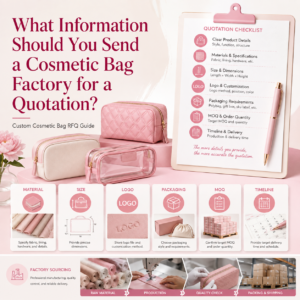
Provide bag type, size, material, color reference, logo artwork, logo method, zipper type, lining requirement, packaging method, order quantity, target market, quality expectations, and approved sample requirements. Clear information helps the supplier quote and produce accurately.
Should I use third-party inspection for cosmetic bag orders?
Third-party inspection can be useful for large orders, new suppliers, premium retail products, or high-risk custom designs. However, a strong factory should also have internal material inspection, in-process inspection, and final QC before shipment.
How can I reduce quality problems in cosmetic bag production?
Reduce quality problems by preparing a clear specification sheet, approving a physical sample, confirming materials and colors, defining defect standards, checking production photos, requesting in-process inspection, and conducting final inspection before shipment.
Start Your Custom Cosmetic Bag Project with Quality Control Support
Better cosmetic bag quality control starts before mass production. Clear specifications, approved samples, reliable materials, strong stitching standards, zipper testing, logo control, lining inspection, packaging review, and final shipment checks all work together to reduce sourcing risk.
If you are developing custom makeup bags, toiletry bags, vanity cases, mini pouches, promotional cosmetic bags, or private label beauty accessories, Bling Accessory Co. can support your project from concept to production.
Contact Us for a Custom Quote