OEM / ODM Cosmetic Bag Pricing Guide
How Much Do Custom Cosmetic Bags Cost? Complete Buyer Pricing Guide
When a beauty brand, skincare company, retailer, subscription box buyer, promotional buyer, or private label seller starts a custom cosmetic bag project, one of the first commercial questions is: How much do custom cosmetic bags cost? The honest answer is that custom cosmetic bag pricing depends on the product specification. Material, size, structure, logo method, MOQ, packaging, quality control, and shipping all affect the final unit cost.
A simple polyester makeup pouch with a printed logo and basic polybag packaging will not cost the same as a premium PU leather vanity case with metal logo plate, custom zipper puller, branded lining, dust bag, and gift box. A clear PVC cosmetic bag, mini pouch, brush bag, toiletry bag, drawstring pouch, and structured cosmetic case all have different production paths. That is why a professional factory quote must be based on the full product brief, not only a photo.
This complete buyer pricing guide explains the main factors behind custom cosmetic bag cost. You will learn how material choice, size, construction, logo customization, MOQ, packaging, sampling, quality inspection, and freight influence pricing. If you are preparing a custom project, you can explore Custom Bag Manufacturing Services, browse the Cosmetic Bag Collection, or request a project quote through Contact Us.
How Much Do Custom Cosmetic Bags Cost?
Custom cosmetic bags are usually quotation-based because every order has different materials, dimensions, logo methods, packaging requirements, and quantities. A factory cannot give a reliable price from only the phrase “custom makeup bag.” The same product category may include a flat mini pouch, soft zipper pouch, clear PVC bag, brush bag, travel toiletry pouch, PU leather vanity case, or multi-piece cosmetic bag set.
The fastest way to understand custom cosmetic bag cost is to separate the price into several parts: material cost, labor cost, logo cost, accessory cost, packaging cost, sampling cost, inspection cost, and shipping cost. The final unit price is the result of how these parts combine.
In most projects, a simple design with available material, standard zipper, one logo method, basic packaging, and a reasonable MOQ will be more cost-efficient. A premium design with custom fabric, special lining, metal hardware, complex logo, retail gift box, and multiple color versions will cost more. The goal is not always to choose the cheapest version. The goal is to choose a cost structure that supports your target customer, retail price, brand positioning, and reorder plan.
For buyers comparing options, the best question is not only “What is the lowest price?” A better question is “Which specification gives us the right balance of cost, quality, MOQ, packaging value, and delivery reliability?”
Main Factors That Affect Cosmetic Bag Pricing
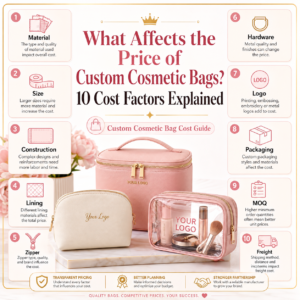
The price of a custom cosmetic bag is affected by several connected factors. If one part changes, the total price may change. For example, switching from polyester to PU leather changes material cost, logo method, sewing difficulty, packaging protection, and perceived value. Adding a metal logo plate may require tooling and attachment labor. Upgrading from a plain polybag to a printed belly band or gift box adds packaging cost and production coordination.
| Pricing Factor | How It Affects Cost | Buyer Decision |
|---|---|---|
| Material | Different fabrics, PU, PVC, TPU, canvas, and recycled materials have different costs. | Choose material based on market position, not only appearance. |
| Size and Structure | Larger bags and complex structures use more material and labor. | Confirm what the bag must hold before choosing size. |
| Logo Method | Printing, embroidery, patches, metal plates, debossing, and custom pullers have different costs. | Match the logo method to material and brand level. |
| Packaging | Polybags, hangtags, belly bands, dust bags, and gift boxes change unit cost. | Use retail packaging when it helps conversion or shelf value. |
| MOQ and Quantity | Higher quantities usually spread setup cost across more units. | Balance lower unit cost with inventory risk. |
A strong quotation should clearly state what is included. Buyers should confirm whether the quoted price includes the bag, logo, inner label, packaging, carton marks, sample cost, mold cost, inspection, or shipping. Without clear quotation details, price comparison can become misleading.
Material Cost: Fabric, PU, PVC, TPU, Canvas, and More
Material is one of the biggest drivers of custom cosmetic bag pricing. Basic polyester is often more cost-efficient than premium PU leather, specialty velvet, quilted fabric, clear TPU, or custom printed material. However, the cheapest material is not always the best business choice. The right material should match the target customer, retail price, brand image, cleaning needs, and usage scenario.
Polyester and nylon are common for promotional cosmetic bags, travel pouches, and lightweight makeup bags. They are practical, flexible, and suitable for many logo methods. PU leather creates a more premium look and can support debossing, foil stamping, metal labels, and structured shapes. Canvas and cotton create a natural or boutique feeling. PVC and TPU are used for clear cosmetic bags and travel-friendly transparent pouches. Velvet, satin, terry cloth, teddy fabric, and plush materials can support gift and trend-driven products.
Material thickness also affects cost. A thicker fabric may feel stronger and more premium, but it may cost more and require different sewing handling. A thin material may reduce cost but could make the product feel weak. Lining also matters. A cosmetic bag with no lining is usually cheaper, but a lined bag often feels more finished and can protect inner seams.
Custom-dyed material, special texture, exclusive print, recycled material, or rare finish can increase both MOQ and unit cost. If a buyer is launching a first order, using available material can reduce risk. If a brand already has strong demand and a clear retail price, custom material can help create differentiation.
Before confirming the material, review the Cosmetic Bag Materials Guide and the PU Leather Cosmetic Bags Guide. These resources help buyers compare material feel, durability, logo suitability, and brand positioning.
Size, Structure, and Sewing Complexity
Size affects price because larger cosmetic bags use more material, longer zippers, more lining, larger packaging, and more carton space. A mini pouch is usually simpler than a travel toiletry bag or vanity case. However, size alone does not explain the full cost. Structure can matter even more.
A flat zipper pouch is usually more cost-efficient because it uses a simple construction. A gusseted cosmetic bag requires more pattern planning and sewing. A brush bag may need inner slots, protective flaps, elastic loops, or structured panels. A toiletry bag may need water-resistant lining, side pockets, handles, or larger capacity. A vanity case may need padding, stronger structure, handle reinforcement, and more careful packaging.
Interior features also add cost. Inner pockets, mesh compartments, elastic holders, removable pouches, divider panels, clear windows, brush slots, card pockets, and bottle loops all require extra materials and labor. These features can increase value, but they should be added only when they support real customer use.
Sewing difficulty changes labor cost. Curved shapes, piping, quilted panels, clear PVC seams, thick PU leather, fluffy materials, and structured cases require more careful production. If a design looks beautiful but is difficult to sew consistently, the factory may need more time, stronger quality control, and a higher price.
Buyers should test the bag with real products before approving production. Put lipsticks, skincare bottles, brushes, compact powder, travel bottles, or accessories inside the sample. Check whether the bag closes smoothly, holds shape, and supports the intended retail value.
Logo Customization Cost
Logo customization can be a small part of the cost or a major cost driver depending on the method. A simple screen print may be efficient for large quantities and simple artwork. Embroidery adds texture but requires digitizing and thread work. Heat transfer can support multi-color artwork but must be tested for adhesion. Woven labels, rubber patches, silicone patches, PU patches, metal plates, debossing molds, and custom zipper pullers all have different setup and production costs.
The cheapest logo method is not always the best. A premium PU cosmetic bag may look better with debossing or a metal plate than with a large printed logo. A canvas pouch may work well with embroidery or a woven label. A nylon travel pouch may pair well with a rubber patch. A clear PVC pouch may need a carefully placed patch or print that does not block visibility.
Logo size and color also affect price. A one-color logo is usually easier to produce than a complex multi-color design. Small lettering can be difficult for embroidery or patches. Metallic finishes, gradient artwork, molded logos, and custom hardware may increase setup time and cost.
Custom zipper pullers are often overlooked. They can improve perceived value, but they may require mold fees and higher MOQ. Metal logo plates can make a pouch feel more retail-ready, but they add material cost, attachment labor, and inspection requirements.
To choose the right branding method, review the Cosmetic Bag Logo Printing Guide and the Patch Cosmetic Bags Guide. A good logo method should match both the material and the brand’s price tier.
Packaging Cost for Retail and Gift Sets
Packaging can change both product cost and customer perception. A cosmetic bag packed in a simple polybag may be enough for wholesale or promotional use. A retail cosmetic pouch may need a hangtag, belly band, barcode label, insert card, dust bag, paper sleeve, or gift box. A premium gift set may need a rigid box, drawer box, tissue paper, branded card, or protective inner packaging.
Basic packaging keeps cost lower and works well for bulk orders, low-cost promotional campaigns, and simple wholesale supply. Retail packaging costs more, but it can help the product sell better in stores or online. A belly band can make a cosmetic bag look more retail-ready while keeping the product visible. A gift box increases perceived value but also increases packing labor, carton size, and freight volume.
Packaging versions can also affect MOQ. If each color requires a different barcode, language, SKU label, belly band, or insert card, the packaging cost and production coordination increase. Buyers should confirm whether packaging MOQ applies per design, per SKU, or per total order.
Packaging should be planned before the final quote. If packaging is added after sampling, the price, lead time, and carton packing plan may change. A good supplier should help test whether the belly band fits, whether the barcode scans, whether the box protects the product, and whether the carton packing is efficient.
For packaging decisions, review the Cosmetic Bag Packaging Guide and the article on Cosmetic Bags with Belly Bands.
MOQ and Quantity: Why Unit Price Changes
MOQ and unit price are closely connected. MOQ means Minimum Order Quantity, and it affects how setup costs are spread across the order. A lower quantity may reduce total investment, but the unit cost is often higher because sample preparation, artwork setup, cutting, line arrangement, packaging setup, and inspection preparation are divided across fewer pieces.
A higher quantity can often reduce unit cost because the factory can purchase materials more efficiently, run production more smoothly, and reduce per-unit setup impact. However, a higher MOQ also means more inventory risk. Buyers should not order more than they can reasonably sell, store, or use within the campaign period.
Color split can change the calculation. A 1,000-piece order in one color is not the same as 1,000 pieces split into five colors. Each color may require separate material preparation, cutting, sewing, packing, labeling, and inspection. The same issue can happen with multiple logo versions or packaging versions.
For first orders, a practical approach is to reduce variation. Start with one hero style, one or two strong colors, one logo method, and one packaging format. This keeps MOQ and pricing easier to manage. After market feedback, the buyer can expand into more colors, materials, or premium packaging.
For a deeper MOQ explanation, review Cosmetic Bag MOQ Explained and What Is the MOQ for Custom Cosmetic Bags?.
Sampling, Development, and Pre-Production Cost
Sampling is an essential part of custom cosmetic bag pricing. A sample helps confirm whether the product can be produced according to the buyer’s expectations. It also helps reveal issues before bulk production, such as wrong size, poor material match, zipper problems, weak logo clarity, lining wrinkles, packaging mismatch, or carton packing concerns.
Sample cost depends on complexity. A simple existing pouch with a logo may be easier to sample. A full custom vanity case with new pattern, special material, custom puller, printed lining, and retail packaging requires more development work. If the buyer requests multiple revisions, development time and cost may increase.
Buyers should treat sampling as risk control rather than an unnecessary cost. A low sample cost is not useful if the sample does not represent the final production quality. A good pre-production sample should match the approved material, size, zipper, lining, logo, packaging, and construction standard.
Some suppliers may refund or deduct sample fees from the bulk order under certain conditions, while others treat sampling as a separate development charge. Buyers should ask how sample cost, mold cost, logo setup, and packaging proofing are handled before starting the project.
To plan the full development process, read How to Customize Cosmetic Bags for Your Beauty Brand.
Quality Control and Inspection Cost
Quality control affects pricing because inspection takes time, labor, and management. A cosmetic bag factory must check material, cutting, stitching, zipper smoothness, lining, logo accuracy, packaging, carton marks, and final quantity. If the order requires stricter inspection, more detailed checking, or retail-ready packaging control, the production cost may be higher.
Low-cost production with weak inspection can create expensive problems later. A crooked logo, stuck zipper, loose thread, wrong color, dirty lining, poor barcode label, or damaged packaging can lead to returns, delays, customer complaints, and brand damage. For private label and retail buyers, quality consistency is part of the product cost.
Different product types require different inspection focus. Clear PVC bags need checks for scratches, odor, and transparency. PU leather pouches need surface inspection and edge finishing control. Brush bags need slot and flap accuracy. Toiletry bags need lining and zipper checks. Vanity cases need structure, handle, and hardware inspection. Belly band packaging needs barcode and fit verification.
Buyers should compare quotes based on quality standard, not only unit price. A supplier with stronger inspection may appear more expensive, but the total business risk may be lower. If the product will be sold in retail or used for a major campaign, quality control should not be treated as optional.
For a complete inspection framework, review the Cosmetic Bag Quality Control Guide.
Shipping and Landed Cost
The factory unit price is not the same as the landed cost. Landed cost includes the product cost plus packaging, shipping, duties, taxes, customs clearance, warehousing, and local delivery. Buyers who compare only the ex-factory price may underestimate the real cost of bringing custom cosmetic bags into their market.
Shipping cost depends on order quantity, carton size, gross weight, shipping method, destination, and delivery timeline. A flat mini pouch may pack efficiently. A structured vanity case or gift-boxed cosmetic bag may take more carton space. Clear pouches and PU leather pouches may need extra protection to prevent scratches, pressure marks, or deformation.
Air shipping is faster but usually more expensive. Sea shipping is more cost-efficient for larger orders but requires more planning time. Express delivery may be useful for samples or urgent small shipments. Buyers should plan production and shipping together, especially for holiday launches, subscription boxes, retail delivery windows, or promotional campaigns.
Packaging choices can increase landed cost. Gift boxes, dust bags, paper sleeves, and retail cartons may improve selling value, but they also increase volume. This is not necessarily bad. The question is whether the packaging supports a higher retail price or better conversion.
When requesting a quote, ask whether the supplier can provide estimated carton size, packing quantity, gross weight, and shipping options. These details help buyers calculate the real project cost more accurately.
Pricing Logic by Buyer Type
Startup Beauty Brands
Startups often need to control cash flow and reduce inventory risk. The best pricing strategy is usually to choose an existing style, available material, simple logo method, and basic packaging. This keeps the first order practical while allowing the brand to test demand, product photos, retail price, and customer feedback.
Growing Skincare and Makeup Brands
Growing brands often need better branding and more consistent packaging. They may choose upgraded materials, custom colors, woven labels, belly bands, printed insert cards, or branded lining. The price may increase, but the product can better support retail value and customer experience.
Retailers and Wholesale Buyers
Retailers and wholesalers should focus on margin, SKU planning, packaging, barcode labels, carton marks, and reorder consistency. The quote should clarify price by color, style, size, packaging version, and quantity. A slightly higher unit price may be acceptable if the product is retail-ready and easier to manage.
Promotional Buyers
Promotional buyers usually care about deadline, logo visibility, cost control, and packing accuracy. Simple polyester pouches, drawstring bags, mini pouches, and clear pouches can work well. The product does not always need luxury packaging, but logo quality and delivery reliability are critical.
Private Label Brands
Private label brands should plan pricing across the full product line. A hero cosmetic bag may justify better materials and packaging. A low-cost mini pouch may support gift-with-purchase campaigns. A premium vanity case may support holiday gifting. For broader wholesale planning, review the Wholesale Cosmetic Bags Guide and Private Label Cosmetic Bag Guide.
What to Send for an Accurate Quote
A factory can provide a better price when the buyer sends a complete project brief. If the brief is vague, the quote may be rough or inaccurate. Use the checklist below before requesting custom cosmetic bag pricing.
- Bag type: mini pouch, makeup bag, cosmetic pouch, brush bag, toiletry bag, clear bag, drawstring bag, vanity case, or cosmetic bag set.
- Reference images: share photos, sketches, product links, or design examples.
- Target size: length, height, depth, and what products the bag must hold.
- Material: polyester, nylon, PU leather, canvas, cotton, PVC, TPU, satin, velvet, RPET, or other materials.
- Color: standard color, custom Pantone color, printed pattern, or multiple color versions.
- Logo artwork: vector file preferred, plus logo size and placement.
- Logo method: screen printing, embroidery, heat transfer, woven label, patch, debossing, metal plate, or custom puller.
- Structure details: lining, pockets, handle, zipper, compartments, padding, clear windows, or special hardware.
- Packaging: polybag, hangtag, belly band, barcode label, insert card, dust bag, sleeve, or gift box.
- Quantity: target order quantity, color split, SKU count, and possible reorder plan.
- Sales channel: retail, e-commerce, wholesale, GWP, subscription box, promotional campaign, or private label.
- Delivery timeline: sample deadline, bulk production deadline, and shipping destination.
If you do not know every detail yet, start with your target use case, customer, budget, and launch plan. A capable cosmetic bag manufacturer can recommend practical specifications that fit your cost target.
Common Pricing Mistakes to Avoid
The first mistake is comparing prices without comparing specifications. A low quote may use thinner material, weaker zipper, basic lining, simple packaging, or limited inspection. Always compare material, size, logo, packaging, MOQ, and quality standard.
The second mistake is asking for a price without a target quantity. Unit cost changes with quantity. If you ask for “best price” without MOQ or order quantity, the supplier cannot calculate production efficiency accurately.
The third mistake is choosing premium packaging without checking landed cost. Gift boxes, dust bags, insert cards, and belly bands can improve retail value, but they also affect carton size and shipping cost.
The fourth mistake is over-customizing the first order. Multiple colors, custom fabric, complex logo, special zipper pullers, and retail boxes can increase cost and MOQ. If you are still testing the market, simplify the first production run.
The fifth mistake is ignoring sampling and quality control. A cheaper bag can become expensive if the final product has zipper issues, logo defects, wrong color, poor stitching, or packaging problems.
The sixth mistake is not planning reorders. If your first order sells well, you need consistent material, color, logo, and packaging for the next order. Ask the supplier how they maintain consistency across batches.
FAQ: Custom Cosmetic Bag Cost and Pricing
How much do custom cosmetic bags cost?
Custom cosmetic bag cost depends on material, size, structure, logo method, MOQ, packaging, inspection, and shipping. A reliable quote requires a clear product specification and target quantity.
Why do custom cosmetic bag prices vary so much?
Prices vary because different bags use different materials, zippers, linings, logo methods, packaging, labor steps, and quality standards. A simple pouch and a premium vanity case have very different production costs.
What is the biggest cost factor in custom cosmetic bags?
Material, structure, logo method, packaging, and order quantity are usually the biggest cost factors. For complex designs, labor and construction details can also strongly affect price.
Does MOQ affect cosmetic bag unit price?
Yes. Higher quantities often reduce unit cost because setup, material sourcing, and production preparation are spread across more pieces. Lower quantities may reduce total investment but often have a higher unit cost.
Which logo method is most cost-effective?
Screen printing and heat transfer are often practical for simple logos and many materials. Embroidery, patches, metal plates, debossing, and custom zipper pullers may cost more but can increase perceived value.
Does packaging increase custom cosmetic bag cost?
Yes. Polybags are usually more cost-efficient, while belly bands, hangtags, insert cards, dust bags, retail sleeves, and gift boxes add cost. Good packaging can also improve retail presentation and conversion.
How can I lower custom cosmetic bag cost?
Use available materials, choose a practical existing structure, reduce color split, select a suitable logo method, keep packaging simple, and order a quantity that balances unit cost with inventory risk.
Why is the cheapest quote risky?
The cheapest quote may use weaker materials, poor zipper quality, basic lining, limited inspection, or low-grade packaging. Buyers should compare full specifications, not only unit price.
What should I send to get a custom cosmetic bag quote?
Send bag type, size, reference images, material, color, logo artwork, logo method, packaging, quantity, sales channel, shipping destination, and timeline.
Where can I request custom cosmetic bag pricing?
You can contact Bling Accessory Co. through the Contact Us page and share your project details for MOQ, sample, unit price, packaging, and production support.
Request a Custom Cosmetic Bag Price Quote
Custom cosmetic bag pricing is not only about finding the lowest unit cost. It is about building a product that fits your brand, budget, MOQ, sales channel, packaging plan, quality standard, and delivery schedule. Whether you need a simple makeup pouch, low MOQ cosmetic bag, wholesale beauty pouch, private label cosmetic bag, PU leather vanity case, clear travel pouch, brush bag, toiletry bag, or retail-ready gift set, the right manufacturer can help you compare cost options clearly.
Share your bag type, size, material idea, logo artwork, packaging requirement, target quantity, and launch timeline to discuss sample cost, unit price, MOQ, production time, quality control, and shipping options.