Private Label Cosmetic Bag Manufacturer China: The Complete OEM, Wholesale, and Brand-Building Guide
A private label cosmetic bag is one of the most practical and profitable accessory products a beauty brand can add to its line. It is compact enough for ecommerce, flexible enough for wholesale, useful enough for repeat use, and visual enough to support strong branding. For brands that want to expand into beauty accessories without building a factory, working with a reliable custom cosmetic bag supplier in China is often the fastest and most cost-effective route.
Bling Accessory Co. positions itself as a Chinese OEM/ODM manufacturer specializing in custom cosmetic bags, with more than 15 years of experience and a broader product range that includes trend bags, hair accessories, packing and promo bags, personal care items, travel accessories, school supply products, and more. The site structure already shows a content and product ecosystem that is useful for internal linking and topical authority building.
Contents
- Why private label cosmetic bags are growing
- What a private label cosmetic bag actually is
- Why China remains a strong sourcing base
- Main cosmetic bag types and use cases
- Materials, finishes, and construction
- Customization and branding options
- The OEM production process
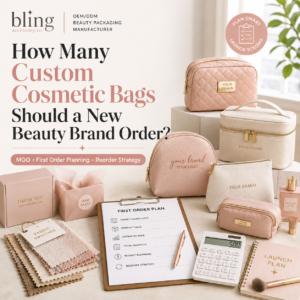
- MOQ, pricing, and lead-time strategy
- Quality control and inspection checklist
- How to build a private label cosmetic bag brand
- Internal link structure for SEO
- FAQ
- TDK, keywords, URL, and tags
Why Private Label Cosmetic Bags Are Growing So Fast
Cosmetic bags sit in a valuable commercial intersection: they are functional, giftable, visually branded, lightweight, and easy to bundle with other beauty products. That combination is exactly why the category continues to grow across ecommerce, retail, promotional gifting, and influencer-driven beauty launches.
Private label beauty commerce has shifted toward products that make a brand feel complete rather than fragmented. Consumers do not just want a lipstick or skincare serum. They also want the organizer, pouch, travel set, and storage solution that makes the product easier to use. Cosmetic bags help create that sense of completeness. They also generate a more premium unboxing moment, which matters greatly in direct-to-consumer channels where the post-purchase experience can determine repeat purchase behavior.
Another reason for growth is product versatility. A single cosmetic bag design can be sold as a standalone retail SKU, bundled with a makeup set, included in a gift-with-purchase campaign, used as a subscription box insert, or adapted for seasonal promotions. That flexibility lowers development risk and makes the product appealing for private label buyers who want to test multiple channels.
From a sourcing perspective, cosmetic bags are also easier to scale than many hard goods. They use fabric, zippers, lining, trim, and printing methods that manufacturers already handle efficiently. Because of that, buyers can often iterate quickly on color, size, shape, logo placement, and packaging without needing to redesign the entire production system. That speed is useful in beauty, where trend cycles can move quickly and marketing calendars are often tied to launches, holidays, travel season, and social media campaigns.
In practical terms, the product works because it solves a real daily problem. People travel with cosmetics, carry skincare in handbags, store brushes and tools separately, and need a compact way to keep small items organized. A cosmetic bag is therefore not a novelty item; it is a utility product with emotional and aesthetic appeal. When a utility product also carries a clear brand identity, the commercial opportunity becomes much stronger.
What a Private Label Cosmetic Bag Actually Means
A private label cosmetic bag is produced by a factory or OEM/ODM supplier but sold under the buyer’s own brand name. The manufacturing partner handles production, and the buyer controls branding, customer-facing packaging, and often the final product specification. In simple terms, the factory makes the bag, but the brand owns the presentation.
This model is different from buying generic stock goods because the buyer is not simply selecting an off-the-shelf item. Private label sourcing allows modification of the product identity. That can include logo methods, zipper pulls, dimensions, fabric texture, compartment layout, interior lining, piping, label placement, and packaging style. Some brands go farther and develop exclusive silhouettes that become part of their visual identity.
The strength of private label is control. You can sell a product that matches your brand tone instead of conforming to a supplier’s existing assortment. If your audience prefers minimalist luxury, the bag can be clean, matte, and restrained. If your audience prefers Gen Z trend aesthetics, the bag can use brighter colorways, textured fabric, or playful typography. If your audience is sustainability-focused, the product can be built around recycled textiles and low-waste packaging.
For a beauty brand, this control matters because cosmetic bags are highly visible. They appear in photographs, influencer unboxings, gift sets, social posts, and product pages. A poorly designed pouch weakens the whole line. A strong one raises the perceived value of everything around it. In that sense, the bag is not just packaging; it is part of the product architecture.
Why China Remains a Strong Sourcing Base for Custom Cosmetic Bags
China continues to be one of the most important sourcing destinations for custom cosmetic bags because of its supply-chain depth, manufacturing specialization, and export experience. A buyer can usually find factories that understand soft goods construction, decorative finishing, printing methods, packaging coordination, and international shipping requirements.
The most obvious advantage is cost efficiency. When raw materials, trim accessories, labor, and finishing services are all available within a concentrated manufacturing ecosystem, the buyer benefits from lower transaction friction. That does not mean the cheapest supplier is the best supplier. It means the sourcing environment makes it easier to find a balance between cost, flexibility, and quality.
China also supports a broad range of order sizes. Large brands can place sizable wholesale orders, while smaller ecommerce sellers can often negotiate pilot runs or low-MOQ test production. That matters for private label launches because not every brand wants to commit to a full inventory build at the beginning of a campaign.
Another reason China remains important is the speed of product iteration. Factory teams are used to turning design references into samples, revising materials, adjusting structural details, and sending updated versions quickly. For beauty accessories, where trends and seasonal launches matter, fast sampling can be a decisive advantage.
Bling Accessory Co.’s site also reflects a broader product ecosystem that supports cross-selling and content clustering. The homepage emphasizes custom cosmetic bags as the core expertise, while the navigation extends into trend bags, hair accessories, lifestyle accessories, packing and promo bags, personal care, tech accessories, travel accessories, teen bags and accessories, and related blog content. That kind of structure is helpful for SEO because it creates topical relevance around the same commercial theme.
Main Private Label Cosmetic Bag Types and How They Sell
Travel Cosmetic Bags
Travel cosmetic bags remain one of the strongest segments because buyers care about portability, spill protection, organization, and easy cleaning. These bags are especially valuable for airport travel, weekend trips, business travel, gym bags, and carry-on use. The best-selling versions often balance lightweight construction with a structured shape that prevents items from getting crushed.
Mini Pouches
Mini pouches are ideal for lip products, sample sizes, small skincare items, compact mirrors, chargers, and everyday handbag organization. They are also relatively easy to brand and ship. On Bling Accessory Co.’s site, the Mini Pouch page is an example of how a focused product family can support discovery and category depth.
Brush Holders and Cylindrical Cases
Brush cases and cylindrical organizer formats are useful for professional makeup artists and consumers who want separate storage for tools. A product such as the Lychee Texture Cylindrical Makeup Case / Travel Brush Holder shows how a single structure can be positioned for both function and premium styling.
Bucket and Handle Pouches
Bucket-style pouches are increasingly popular because they combine a casual fashion look with practical storage volume. A product like the Drawstring Bucket Bag / Mini Handle Pouch Organizer demonstrates how a cosmetic-inspired product can move closer to a lifestyle accessory without losing utility.
Transparent and Waterproof Bags
Clear TPU and PVC cosmetic bags continue to perform well for airport compliance, travel visibility, and easy spill monitoring. They are especially useful for consumers who want to find items quickly or comply with liquid storage requirements. The key sales value is convenience: buyers can see what is inside without opening the pouch.
Luxury Cosmetic Bags
Luxury brands often prioritize shape retention, tactile materials, elegant color palettes, hardware quality, and presentation. These bags are commonly sold as part of gift sets or premium retail bundles, where the cosmetic bag needs to feel like a worthy extension of the beauty product itself.
Promotional Bags
Promotional cosmetic bags work well in campaigns because they offer repeat usage. A logo printed on a pouch can continue to generate impressions long after the original promotional period ends. That makes them especially effective for trade shows, product launches, seasonal campaigns, and retail gifts.
Materials, Finishes, and Construction Choices That Change the Product
Material selection determines more than visual style. It affects price, durability, waterproof performance, cleaning behavior, hand feel, branding quality, and the customer’s impression of your product. If you choose the wrong material, the bag may look cheap, fail in use, or create higher defect risk in production. If you choose the right material, even a simple silhouette can feel premium.
Bling Accessory Co’s materials guide is a useful example of how a site can build topical authority around sourcing questions. The article covers material selection, finishes, sustainability, and wholesale options, which makes it a strong supporting resource for a private label buyer.
PU Leather
PU leather is widely used when the buyer wants a structured, polished, and semi-luxury appearance. It works well with embossing, debossing, and metal logo plates. It also photographs nicely, which is useful for ecommerce listings. PU leather can be a strong choice for brands that want a more refined aesthetic without moving into very high-cost genuine leather sourcing.
Canvas and Cotton
Canvas and cotton are common for casual, eco-friendly, or artisanal product lines. They feel approachable and can be printed with bold artwork or minimalist branding. These materials often work well for beauty brands that want a softer, natural identity or that need a fabric more aligned with sustainability messaging.
Nylon and Polyester
Nylon and polyester are practical choices for travel, sports, and daily use. They are generally lightweight, durable, and easier to work with in many functional formats. When buyers prioritize everyday resilience over luxury texture, these materials often provide the best cost-to-performance ratio.
Transparent TPU and PVC
Transparent materials remain popular for travel and compliance-based use cases. TPU is often favored when brands want a more modern feel and a more sustainability-friendly direction than traditional PVC. Clear bags are also useful for product visibility, making them practical for retail shelves and travel sets.
Velvet and Satin
Velvet and satin are commonly used for gift packaging, premium collections, and seasonal launches. They communicate softness, elegance, and gift-worthiness. These materials may not be ideal for rugged travel use, but they are excellent when the product’s role is to elevate a beauty brand’s presentation.
Recycled and Eco-Friendly Fabrics
Eco-conscious buyers increasingly ask for RPET, recycled textile blends, organic cotton, and lower-impact packaging solutions. Sustainability is no longer a side note in many markets. In Europe especially, buyers often want proof that the product aligns with their brand values and customer expectations.
Construction Details That Matter
Even small construction decisions can change product performance. Zipper quality affects user satisfaction. Lining selection affects cleaning and wear. Stitch density influences strength. Edge binding affects perceived finish. Reinforcement at stress points helps the bag survive daily use. If the bag will be used frequently, the construction should prioritize longevity rather than just appearance.
Customization and Branding Options for Private Label Buyers
Private label succeeds when the product feels intentionally branded rather than mechanically generic. Cosmetic bags offer many opportunities to create a distinct look even if the basic silhouette is simple. The goal is to make the bag recognizable and consistent with the rest of the brand system.
Logo Application Methods
- Silk screen printing: economical and effective for simple logos and larger runs.
- Heat transfer: suitable for colorful graphics and more complex artwork.
- Embroidery: adds texture and a more premium tactile impression.
- Debossing / embossing: ideal for PU leather and premium branding.
- Metal logo plates: useful for luxury positioning.
- Woven labels: practical for soft, fashion-oriented branding.
Color Strategy
Color should not be selected only because it looks nice in a mockup. It should support positioning. Neutral colors work well for luxury, beauty, and minimalist brands. Pastel tones can fit softer consumer identities. Bright colors or contrast accents may be better for youth-oriented or trend-led launches. Matching the color story to the brand story keeps the assortment coherent.
Packaging and Presentation
Packaging can upgrade a product from practical to gift-worthy. Custom inserts, hang tags, barcode labels, branded tissue, kraft boxes, and dust bags all change how the buyer perceives the item. Cosmetic bags are especially sensitive to packaging because they are often part of a gifting or unboxing experience. This is one reason many private label brands treat the packaging as part of the product rather than as an afterthought.
Functional Customization
Beyond visual branding, the bag can be customized for function. Buyers may request extra compartments, brush slots, waterproof lining, detachable straps, handle loops, double zippers, clear windows, fold-flat construction, or reinforced bases. These changes are important when serving users with different behavior patterns, such as commuters, travelers, professional makeup artists, or students.
The OEM Production Process From Brief to Shipment
A well-managed OEM process reduces risk and speeds up launch. The typical workflow looks simple on paper, but each stage has strategic implications for quality, cost, and timeline.
1. Product Brief
The buyer submits the design direction, target price point, dimensions, material ideas, color preferences, logo files, and packaging requirements. A strong brief reduces back-and-forth and helps the factory quote accurately.
2. Quotation and Feasibility Review
The supplier reviews construction complexity, material availability, printing methods, and order quantity. This stage is where the buyer learns whether the target cost and requested specification are realistic. A good supplier will explain trade-offs clearly rather than promising everything at once.
3. Sampling
The sample stage turns the idea into something tangible. This is where buyers evaluate size, proportions, zipper function, logo position, material feel, and overall look. Revisions are common and should be expected. The objective is to improve clarity before mass production begins.
4. Material Reservation and Planning
Once the sample is approved, materials are reserved and production is scheduled. If the order uses special fabrics or custom hardware, planning becomes even more important because it influences lead time and quality consistency.
5. Mass Production
Production usually includes cutting, stitching, shaping, printing, adding hardware, trimming edges, inspection, and packing. For structured cosmetic bags, maintaining shape and consistency is often one of the most important parts of the process.
6. Quality Inspection
Inspection checks logo accuracy, zipper movement, stitching quality, color consistency, size tolerance, and packaging completeness. For export orders, third-party inspection can be useful when the order value or product complexity is high.
7. Shipping and Documentation
After inspection, the supplier prepares export packaging, labeling, shipping documents, and logistics coordination. Depending on the destination and urgency, the shipment may move by sea, air, express, or a combined solution.
MOQ, Pricing, and Lead-Time Strategy
Many private label buyers focus on unit price too early, when the more useful question is total launch strategy. MOQ, sample cost, packaging cost, lead time, and freight all affect the actual economics of a program. A lower unit price is not helpful if the order size is too large for the brand to absorb or if the lead time destroys a seasonal launch window.
Low MOQ orders are especially valuable for startups and ecommerce brands testing a concept. They reduce inventory exposure and make it possible to validate market response before committing to a larger buy. However, low MOQ often comes with fewer customization options or slightly higher unit cost. That trade-off is normal and should be evaluated in the context of launch risk, not just margin math.
For brands that are already selling, the strategy may shift. A proven SKU can support a bigger order, more advanced packaging, or premium material upgrades because the sales history reduces uncertainty. In that case, the buyer may accept a larger MOQ in exchange for better pricing and stronger retail presentation.
Lead time also matters. If the product is tied to a holiday gift set, influencer campaign, or travel season promotion, missing the launch window can be more expensive than paying slightly more for faster production. The best sourcing strategy is therefore the one that aligns MOQ, timing, and margin structure with the actual business objective.
Quality Control Checklist for Cosmetic Bags
Quality control should be defined before production begins. Cosmetic bags seem simple, but they can fail in ways that affect the customer experience immediately. A bag that opens poorly, looks misaligned, or feels flimsy creates negative brand signals even if the product is inexpensive.
| Inspection Area | What to Check | Why It Matters |
|---|---|---|
| Stitching | Loose threads, seam strength, symmetry | Impacts durability and visual quality |
| Zippers | Smooth movement, alignment, puller quality | Affects daily usability and perceived value |
| Logo | Position, color, sharpness, adhesion | Brand accuracy is critical for private label |
| Material | Texture, thickness, color consistency | Creates the first impression of quality |
| Dimensions | Length, width, height, compartment accuracy | Ensures the bag functions as intended |
| Packaging | Cleanliness, labels, barcode placement, box fit | Important for retail, ecommerce, and gifting |
For higher-value products, buyers should also test spill resistance, abrasion resistance, opening/closing cycle performance, and color fastness. If the bag is designed for travel or daily carry, these tests become especially important because the product will encounter repeated friction and handling.
How to Build a Private Label Cosmetic Bag Brand That Sells
Brand building starts with positioning. A cosmetic bag is a broad category, but your brand should not try to be everything to everyone. Instead, decide whether the line is premium, minimalist, eco-friendly, travel-focused, youthful, professional, or promotional. That choice should then inform product design, photography, copywriting, packaging, and channel strategy.
One of the strongest advantages of cosmetic bags is their compatibility with visual marketing. They perform well in flat lays, unboxing videos, shelf displays, and lifestyle photography. That means a good product can support both conversion and awareness. For ecommerce brands, this is especially useful because strong visual merchandising can lower ad friction and improve click-through rates.
Many successful brands build a product ladder. The entry price point might be a simple mini pouch, while the mid-tier product is a travel organizer with compartments, and the premium tier is a structured PU or velvet cosmetic bag with custom packaging. This ladder increases average order value and creates a natural upsell path.
The site’s broader assortment also suggests a useful cross-sell strategy. A beauty customer who buys a cosmetic bag may also be interested in hair accessories, personal care items, travel accessories, or packing and promo bags. The categories visible on the site support that logic and make it easier to build thematic bundles.
Consistency is the final piece. Brand trust grows when the same typography, color system, packaging quality, and product tone are repeated across the line. Private label beauty brands that look coherent usually convert better because they feel more established and more intentional.
FAQ: Private Label Cosmetic Bag
What is the best material for a private label cosmetic bag?
The best material depends on the use case. PU leather is strong for premium positioning, nylon is practical for travel, TPU and PVC suit transparent waterproof designs, and cotton or RPET fit eco-friendly branding.
Can I order a small quantity first?
Yes. Many manufacturers support low MOQ launches so brands can test response before moving into larger wholesale production.
What kind of logo works best?
That depends on the visual identity and material. Embossing, debossing, embroidery, screen printing, and metal labels all work well in different situations.
How do I avoid quality problems?
Use a detailed brief, approve the sample carefully, confirm packaging standards, and inspect the first bulk run before shipment whenever possible.
Conclusion
A private label cosmetic bag is a small product with a large strategic role. It can support brand storytelling, customer retention, gift bundling, product differentiation, and stronger unboxing value. When sourced from the right manufacturer, it becomes a flexible asset that works across ecommerce, retail, wholesale, and promotional channels.