OEM / ODM Cosmetic Bag Order Quantity Guide
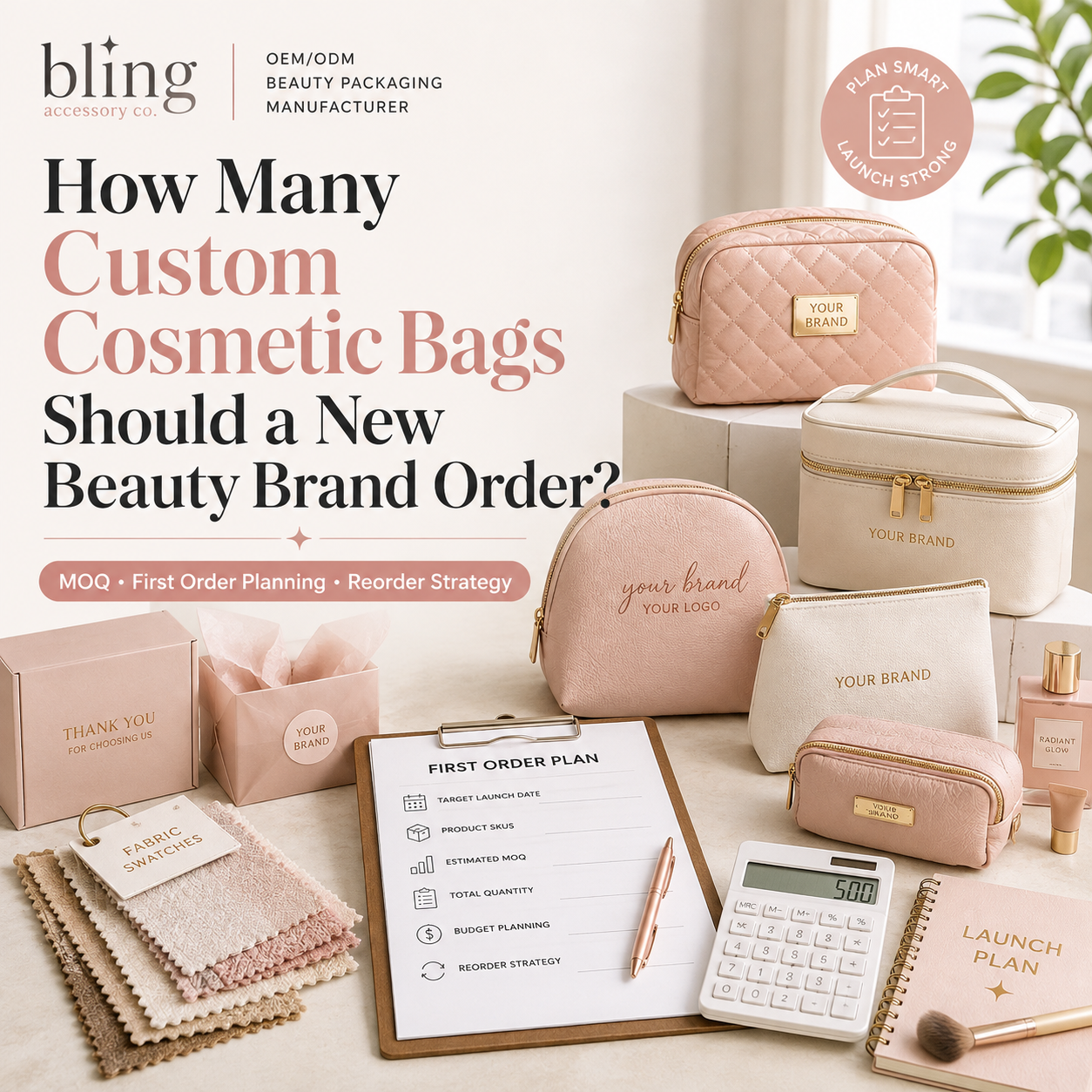
How Many Custom Cosmetic Bags Should a New Beauty Brand Order?
For a new beauty brand, choosing the right custom cosmetic bag order quantity can directly affect cash flow, inventory risk, unit cost, launch timing, packaging decisions, and customer experience. Order too few pieces, and the unit price may be high, production may be inefficient, and you may run out of stock quickly. Order too many pieces, and you may tie up cash in inventory before you know whether the design, color, packaging, and retail price will work.
The best first order quantity is not the same for every brand. A skincare startup testing a gift-with-purchase pouch has different needs from a retailer launching a private label cosmetic bag collection. A subscription box buyer may need a fixed campaign quantity. A boutique beauty brand may want a low MOQ test order. A wholesale buyer may need enough inventory to support several months of sales. That is why new brands should plan order quantity around MOQ, sales channel, launch goal, budget, reorder timing, and packaging strategy.
This guide explains how many custom cosmetic bags a new beauty brand should order, how to think about MOQ, when low MOQ makes sense, how quantity affects unit price, and how to build a safer first production plan. If you are preparing a custom project, you can explore Custom Bag Manufacturing Services, browse the Cosmetic Bag Collection, or request support through Contact Us.
Short Answer: What Is a Smart First Order Quantity?
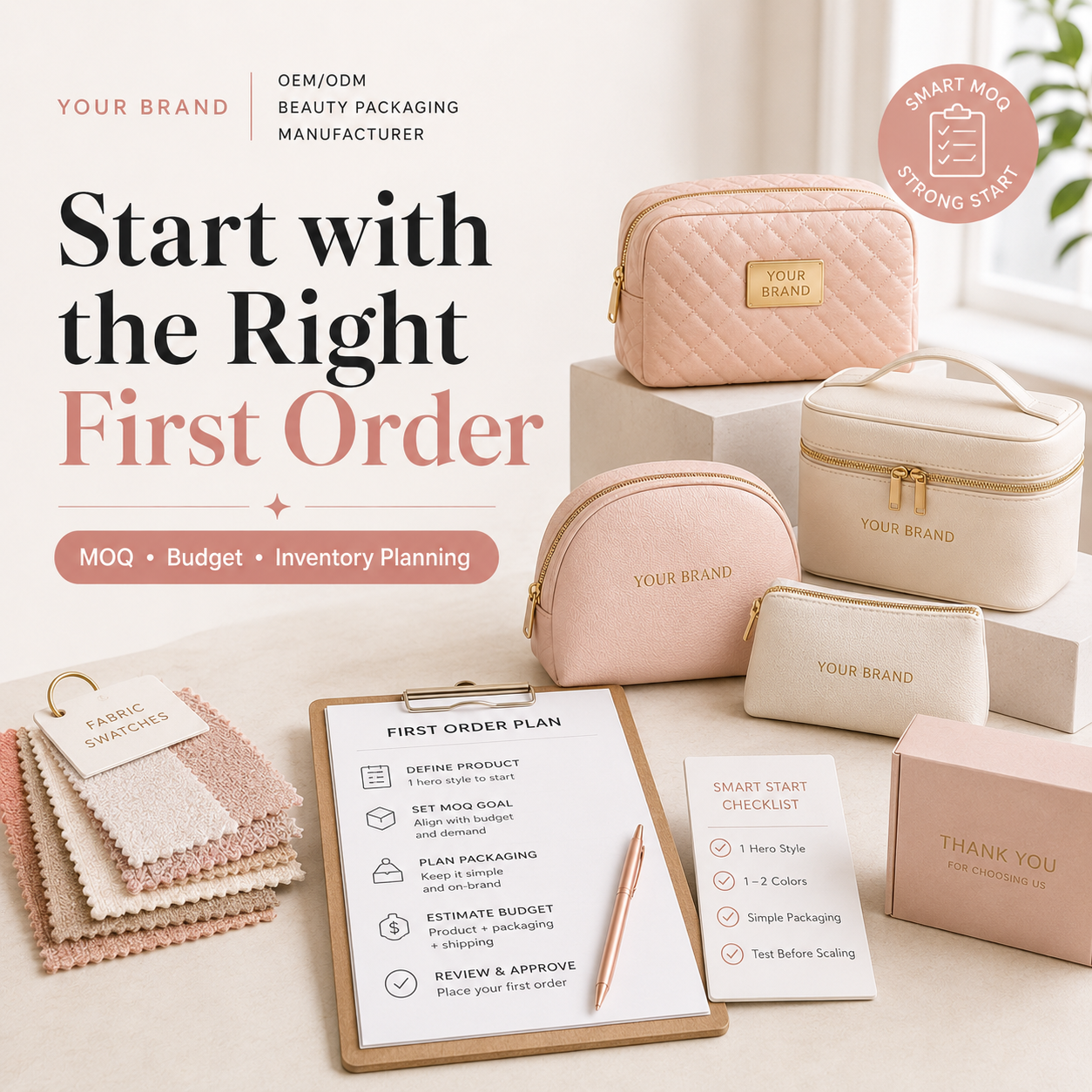
For many new beauty brands, a smart first custom cosmetic bag order is usually the smallest quantity that still gives stable production, acceptable unit cost, and enough inventory to test real demand. In many cases, this means starting with one hero style, one or two colors, one logo method, simple packaging, and a quantity that matches your launch plan.
If you are testing a new product concept, a lower MOQ order can reduce inventory risk. If you already have confirmed retail orders, wholesale commitments, subscription box demand, or a planned gift-with-purchase campaign, a larger first order may be more efficient. The right number depends on your business model, not only the factory’s minimum.
A new brand should not automatically order the lowest possible quantity or the biggest quantity the budget allows. Instead, calculate expected sales, campaign needs, reorder time, storage space, cash flow, and safety stock. Then compare that number with the factory’s MOQ and unit price breaks.
A practical rule is to start focused. Choose one cosmetic bag that clearly supports your brand: a makeup pouch, mini pouch, travel cosmetic bag, clear pouch, brush bag, toiletry bag, drawstring bag, or vanity case. Avoid launching too many styles, colors, and packaging versions in the first order unless you already have strong demand.
Why Order Quantity Matters for New Beauty Brands
Order quantity is a strategic decision. It affects product cost, inventory risk, supplier relationship, production lead time, packaging investment, and reorder planning. For new beauty brands, cash is often limited, and product-market fit may still be uncertain. This makes quantity planning especially important.
A small first order can help test demand. It allows a brand to see whether customers like the material, color, shape, logo placement, size, and packaging. It also helps test photography, product page conversion, retail pricing, influencer response, and bundle performance. If feedback is strong, the brand can reorder with more confidence.
A larger first order can lower unit cost and support stronger launch inventory. It may be better for brands with confirmed wholesale accounts, planned retail distribution, a large e-commerce audience, or subscription box commitments. However, a large order creates risk if the product does not sell as expected.
The goal is to avoid both stockout and overstock. Running out too early can interrupt campaigns, delay fulfillment, and weaken momentum. Overstock can tie up cash, occupy storage space, and force discounting. Smart quantity planning finds the balance between market testing and production efficiency.
MOQ Basics: Why Factories Have Minimum Orders
MOQ means Minimum Order Quantity. In custom cosmetic bag manufacturing, MOQ may apply per style, per color, per material, per logo version, or per packaging version. A buyer should always ask whether the MOQ is for the total order or for each SKU.
Factories have MOQ because production requires setup. The supplier must source materials, prepare patterns, cut fabric, arrange sewing lines, apply logos, prepare packaging, inspect goods, and pack cartons. Even a simple cosmetic pouch requires multiple production steps. When the order is too small, the setup work becomes inefficient.
MOQ also depends on upstream suppliers. Fabric suppliers, zipper suppliers, packaging factories, embroidery workshops, patch suppliers, and hardware suppliers may each have their own minimums. A cosmetic bag factory may be flexible, but a custom material or special logo component can still increase the practical MOQ.
Low MOQ is most realistic when the buyer uses existing ODM styles, available materials, standard colors, simple logos, and basic packaging. Fully custom OEM designs, custom-dyed fabrics, multiple colors, special hardware, printed lining, and retail gift boxes usually need more quantity planning. For deeper MOQ planning, read What Is the MOQ for Custom Cosmetic Bags? and Low MOQ Cosmetic Bag Manufacturer.
Practical First Order Quantity Ranges
The exact first order quantity depends on your product and supplier, but the table below shows how new beauty brands can think about different quantity levels.
| Order Quantity Level | Best For | Main Advantage | Main Risk |
|---|---|---|---|
| Very Small Test Quantity | Samples, photos, early feedback, influencer seeding | Low inventory risk | Higher unit cost and limited customization |
| Low MOQ First Order | New beauty brand launch, small e-commerce test, boutique retail | Good balance of test volume and production feasibility | May sell out quickly if demand is strong |
| Standard First Production Run | GWP campaigns, wholesale testing, subscription box programs | More stable unit cost and better production efficiency | Requires stronger demand planning |
| Larger Launch Order | Confirmed retail purchase orders or high-volume campaigns | Better cost efficiency and stronger inventory support | Higher cash and storage risk |
A new beauty brand should usually avoid spreading a small first order across too many styles. A single strong product with enough quantity is usually easier to sell, photograph, inspect, and reorder than a scattered collection of many low-volume SKUs.
Order Quantity by Buyer Scenario
Beauty Startup Testing a First Product
A beauty startup should start with a focused low MOQ order if it does not have confirmed demand. The safest approach is one proven bag style, available material, one logo method, and simple packaging. This lets the brand test photos, website conversion, customer reviews, influencer content, and packaging response.
Skincare Brand Creating a Gift-with-Purchase Bag
A skincare brand should calculate order quantity based on the planned campaign volume. If the brand expects to give one bag with each qualifying purchase, the order should cover expected campaign sales plus a small buffer. The bag must also fit the skincare products or samples included in the promotion.
Retailer Launching a Private Label Pouch
Retailers should think in terms of SKU count, store count, and replenishment. If the cosmetic bag will be sold in multiple colors, each color needs enough inventory to look meaningful in the assortment. Retail-ready packaging, barcode labels, and carton separation should be planned from the beginning.
Subscription Box Buyer
Subscription box quantity is usually tied to subscriber count and campaign schedule. The buyer should confirm the exact quantity needed, box dimensions, packing direction, and delivery deadline before sampling. A compact pouch, drawstring bag, mini pouch, or satin pouch may work well if it fits the box and budget.
Wholesale or Distributor Buyer
Wholesale buyers should order enough to support sales to downstream retailers while maintaining stock for reorders. They should pay close attention to unit cost, carton packing, SKU separation, and consistent supply. For broader wholesale planning, review the Wholesale Cosmetic Bags Guide.
How Bag Type Affects Order Quantity
The type of cosmetic bag affects order quantity because each structure has different material, labor, and component requirements. A simple flat pouch is usually easier to produce at a lower quantity than a structured vanity case or multi-compartment toiletry bag.
Mini pouches, flat makeup pouches, and drawstring cosmetic bags are often suitable for first-order testing because they are practical, lightweight, and easier to customize. They work well for gift-with-purchase campaigns, subscription boxes, sample sets, promotional projects, and entry-level retail.
Travel cosmetic bags and toiletry bags usually require more capacity planning. If they need inner pockets, water-resistant lining, wide opening, handle, or larger structure, the production cost and MOQ may increase. Brush bags require slots, flaps, and careful size matching. Clear PVC or TPU bags require attention to material thickness, odor, scratches, and edge finishing.
Vanity cases and structured cosmetic cases can create higher perceived value, but they usually need more careful sampling, stronger packaging, and better quality control. New brands should choose these products when the retail price and target customer can support the higher development cost.
If you are unsure which product to start with, compare Mini Pouch Buying Guide, Drawstring Cosmetic Bags, Travel Cosmetic Bag Guide, and Custom Vanity Cases.
Color Split, SKU Count, and Inventory Risk
One of the biggest mistakes new brands make is splitting a small first order into too many colors. For example, ordering 1,000 pieces across five colors may sound balanced, but it can create production inefficiency and weak inventory depth. Each color may need separate material preparation, cutting, sewing, inspection, labeling, and packing.
A stronger first order strategy is to choose one hero color and one secondary color. The hero color should match the brand identity and have the strongest commercial appeal. The secondary color can test another customer segment. Avoid adding too many seasonal colors before you know which color customers prefer.
SKU count also affects packaging. Each color may need separate barcode labels, SKU stickers, carton marks, product pages, photos, inventory tracking, and warehouse slots. More SKUs increase complexity even if total quantity is the same.
For new beauty brands, simple SKU planning is usually safer. Start with fewer variations, collect sales data, and expand after the first reorder. The goal is not to show many choices; the goal is to prove demand with a product customers actually buy.
How Quantity Affects Unit Cost
Quantity has a direct effect on unit cost. Lower quantities usually have higher unit prices because setup costs are spread across fewer pieces. Higher quantities often reduce unit cost because material purchasing, cutting, sewing, logo production, inspection, and packing become more efficient.
However, lower unit cost is not always the best decision for a new beauty brand. A large order may look attractive on a price sheet, but if it creates slow-moving inventory, the real business cost is higher. Overstock can lead to storage fees, discounting, cash pressure, and outdated packaging.
A new brand should compare both unit cost and total investment. Ask the supplier for pricing at several quantity levels, such as a low MOQ option, standard production option, and larger reorder option. This helps you understand price breaks without committing too early.
For example, the lowest quantity may be best for market testing. The middle quantity may be best for a confident launch. The larger quantity may be best for a reorder after sales data confirms demand. For deeper pricing logic, review How Much Do Custom Cosmetic Bags Cost?.
Cash Flow, Storage, and Sell-Through Planning
First order quantity should be connected to cash flow. Cosmetic bags are physical inventory. The order will require payment, production time, shipping time, storage space, product photography, website setup, marketing content, and fulfillment handling. A new brand should not spend too much budget on inventory before building a clear sales plan.
Sell-through planning is simple but important. Estimate how many units you expect to sell or give away each month. Then compare that number with production lead time and shipping time. If a reorder takes several weeks, you need enough inventory to cover sales during the reorder cycle.
Storage also matters. Flat pouches take less space than structured vanity cases. Gift boxes take more space than polybags. Multi-SKU orders need more warehouse organization. If you are using a fulfillment center, check storage fees and receiving requirements before confirming packaging.
A safe first order should leave budget for marketing, photography, product page creation, paid testing, influencer seeding, samples, and reorder planning. Inventory is only useful if the brand can sell it.
Why Sampling Comes Before the First Order
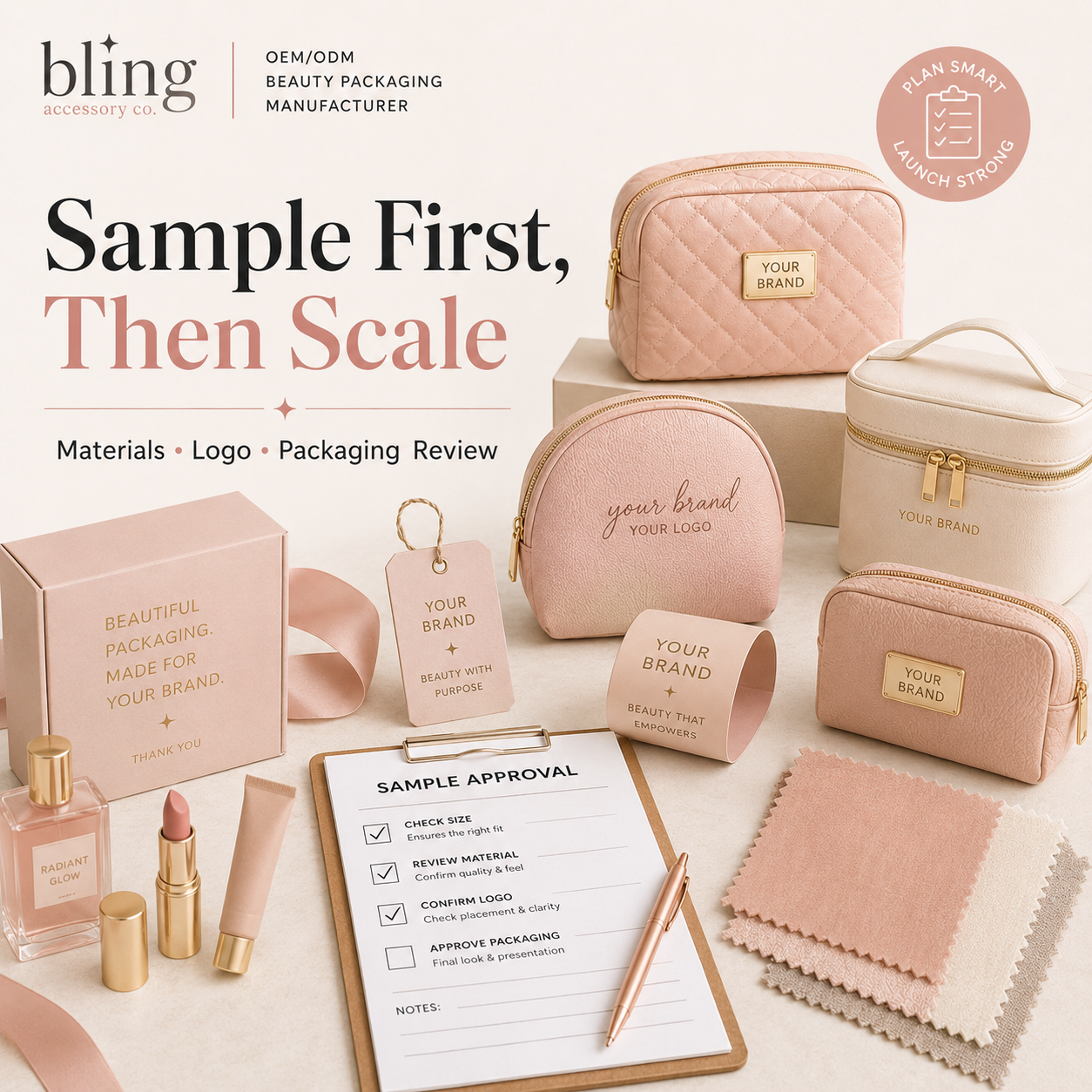
Sampling should happen before confirming the first bulk order. A sample lets you test size, material, zipper, lining, logo placement, stitching, color, packaging, and product function. It also helps you decide whether the planned order quantity is realistic.
A sample may reveal that the bag is too small, too large, too soft, too stiff, too expensive, or not aligned with the brand. The logo may need adjustment. The zipper may need upgrading. The packaging may not fit. The color may look different from the screen. These issues are easier to fix before mass production.
New beauty brands should use the sample for photography and internal review, but they should also test it with real products. Place skincare bottles, lipsticks, brushes, compact powder, sample sachets, or travel items inside. Check whether it closes smoothly, looks good when filled, and supports the intended retail price.
After sample approval, request a final pre-production sample if the project has multiple details. Bulk production should match this approved sample. For quality planning, review the Cosmetic Bag Quality Control Guide.
Packaging and First Order Quantity
Packaging affects both order quantity and cost. Simple polybag packaging is usually easier for first orders. Hangtags, belly bands, insert cards, barcode labels, dust bags, paper sleeves, and gift boxes can improve retail presentation, but they may increase packaging MOQ, unit cost, and carton volume.
A new beauty brand should choose packaging based on sales channel. If the bag is sold online, packaging should protect the product and look good in unboxing content. If it is sold in retail stores, packaging may need barcode labels, hangtags, or shelf-ready presentation. If it is used as a gift-with-purchase, packaging can be simpler but should still feel clean and branded.
Avoid developing too many packaging versions for the first order. One clear packaging format is easier to manage and inspect. If the first order performs well, upgrade packaging in the reorder or create special seasonal packaging later.
For packaging planning, review the Cosmetic Bag Packaging Guide and Cosmetic Bags with Belly Bands.
Reorder Strategy for New Beauty Brands
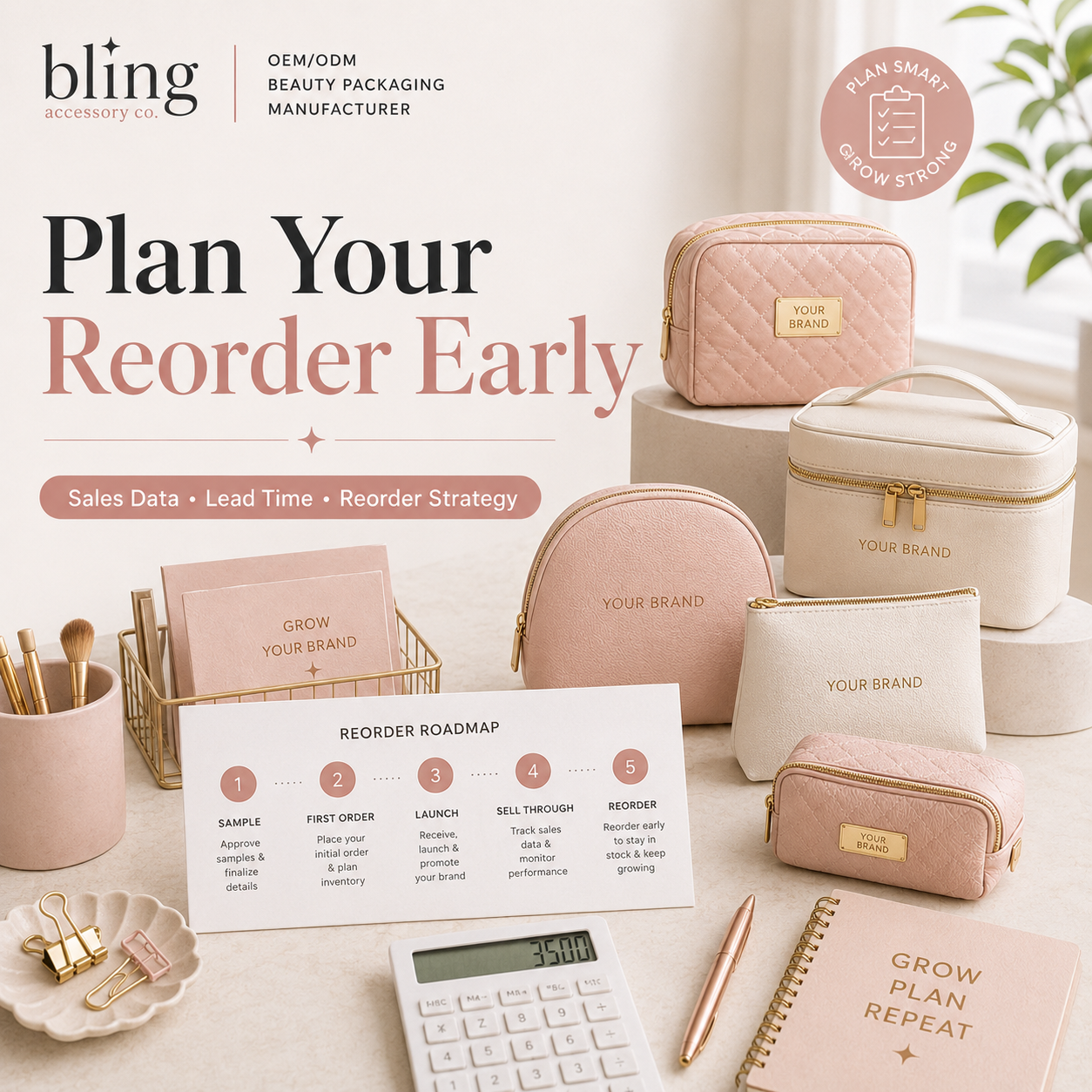
The first order should not be planned alone. A smart buyer also thinks about the reorder. If the first batch sells well, how quickly can the supplier reproduce the same material, color, logo, packaging, and quality? How long will production take? Will the same fabric still be available? Can the packaging be repeated?
A new beauty brand should track sales weekly after launch. Measure which color sells fastest, which customer segment responds, which bundle performs best, and whether customers mention size, material, or packaging in feedback. This data helps improve the reorder.
The second order can often be more confident than the first. After market validation, you may increase quantity, add another color, upgrade packaging, improve the logo method, or expand into a matching set. A reorder can also improve unit cost because the supplier already understands the product.
Keep records of the approved sample, material, Pantone color, logo size, zipper color, packaging artwork, barcode, carton marks, and production notes. These details help maintain consistency across batches.
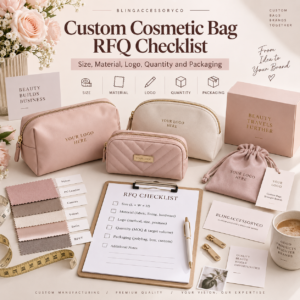
What to Send for Quantity Advice and Quote
To receive useful order quantity advice, send the factory a complete brief. The supplier can recommend MOQ, unit price breaks, sampling approach, and packaging options only when it understands the project.
- Bag type: makeup pouch, mini pouch, travel cosmetic bag, clear pouch, brush bag, toiletry bag, drawstring bag, vanity case, or cosmetic bag set.
- Reference images: product photos, sketches, competitor examples, or mood board.
- Target size: length, height, depth, or products the bag must hold.
- Material preference: polyester, nylon, PU leather, canvas, cotton, PVC, TPU, satin, velvet, RPET, or available material.
- Color plan: one color, two colors, custom Pantone, or color split by quantity.
- Logo file: AI, PDF, SVG, EPS, or high-resolution PNG.
- Logo method: screen printing, embroidery, woven label, debossing, patch, heat transfer, metal plate, or factory recommendation.
- Packaging: polybag, hangtag, belly band, insert card, barcode label, dust bag, retail sleeve, or gift box.
- Target quantity: first order estimate and possible reorder quantity.
- Sales channel: e-commerce, retail, wholesale, subscription box, gift-with-purchase, promotional campaign, or private label.
- Launch timeline: sample deadline, bulk delivery deadline, and destination country.
For a complete RFQ format, read What Information Should You Send a Cosmetic Bag Factory for a Quotation?.
Common First Order Quantity Mistakes
The first mistake is ordering too many colors. A new beauty brand does not need every possible shade in the first launch. Too many colors increase production complexity and inventory risk.
The second mistake is ordering only the lowest possible quantity without considering unit cost. A very small order may protect cash flow, but the unit price may make retail margin too weak.
The third mistake is ordering too much before testing the product. A large order may look efficient, but it can become a financial burden if customers do not respond to the design, size, material, or price.
The fourth mistake is ignoring reorder timing. If production and shipping take several weeks, the brand needs enough inventory to avoid stockouts during the reorder cycle.
The fifth mistake is changing too many details after sampling. Material, color, logo, packaging, and structure changes can affect price, MOQ, and lead time. Finalize details before production starts.
The sixth mistake is not aligning quantity with sales channel. A retail launch, subscription box campaign, e-commerce test, and wholesale program all need different inventory planning.
FAQ: Custom Cosmetic Bag Order Quantity
How many custom cosmetic bags should a new beauty brand order?
A new beauty brand should order enough to test real demand while avoiding excessive inventory risk. The right quantity depends on MOQ, budget, sales channel, launch plan, reorder time, and expected monthly sales.
Should startups choose low MOQ cosmetic bags?
Low MOQ can be useful for startups because it reduces inventory risk and helps test the market. However, low MOQ may have higher unit cost and fewer customization options.
Is it better to order one style or several styles first?
For most new brands, one strong hero style is safer than several small-volume styles. It is easier to photograph, market, inspect, and reorder.
How many colors should I order for the first cosmetic bag launch?
One or two colors are usually easier to manage for a first order. Too many colors increase SKU complexity, inventory risk, packaging work, and production management.
Does order quantity affect cosmetic bag price?
Yes. Higher quantities often reduce unit cost because setup, material sourcing, cutting, sewing, logo application, inspection, and packing become more efficient.
What if my first order sells out quickly?
Selling out quickly can be positive, but you should plan reorder timing in advance. Keep approved samples, material information, color references, logo specifications, and packaging files ready for faster repeat production.
Should I order more to get a lower unit price?
Only if you have enough demand confidence. A lower unit price is helpful, but excess inventory can create cash flow and storage problems.
Can I split MOQ across multiple colors?
Sometimes, but not always. Many factories calculate MOQ by color, style, material, logo version, or packaging version. Confirm the split before ordering.
Should I approve a sample before placing the first order?
Yes. Sampling helps confirm material, size, zipper, lining, logo, stitching, packaging, and overall product quality before bulk production.
Where can I request custom cosmetic bag quantity advice?
You can contact Bling Accessory Co. through the Contact Us page and share your bag type, quantity plan, material, logo, packaging, launch timeline, and destination.
Plan Your First Custom Cosmetic Bag Order
The right first custom cosmetic bag order should balance MOQ, unit cost, inventory risk, cash flow, packaging, quality, and reorder timing. For a new beauty brand, the safest path is usually a focused first order: one useful bag style, one or two strong colors, practical material, clean logo, simple packaging, approved sample, and clear reorder plan.
Share your cosmetic bag style, target quantity, material preference, color plan, logo artwork, packaging requirement, sales channel, destination, and launch timeline to receive MOQ advice, sample support, price options, production planning, and reorder guidance.
-300x300.jpg)