What Should I Check Before Approving a Cosmetic Bag Sample?
Before approving a cosmetic bag sample, check whether it matches the agreed specification, works with the intended contents, and represents what the supplier will actually manufacture. An attractive exterior is only part of that decision. The sample also needs to demonstrate usable capacity, suitable materials, functional closures, accurate branding and appropriate packaging.
For beauty brands, private label buyers, importers and sourcing teams, approval is a communication task as much as an inspection task. A supplier needs to know exactly which features are accepted, which require correction and whether production is authorized. This guide explains how to evaluate the physical sample, separate confirmed details from temporary substitutions, and create a written approval record that purchasing, product development and QC can use consistently.
Quick Answer
Before approving a cosmetic bag sample, compare its dimensions, usable capacity, materials, color, stitching, zipper, lining, logo and packaging with the agreed specification. Test it with the intended contents and identify any temporary materials or unfinished details. Record each discrepancy with photographs and a clear required correction. Approve only the features that have been verified, and state separately whether bulk production may proceed. Keep an identified reference sample and the matching specification revision. A satisfactory development sample does not demonstrate the quality of a future production batch or replace any required product testing.
Buyer Snapshot: What Needs to Be Confirmed?
| Decision factor | What to check | Evidence to retain |
|---|---|---|
| Sample identity | Purpose, revision and temporary substitutions | Sample ID and supplier confirmation |
| Fit and function | Measurements, opening access and loaded closure | Measurement record and contents list |
| Materials and color | Shell, lining, trims and approved references | Material identifiers and physical swatches |
| Construction | Seams, zipper attachment and stress points | Detail photographs and inspection notes |
| Brand presentation | Logo execution, placement and packaging fit | Artwork revision and packed sample |
| Required testing | Unverified performance or compliance requirements | Applicable test plan and relevant reports |
| Approval scope | Accepted features, open issues and production permission | Dated approval record acknowledged by the supplier |
Table of Contents
What Does Approving a Cosmetic Bag Sample Actually Mean?
Approval should confirm a defined sample purpose and an identified set of specifications. It should not silently accept details that the buyer has not evaluated.
A development prototype may be intended to confirm shape or pocket layout while using substitute fabric. A pre-production sample intended for final release should identify the materials, construction and decoration planned for production, together with any remaining differences. Supplier terminology varies, so confirm the purpose instead of relying on the sample’s name.
For example, accepting the dimensions of a pouch made from temporary fabric does not establish approval of the final fabric’s color, stiffness or logo adhesion. Those features still need suitable evidence.
Buyer action: Ask the supplier to list what is final, what is provisional and what decision the sample is intended to support. Reconcile that list with the original custom cosmetic bag RFQ checklist and the latest specification.
How Should I Check Size, Capacity and Everyday Function?
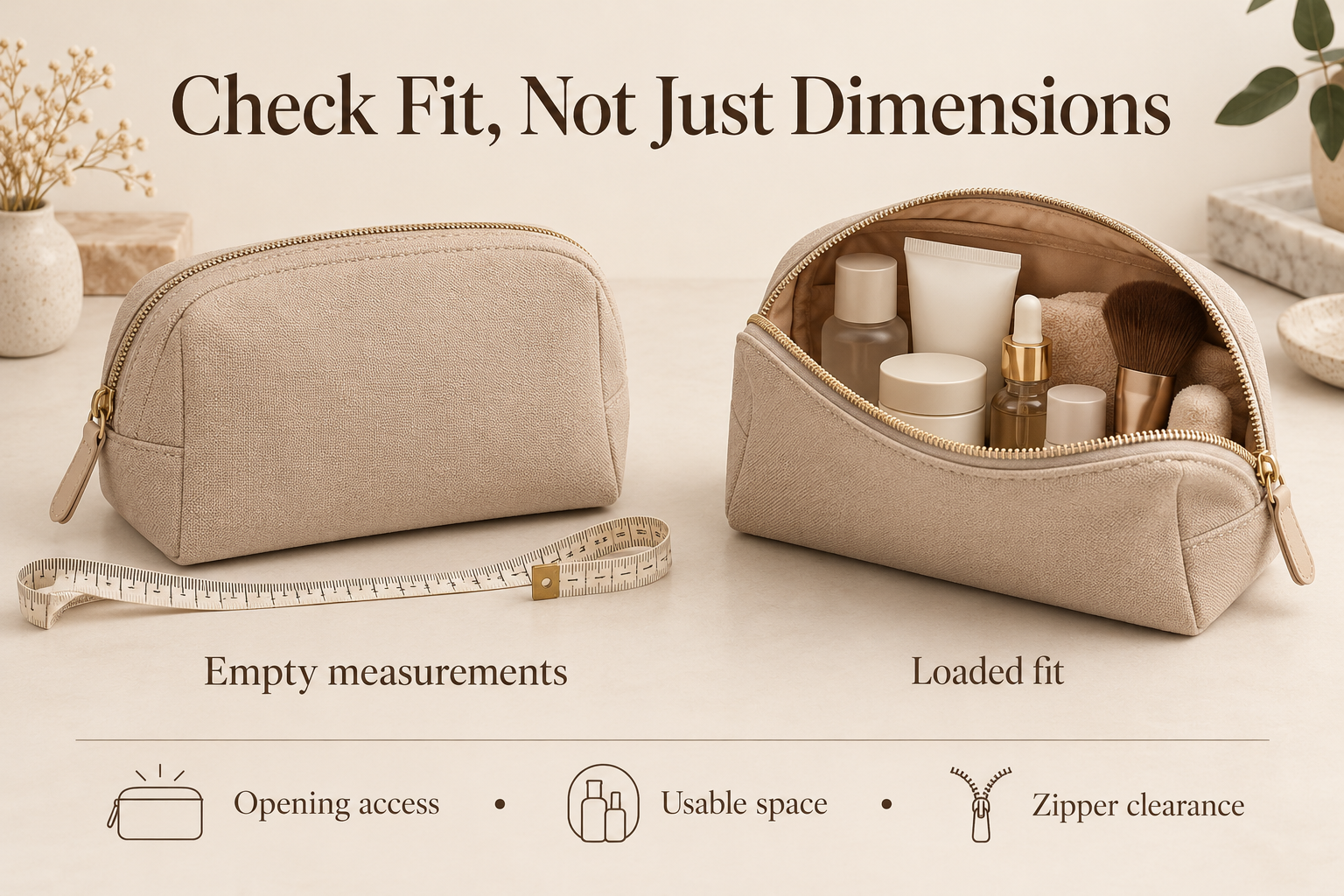
Measure the sample using an agreed method, then check it with the intended contents. External dimensions alone do not establish usable capacity or convenient access.
Specify whether measurements describe the empty bag, a flattened pouch or an assembled structure. Identify the measurement points and agree tolerances before judging a result. Stretching a soft bag while measuring can produce a different result from measuring it without tension.
Load the actual product containers, brushes or retail set where available. Check whether the opening allows insertion and removal, whether pockets remain usable, and whether the zipper closes without forcing the bag into shape.
Manufacturing insight: Lining, padding, seam allowances and internal bindings occupy space inside a sewn bag. A bag can match its external dimensions yet have insufficient clearance around a bottle cap or brush handle.
For example, a structured case may hold its contents when open but press against them when the lid closes. That is a fit issue even if the empty case looks correct.
Buyer action: Photograph the loaded arrangement and record the contents used. Match the evaluation to the intended format: a brush organizer, flat pouch and structured case have different functional priorities within the cosmetic bag collection.
How Do I Verify Materials, Color and Construction?
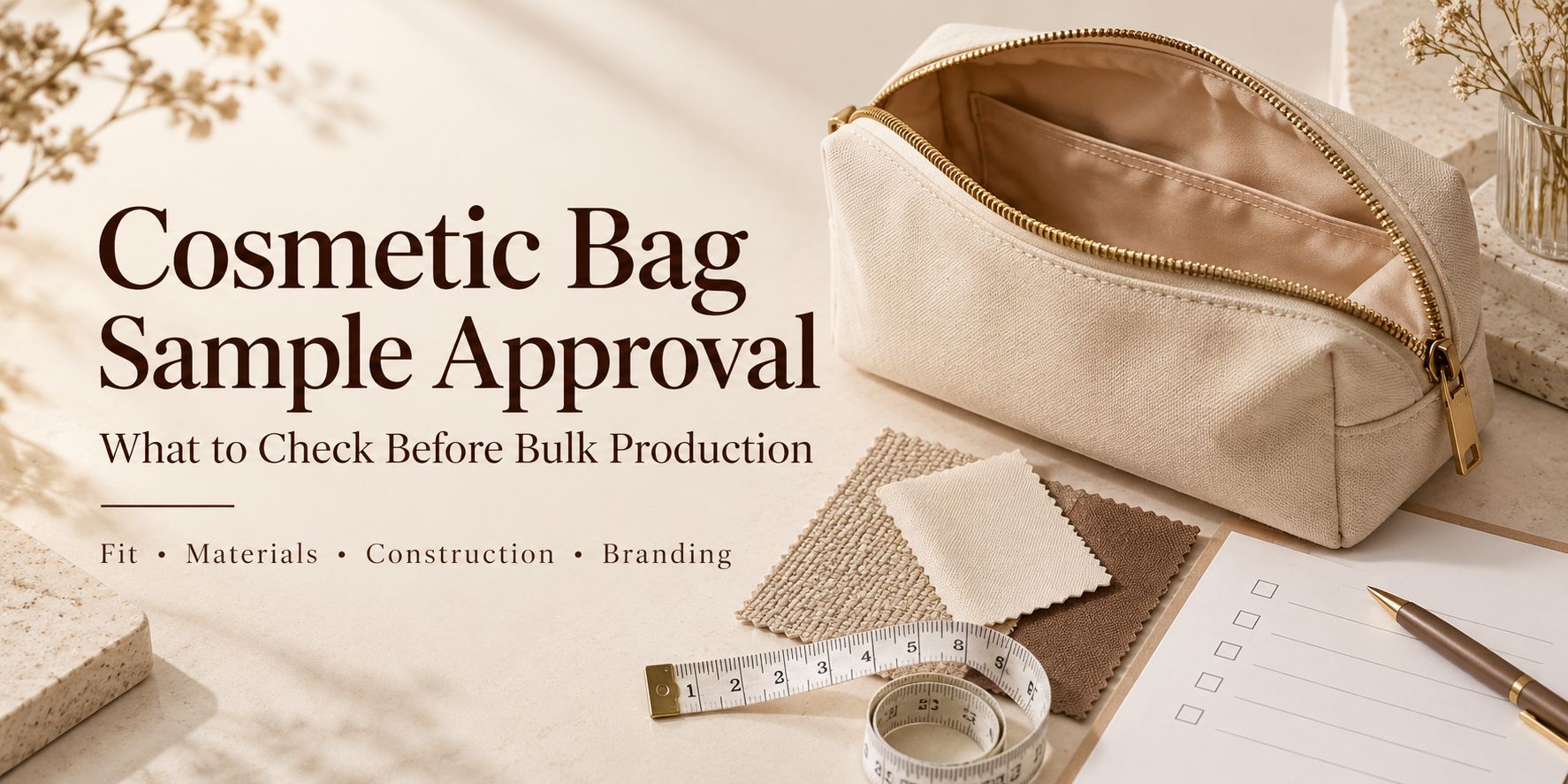
Compare the sample with identified material references and inspect how its components work together. A similar appearance does not establish that the shell, lining or trims match the ordered specification.
Confirm material composition and the specified finish, backing, thickness or weight where relevant. Compare color and texture with approved physical references under consistent viewing conditions. Screen images are useful for communication but should not be the sole reference for a color-sensitive project.
Inspect accessible seams, zipper ends, pocket attachments and handle connections. Look for skipped stitches, open seams, trapped lining, exposed rough edges and attachment points that distort during normal intended use.
Manufacturing insight: Changing material stiffness can affect how a curved seam turns, how the opening sits and how the finished bag holds its shape. Approval of a pattern in substitute fabric therefore may not resolve construction behavior in the final material.
For example, a lining that looks tidy while the pouch is empty may move into the zipper path after the pouch is filled. Record the condition that causes the problem, rather than describing the zipper only as “not smooth.”
Buyer action: Link each finding to a component, photograph and required correction. Ask for confirmation that the corrected material or construction will be used in production.
What Should I Check About the Logo and Packaging?
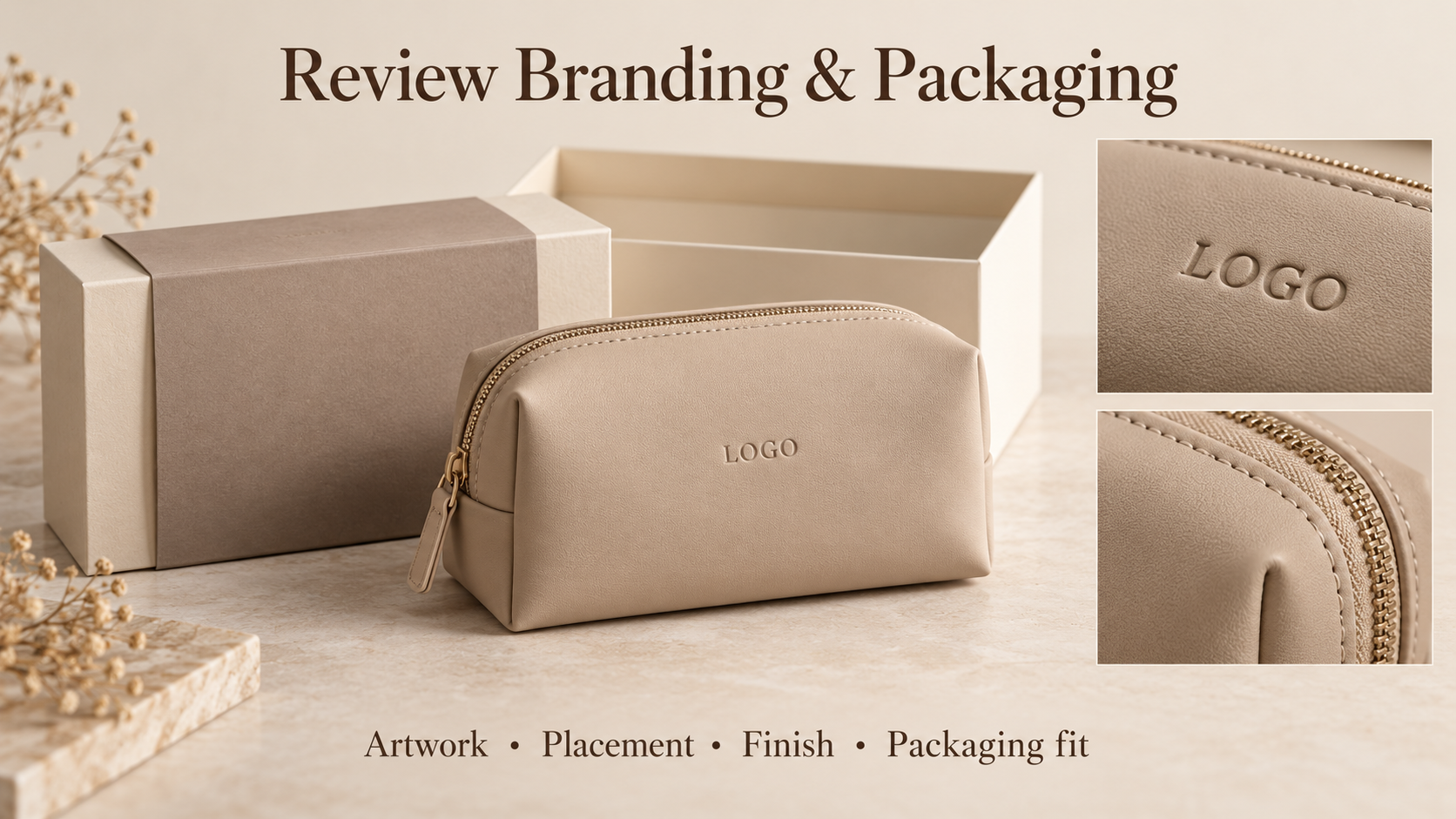
Check the logo against the approved artwork and assess the bag in its intended packaging. Branding approval should cover execution and placement, not simply whether the correct name appears.
Confirm spelling, artwork revision, size, orientation, color and location relative to finished seams or other agreed reference points. Inspect the result on the assembled bag because folds, curves and panel tension can change the visual alignment.
For embroidery, inspect the reverse side and its interaction with the lining. For printing, transfer or foil decoration, inspect edge definition and any visible lifting or transfer. These observations can identify defects but do not replace an agreed durability test.
Packaging should fit without avoidable compression or rubbing against decorated surfaces. Check labels, SKU identification, packing orientation and any barcode requirements against the approved files and receiving process.
For example, a belly band may sit correctly on an empty pouch but cover the logo when the pouch is packed with its intended contents.
Buyer action: Approve the bag and packaging together in their intended packed condition. Record any packaging element that remains a mockup.
What Evidence Is Needed Beyond a Visual Sample Check?
Request additional evidence for requirements that appearance and ordinary handling cannot establish. The necessary evidence depends on the material, intended use, destination market and claims made about the finished product.
Opening a zipper and checking a seam are useful functional observations. They do not establish long-term durability, chemical compliance, waterproof performance or the validity of a recycled-content claim. Match each such requirement to an appropriate verification method and responsible party.
When a test report is relevant, check whether it identifies the material or product being supplied, the tested characteristic and the applicable method. A report for an unrelated fabric should not be treated as evidence for the entire finished bag.
Sample approval also differs from production-lot inspection. ASQ’s explanation of quality sampling describes drawing conclusions about a population or lot from samples taken from it. A development sample made before bulk production is not a sample drawn from that future lot.
Buyer action: Keep outstanding test requirements visible and agree the bulk inspection plan separately. The cosmetic bag quality control guide provides broader context for production-stage checks.
Should I Approve, Request Changes or Hold the Sample?
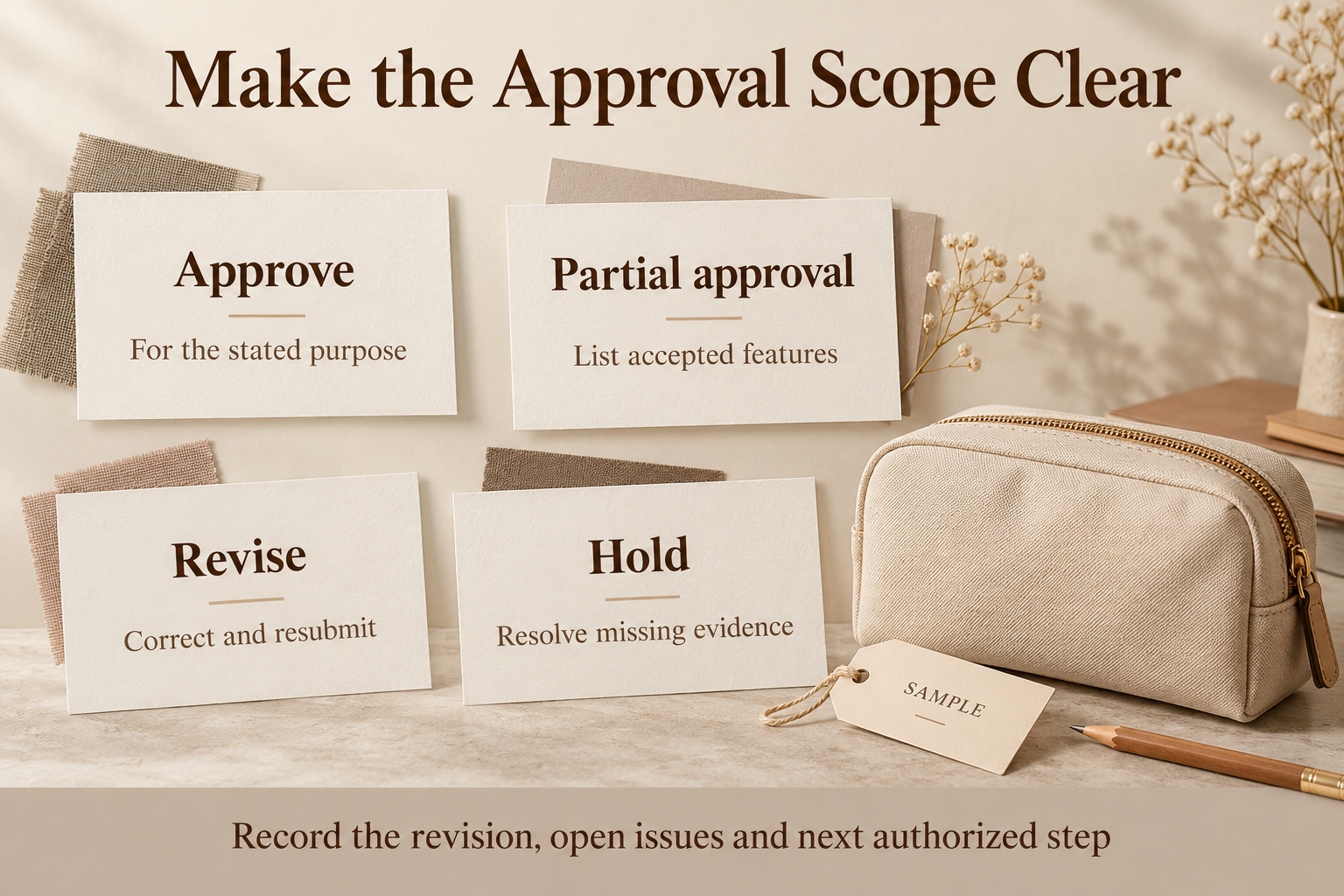
Choose the decision that matches the evidence, then state what work is authorized. Avoid an unexplained “approved with comments,” because purchasing, production and QC may interpret it differently.
| Decision | Appropriate situation | Required instruction |
|---|---|---|
| Approve for the stated purpose | The applicable requirements have been verified. | Identify the reference revision and explicitly authorize the next step. |
| Approve specific features only | Some details are accepted while others remain provisional. | List accepted features and prohibit unapproved work from proceeding. |
| Revise and resubmit | A fit, construction or appearance issue needs correction. | Define the correction and the evidence needed for reapproval. |
| Hold pending evidence | An essential material, test or specification question remains unresolved. | Identify the missing evidence, its owner and the release condition. |
What should the approval record contain?
- Product or style identifier, sample revision and review date.
- The specification and artwork versions used for comparison.
- Material references and all disclosed substitutions.
- Inspection findings, photographs and relevant test evidence.
- Accepted features, required corrections and unresolved items.
- The person responsible for each outstanding action.
- The next step authorized and any restriction on bulk production.
Retain the identified sample and ask the supplier to retain an agreed matching reference. Resolve conflicts between the physical sample and written specification before release, rather than assuming one automatically takes priority.
Buyer action: Request written acknowledgment of the approval record. If another sample is required, confirm its purpose and dependencies using the guide to cosmetic bag sample timing.
Example Scenario: A Good-Looking Sample That Is Not Ready
This is a hypothetical sourcing scenario, not a reported customer project.
A private label beauty brand receives a cosmetic pouch with an acceptable exterior color and correctly positioned logo. During a loaded check, the intended skincare containers push the lining toward the zipper, making closure difficult.
The supplier also confirms that the sample uses a temporary lining. The buyer therefore cannot treat the sample as evidence that the proposed production lining will solve the problem.
The appropriate response is to record acceptance of the reviewed exterior details, request a revised sample with the intended lining and construction, and repeat the loaded closure check. Bulk production remains on hold until the relevant release conditions are met.
The lesson is to separate acceptable features from unresolved function. A favorable overall impression should not conceal a specific issue that affects everyday use.
Buyer Checklist Before Sample Approval
- Identify the sample: Record its purpose, revision and matching specification.
- Confirm substitutions: List every material, trim or packaging item that is not final.
- Measure consistently: Use agreed measurement points, conditions and tolerances.
- Check actual use: Load the intended contents and assess access, pockets and closure.
- Review construction: Inspect seams, lining, zipper attachment and relevant stress points.
- Verify branding and packing: Compare artwork and examine the intended packed presentation.
- Resolve evidence gaps: Identify any required testing or documentation still outstanding.
- Record the decision: State accepted features, corrections, ownership and production permission.
- Retain references: Keep the sample, photographs and approved documents accessible to QC.
Frequently Asked Questions
Can I approve a cosmetic bag sample using photographs alone?
Photographs can support approval of visible details, but they are usually insufficient for a complete functional review. They cannot reliably convey material feel, loaded capacity, zipper resistance or internal construction. If remote approval is necessary, identify its limited scope and request suitable supporting evidence. Reserve physical review for features that cannot be evaluated adequately through images or video.
Does every color need a separate finished sample?
Not automatically, but each color variation needs an appropriate approval method. A shared construction sample may resolve shape, while physical swatches or decorated panels address color-specific questions. Different coatings, fabrics or logo contrasts can introduce additional risks. Agree which variations need finished samples and which can be assessed through component references, and record what each reference actually approves.
What is a golden sample?
A golden sample is a term often used for an agreed physical reference against which later goods are compared. The term alone does not define tolerances, testing requirements or production permission. Identify the sample and link it to the approved specification. If any feature remains provisional, document that limitation so the reference does not become an accidental standard for an unwanted detail.
Who should pay for a revised sample?
Responsibility should follow the agreed commercial terms and the reason for the revision. A buyer-requested design change differs from correcting a sample that does not match the confirmed specification. Document the discrepancy or change before requesting another sample, then confirm any fee, shipping charge and schedule effect. Do not assume revisions are automatically free or automatically chargeable.
What if the supplier changes a material after approval?
The proposed substitution should be reviewed before it is used in production. Ask what is changing and which approved characteristics could be affected, including appearance, fit, decoration and performance. Determine whether component evidence is sufficient or a revised finished sample is needed. Update the specification and approval record so production and inspection teams are working from the same authorized version.
Does sample approval mean the bulk order is ready to start?
Not necessarily. Sample approval establishes only the scope stated in the approval record. The order may still depend on commercial confirmation, material availability, packaging approval, testing or a production slot. Confirm those conditions separately and request an explicit production release process. This prevents an approval message about appearance or fit from being mistaken for authorization to manufacture the entire order.
Accuracy Note
Sample requirements, tolerances, test methods and acceptance criteria must be agreed for the specific product and intended market. Prices, MOQ, sampling arrangements and production lead time can vary with materials, quantities, color splits, logo processes, packaging and current availability. Any certification or regulatory requirement should be checked for its current applicability and scope. Practical sample checks do not replace required laboratory testing or production-lot inspection.
Prepare a Clear Sample Brief
Share your bag specification, intended contents, material references, logo artwork and unresolved sample questions with Bling Accessory Co. Identify which details are already confirmed and which need further development.
Contact Bling Accessory Co. to discuss your sample requirements
Author: Website Operations & Digital Marketing Manager
Last Updated: October 25, 2026