How Do Cosmetic Bag Factories Control Quality Before Shipment?
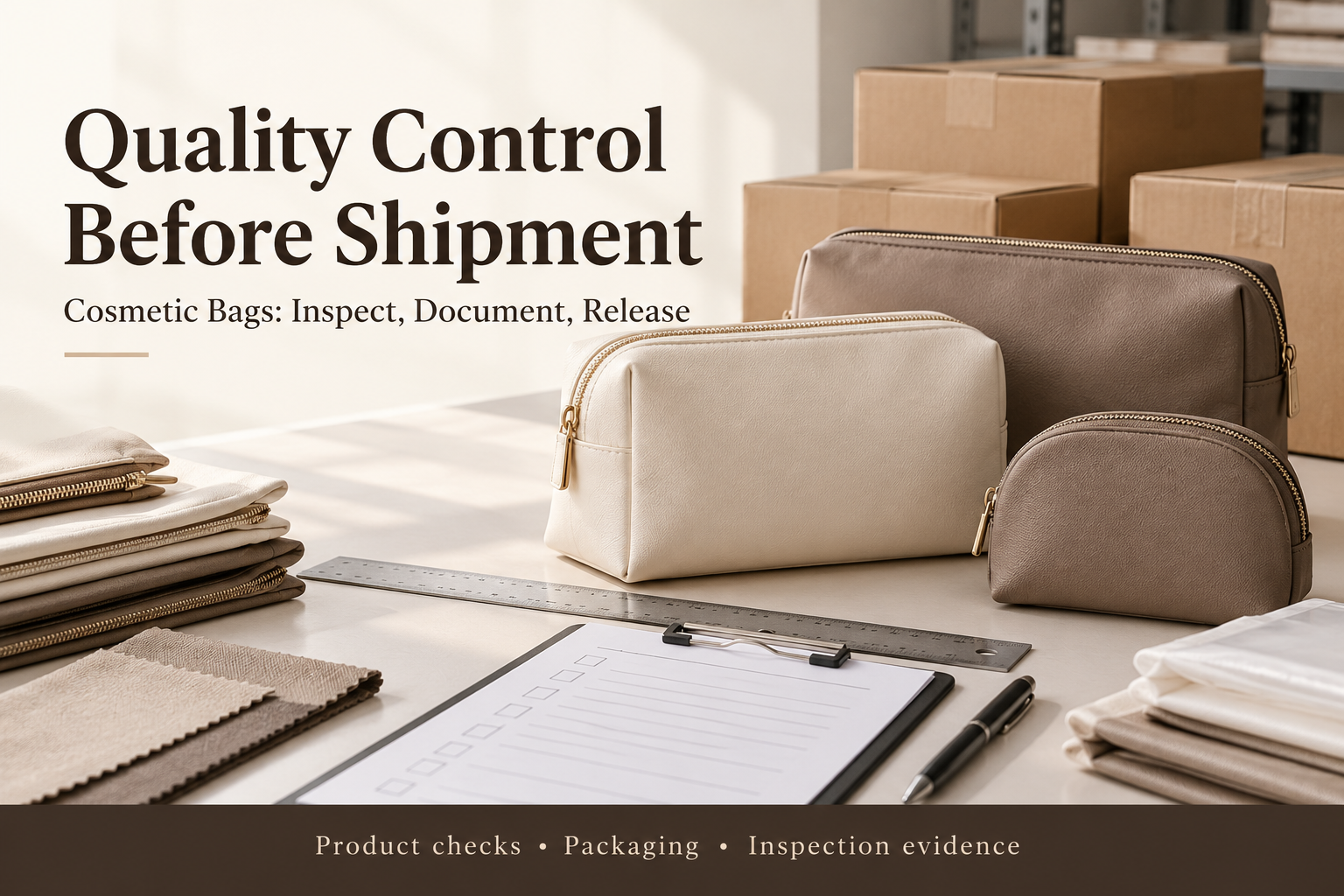
Cosmetic bag factories can control quality before shipment by checking finished goods against approved specifications, recording defects, correcting nonconforming products and verifying packaging before release. The important question for a buyer is not simply whether an inspection happens. It is whether the inspection covers the actual shipment and produces evidence that supports the release decision.
For beauty brands, private label buyers, wholesalers and importers, a good-looking sample does not establish that the completed order is consistent. Different colors, production batches, labels and packing arrangements can introduce problems that were absent during development. This guide explains what a documented pre-shipment process should cover, how to interpret sampling results, what to request in the report and how to handle unresolved issues before goods leave the factory.
<section id="quick-answer" style="margin:28px 0;padding:clamp(20px,3vw,28px);background:#faf5f1;border:1px solid #ead8ca;border-left:5px solid #d09e7d;border-radius:12px;scroll-margin-top:100px;">
  Quick Answer


  A documented pre-shipment quality process checks the identified production lot against the approved sample, specification and packing instructions. It covers appearance, dimensions, stitching, zipper operation, lining, branding, quantities and packaging, with additional tests where required. Inspectors record the sampling method, findings and inspection limitations. Goods that do not meet the agreed criteria should be contained, corrected and rechecked before release. Buyers should review the report and outstanding requirements rather than rely on a general “QC passed” message. A sampling pass supports a lot-acceptance decision; it does not guarantee that every bag is defect-free.
Buyer Snapshot: What Should Be Verified Before Shipment?
| Decision factor | What the buyer needs to confirm | Useful evidence |
|---|---|---|
| Inspection baseline | The correct specification, artwork and reference sample | Document revisions and sample identification |
| Lot readiness | Which finished goods and packed units were available | Quantity and packing-status records |
| Inspection coverage | How cartons, styles and colors were selected | Sampling plan and selection record |
| Product conformity | Appearance, dimensions, construction and function | Measurements, defect counts and photographs |
| Packing accuracy | SKU identity, quantities, labels and protection | Packing-list reconciliation and carton records |
| Open requirements | Tests, corrections or documents still outstanding | Action list with responsible parties |
| Release authority | Who may authorize the identified goods to ship | Written release linked to the inspected lot |
<section id="contents" style="margin:32px 0 40px;padding:24px;border:1px solid #ead8ca;border-radius:12px;scroll-margin-top:100px;">
Table of Contents
- What must be confirmed before final inspection?
- Which product details should be checked?
- How do sampling and AQL work?
- What packaging and quantity checks are needed?
- What should the inspection report include?
- What happens after a failed inspection?
- Example scenario
- Buyer checklist
- Frequently asked questions
What Should Cosmetic Bag Factories Confirm Before Final Inspection?
The factory and inspector should identify the goods being evaluated and the requirements used to judge them. Without that baseline, “passed inspection” does not explain what was accepted.
The inspection pack should include the purchase order, current specification, approved artwork, material references, agreed tolerances and packaging instructions. Any authorized changes after sampling should be included in the same controlled document set.
The approved sample supports comparison, but it does not replace written acceptance criteria. If the reference sample and specification conflict, resolve the difference before inspection rather than asking the inspector to guess which takes priority.
For background on establishing that reference, use the cosmetic bag sample approval checklist.
Readiness also matters. If a color is unfinished or some cartons are unavailable, the report should identify the limitation. Inspecting available stock does not automatically provide evidence about goods completed or added later.
Example: A report covering finished beige pouches should not silently extend to black pouches still awaiting decoration.
Buyer action: Agree the lot definition, completion and packing conditions, inspection scope and release authority before scheduling the visit. Include these requirements in the custom cosmetic bag RFQ and order documents.
Which Product Details Should Inspectors Check?
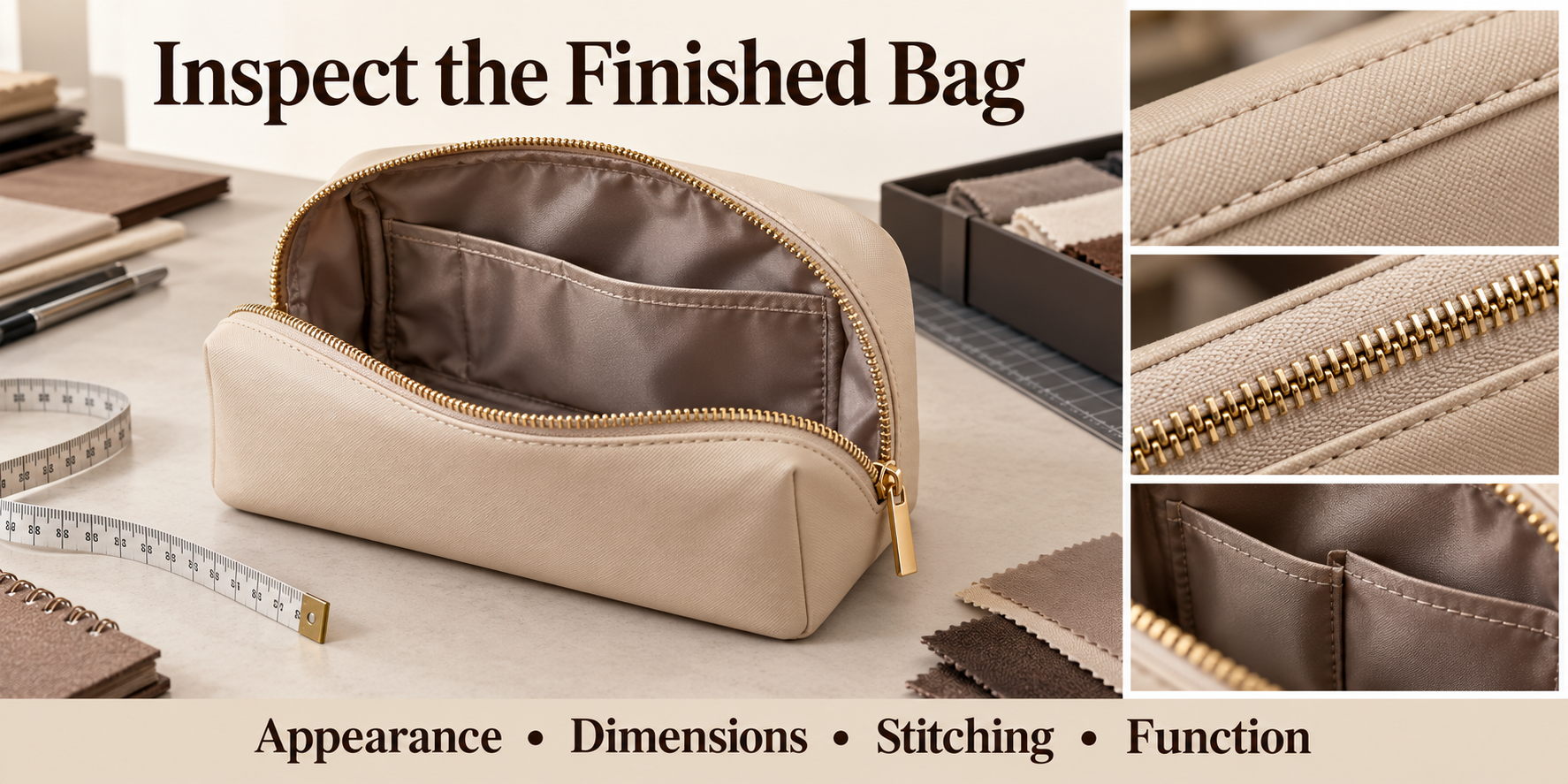
Inspectors should check both visible workmanship and the functions defined in the product specification. The exact checks depend on the bag’s construction, intended contents and performance requirements.
Appearance and dimensions
Compare the shell, lining, color, finish and logo with approved references. Check for stains, scratches, distortion, uneven assembly and other defined appearance defects. Measurements should use agreed points and conditions, with actual results recorded against the specified tolerances.
A soft pouch measured flat is not necessarily comparable with the same pouch measured filled. The report should make the method clear enough for another person to repeat it.
Seams, lining and closure function
Review seam continuity, accessible edge finishing, pocket attachments, zipper ends and relevant reinforcement. Operate the closure under the agreed inspection conditions and note catching, separation or interference from the lining.
Manufacturing insight: A zipper can function correctly as a separate component yet catch after assembly if the lining sits too close to its path. Component acceptance therefore does not replace a finished-bag functional check.
For products designed to hold a particular set, a defined loaded check can reveal insufficient clearance or distorted closure. It should use agreed contents or a suitable reference fixture rather than an improvised load.
Product-specific checks
A clear pouch may need particular attention to surface marks and visibility, while a structured case may require shape and handle checks. Different formats in the cosmetic bag range need inspection criteria matched to their use.
Example: An attractive printed logo may still be misplaced relative to the finished seam. The inspection must compare its actual position with the approved reference, not merely confirm that branding is present.
Buyer action: Specify the method, coverage and acceptance criteria for each important check. Ordinary handling observations should not be presented as proof of long-term durability, chemical compliance or waterproof performance.
How Do Sampling and AQL Affect the Inspection Result?
Sampling supports a decision about an identified lot by checking selected units under an agreed plan. It does not mean every finished bag has been examined.
NIST describes acceptance sampling as using a random sample from a lot to decide its disposition. Its purpose is lot acceptance or rejection, rather than estimating the lot’s exact quality level.
Where an AQL-based system is specified, agree the applicable standard and edition, lot size, inspection level, sampling arrangement, defect categories and acceptance or rejection rules. AQL means Acceptance Quality Limit; an AQL value alone is not a complete inspection instruction.
ASQ’s overview of sampling standards explains that its attributes sampling system includes normal, tightened and reduced plans with switching rules. The appropriate application should be confirmed by a qualified inspection provider.
AQL is not a defect allowance for the shipment. Do not calculate acceptance simply by multiplying an AQL value by the shipment quantity. Use the agreed plan, including its counting rules. A passing result is not permission to knowingly include defective goods.
Define defects before inspection
Agree how critical, major and minor findings are classified for the intended product. A closure that cannot perform its required function may be classified differently from a slight cosmetic variation, but the decision must follow the agreed defect definitions.
Also distinguish the number of defective units from the number of individual defects. A bag can have multiple findings, so the report needs consistent counting rules.
Example: If different colors use different surface finishes, a convenient selection from only the nearest carton may miss relevant variation. Define lot grouping and selection across variants with the inspector.
Buyer action: Request the actual sampling basis, sample sizes and applicable decision limits in the report. Do not accept “AQL checked” as sufficient detail.
What Packaging and Quantity Checks Are Needed?
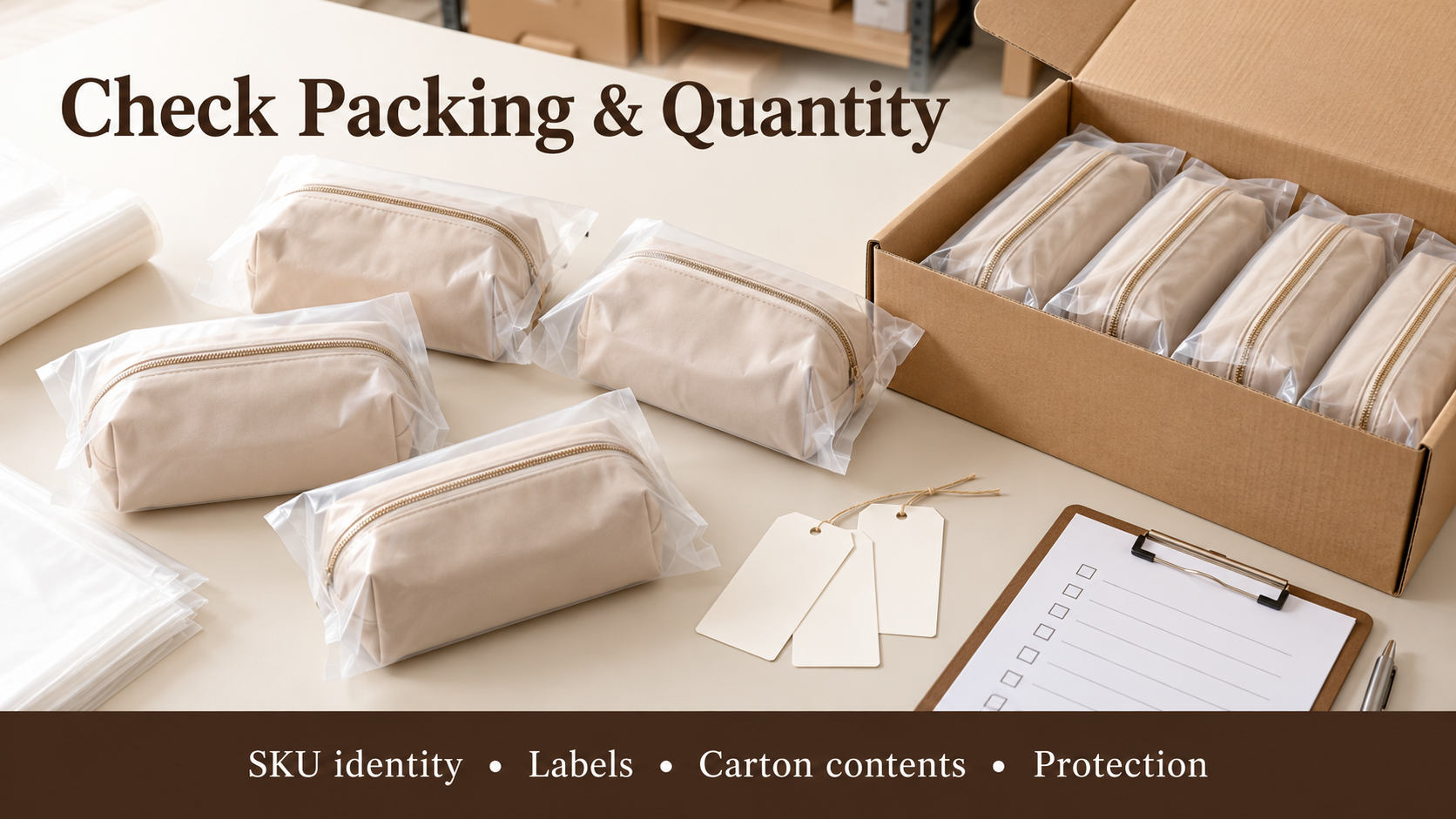
Inspectors should verify that the right products are packed in the right quantities with the required identification and protection. Acceptable bags can still create a shipment problem if labels, assortment or carton contents are wrong.
Compare individual packaging, SKU labels, barcode data, assortment and carton marks with approved instructions. Where scanning is required, confirm that the decoded data matches the intended SKU; a readable barcode containing the wrong information is still incorrect.
The report should distinguish quantities counted directly from quantities inferred through carton counts and packing declarations. Sampled carton checks cannot honestly be described as a complete piece-by-piece count.
Manufacturing insight: Packing can introduce damage after sewing and decoration are complete. Tight folding may distort a structured panel, while contact with hardware or packaging surfaces may mark the finish. Check the bag after unpacking as well as its packed appearance.
Example: The inspected pouch may meet the product specification, but its retail band may hide required identification or place pressure on the logo. Product acceptance does not resolve that packaging issue.
Buyer action: Request packing photographs, carton identifiers and a reconciliation with the packing list. If transit-performance testing is required, specify it separately; a visual carton check does not establish transport protection.
What Should a Pre-Shipment Inspection Report Include?
A useful report makes the inspected scope, findings and limitations traceable to the goods proposed for shipment. A short approval message or a selection of attractive photographs is not an equivalent record.
- Identification: Supplier, inspection location, date, order, styles and lot references.
- Readiness: Quantities finished, packed, available and excluded from inspection.
- Reference documents: Specification, artwork, packaging revisions and approved sample identification.
- Sampling details: Selection method, carton coverage and sample size for each relevant check.
- Results: Measurements, functional findings, defect classifications and counts.
- Evidence: Clear photographs connected to findings and identifiable products.
- Open items: Unperformed tests, missing documents, access limitations and required corrections.
- Conclusion: Inspection result against agreed criteria, separated from shipment authorization.
Different checks may use different sample sizes. For example, appearance review and a destructive test need not cover the same units. The report should state what was actually examined rather than imply that all tests covered the entire inspection sample.
Buyer action: Review the supporting findings before accepting the summary. Connect the report to the broader cosmetic bag quality control plan, including material, production and test records where relevant.
What Happens If the Shipment Fails Inspection?
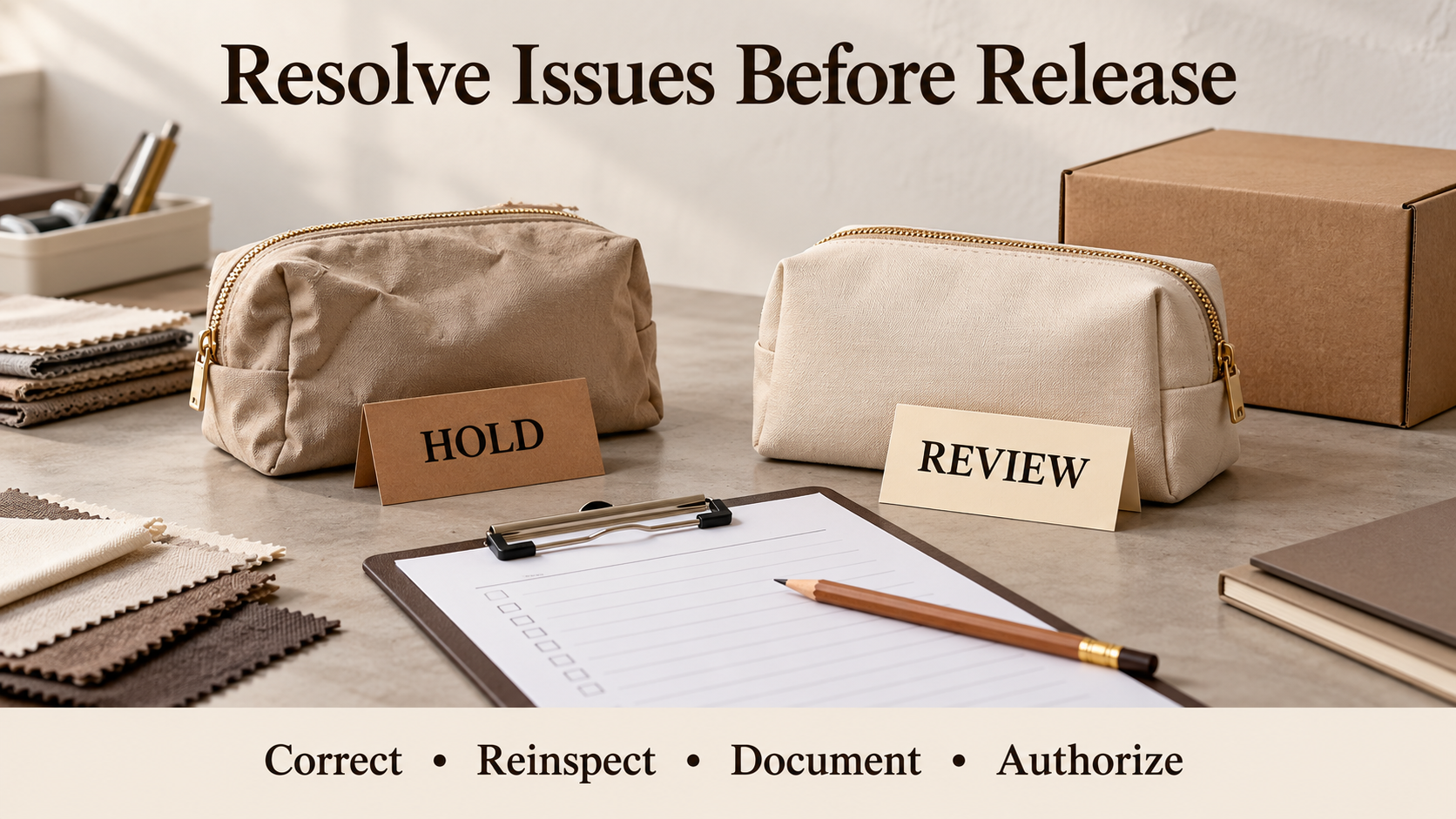
A failed or incomplete inspection should trigger containment and a documented resolution, not an automatic shipment. The affected goods should remain identifiable while the supplier and buyer determine the next action.
| Finding | Appropriate next step | Evidence before release |
|---|---|---|
| Agreed checks pass and required evidence is complete | Submit the identified lot for authorized release | Accepted report and closed outstanding requirements |
| Correctable product defects exceed agreed limits | Hold, define the affected scope, sort or rework, then reinspect | Correction records and acceptable reinspection results |
| Incorrect labels, assortment or packing | Hold affected cartons and correct the packing process | Verified carton contents and revised packing records |
| Goods or required test evidence are unavailable | Record the inspection as limited and keep the relevant release on hold | Completed checks and resolved evidence gaps |
| A safety concern or potentially applicable compliance failure is identified | Segregate the goods and obtain qualified assessment | Documented resolution of applicable requirements |
Correcting the defects found in the sample does not establish that the rest of the lot is acceptable. Investigate whether the same cause affects other units, determine the containment scope and apply an agreed reinspection process.

Reworked goods may also need checks for damage introduced during correction. For example, resewing a lining can resolve zipper interference while creating new stitch marks or affecting the opening.

Buyer action: Require a written disposition that identifies the corrected goods, remaining exclusions and authorized shipment scope. Prevent uninspected replacements or later production from being added under an earlier report without appropriate verification.
<section id="example-scenario" style="margin:0 0 40px;padding:clamp(20px,3vw,28px);background:#faf5f1;border:1px solid #ead8ca;border-radius:12px;scroll-margin-top:100px;">
  Example Scenario: A Zipper Problem Found Before Shipment


This is a hypothetical example, not a reported customer project or inspection result.

A private label buyer receives a report showing that some sampled pouches catch lining fabric during closure. The exterior appearance and logo are acceptable, but the closure findings do not meet the agreed criteria.

The supplier should not simply replace the sampled pieces and describe the order as passed. The next step is to identify the potentially affected production group, hold those goods and investigate the assembly condition causing the interference.

After correction, the relevant goods need verification under the agreed reinspection process. The review should cover closure function and any areas affected by resewing. If cartons were opened or repacked, their identification and contents also need confirmation.

The release decision should follow the completed evidence. A photograph of a corrected pouch alone does not demonstrate that the shipment-wide issue has been resolved.
Buyer Checklist Before Shipment Release
- Confirm the lot: Match order, styles, colors and quantities to the intended shipment.
- Check readiness: Identify unfinished, unpacked or unavailable goods excluded from inspection.
- Verify references: Use the current specification, artwork, approved sample and packing instructions.
- Review sampling: Confirm selection, coverage, counting rules and acceptance criteria.
- Read the findings: Check measurements, functional results and defect evidence.
- Reconcile packaging: Verify SKU data, carton identity, quantities and packing-list consistency.
- Close open issues: Resolve failed checks, missing evidence and required reinspection.
- Control changes: Identify reworked, replaced or subsequently added goods.
- Authorize explicitly: Record who releases which goods and any remaining exclusions.
Frequently Asked Questions
Should I use factory QC or a third-party inspector?
Factory QC and independent inspection can serve complementary purposes. Factory checks support day-to-day production control, while an independent inspection can provide a separate assessment of the identified lot. The appropriate arrangement depends on product risk, supplier history and buyer oversight. Whichever party performs the work, agree the scope, access, methods, reporting and release responsibilities before inspection.
Does checking every bag guarantee a defect-free shipment?
No. Checking every unit for a stated characteristic does not mean every possible defect or performance issue has been tested. Results still depend on the inspection method, conditions and execution. Ask exactly which checks cover every bag and which use sampling. Visual screening, functional checks and laboratory testing address different questions and should not be treated as interchangeable assurances.
Can photographs replace a pre-shipment inspection?
Photographs can support inspection evidence, but they do not establish representative selection or the condition of an entire lot. They may show workmanship and packaging while leaving quantities, measurements and function unverified. If a remote review is used, define its limitations and required supporting records. Do not describe a photo review as an on-site inspection that did not occur.
Does a passing inspection report prove regulatory compliance?
No. A report establishes only the checks and evidence within its stated scope. Visual appearance and ordinary functional checks cannot establish chemical composition or every applicable market requirement. Review relevant test reports and documentation separately, checking their connection to the supplied product. Required compliance evidence should remain a release condition where applicable, even when workmanship inspection is satisfactory.
When should I book the final inspection?
Book it against agreed production and packing readiness conditions, with time available to resolve findings before dispatch. Confirm the expected completion status, inspector access and document availability in advance. There is no universal timing rule suitable for every project. An inspection conducted too early may exclude relevant goods, while one arranged immediately before collection may leave insufficient time for correction.
Can part of an order ship while another part is on hold?
A partial release may be possible if the accepted goods are clearly separated, independently covered by adequate evidence and compatible with the order’s delivery requirements. Identify the released styles, quantities and cartons in writing. Update the packing list and prevent held goods from being mixed into the shipment. If traceability is inadequate, the proposed partial release needs further verification.
<section id="accuracy-note" style="margin:0 0 32px;padding:22px;border:1px solid #ead8ca;border-radius:12px;scroll-margin-top:100px;">
  Accuracy Note


  This guide describes a buyer-facing inspection framework, not a statement that every factory follows the same procedure. Inspection coverage, sampling plans, tolerances, defect classifications and tests must be agreed for the actual product and order. Prices, MOQ and lead times require current project confirmation. Certification and regulatory requirements depend on the materials, intended use and destination market. A passing inspection does not remove the need to resolve applicable testing or documentation requirements.
<section id="next-step" style="margin:0 0 30px;padding:clamp(22px,4vw,36px);background:#faf5f1;border:1px solid #ead8ca;border-top:5px solid #d09e7d;border-radius:12px;scroll-margin-top:100px;">
Define Your Inspection Requirements Before Production
Share your cosmetic bag specification, approved references, order quantities, destination market and packaging requirements with Bling Accessory Co. Include the checks and documentation you need before authorizing shipment.
Author: Website Operations & Digital Marketing Manager
Last Updated: November 2, 2026