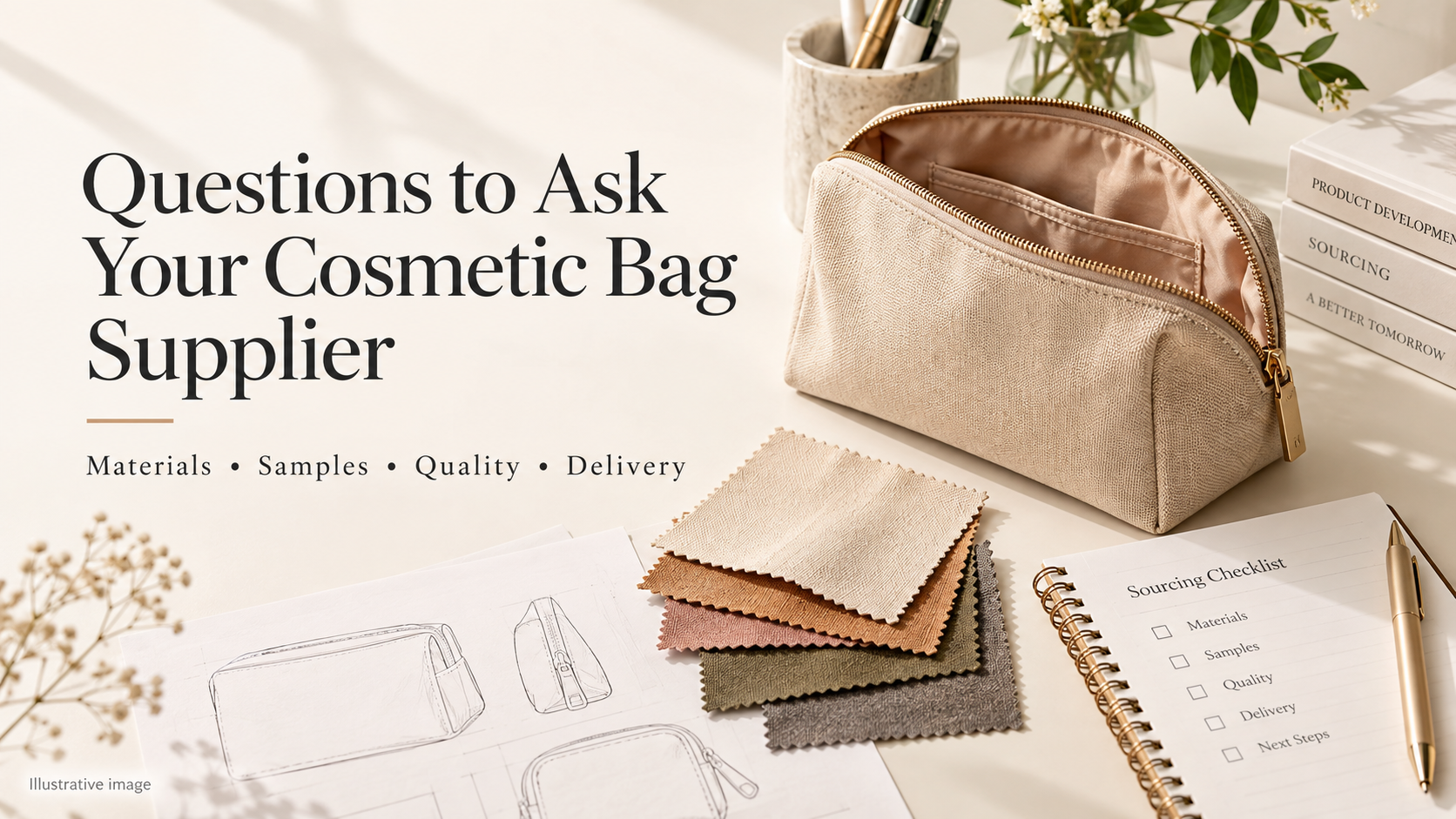
What Questions Should I Ask Before Choosing a Cosmetic Bag Supplier?
Before choosing a cosmetic bag supplier, ask questions that reveal whether its proposed product, production process, and commercial terms fit your project. A useful answer should explain what is included, what remains uncertain, and what evidence or approval will resolve that uncertainty. A quick quotation alone cannot establish those details.
This guide is for beauty brands, skincare companies, private label businesses, retailers, wholesalers, and sourcing teams comparing OEM or ODM partners. It turns common supplier questions into practical evaluation steps, covering materials, MOQ, samples, logo methods, pricing, quality control, packaging, and delivery. You will learn what a workable answer looks like, which follow-up questions matter, and what to confirm before progressing from an initial conversation to sample development or an order.
Quick Answer
Before choosing a cosmetic bag supplier, ask who will manufacture the bag, which materials and components are quoted, what determines MOQ, how samples are approved, and what the price includes. Confirm the production schedule, inspection criteria, packaging responsibilities, and process for handling defects or changes. Ask for supporting specifications, relevant samples, and written terms rather than relying on general promises. Compare suppliers using the same product brief. A suitable partner should explain limitations, identify unresolved requirements, and document how your approved design will become a repeatable production order.
Buyer Snapshot: What Should You Establish?
| Decision factor | What the answer should establish |
|---|---|
| Project fit | Relevant construction capability and a clear manufacturing role. |
| Product definition | Specified materials, components, dimensions, and logo treatment. |
| Order feasibility | MOQ conditions and options that fit the proposed quantity. |
| Sample approval | What the sample represents and which details remain provisional. |
| Commercial scope | Comparable pricing, exclusions, and payment milestones. |
| Production control | Scheduling assumptions, inspection criteria, and change approval. |
| Delivery and continuity | Packaging instructions, issue resolution, and reorder records. |
Table of Contents
- What should I ask a cosmetic bag supplier first?
- Can you make this bag for its intended use?
- Which materials and components are included?
- What sets the MOQ for my configuration?
- How will you confirm the logo method?
- What exactly will the sample approve?
- What is included in the quotation?
- When does the production lead time start?
- How will quality be checked and problems resolved?
- Which documents apply to my product and market?
- How will packaging and reorders be controlled?
- How should I compare the answers?
- Example scenario
- Buyer checklist
- Frequently asked questions
- Discuss your project
What Should I Ask a Cosmetic Bag Supplier First?
Start by asking whether the supplier can support your specific product and who will be responsible for making it. Establish the bag type, intended use, quantity direction, and delivery requirement before discussing detailed customization.
Ask: “Which parts of this project would you produce internally, and which would you source or subcontract?” A manufacturer may use specialist partners, while a trading company may coordinate production. The useful distinction is the disclosed responsibility for development, execution, and corrections.
For example, a supplier might sew the pouch internally but arrange external embroidery. Follow up by asking who approves the embroidered panels and handles rejected work.
Before moving on: record the proposed production arrangement and your main project contact. Prepare a consistent brief using the custom cosmetic bag RFQ checklist so each shortlisted supplier evaluates the same requirements.
Can You Make This Bag for Its Intended Use?
Ask the supplier to explain how its proposed construction supports the way the bag will be filled, carried, opened, and displayed. Similar appearance does not establish equivalent function.
A gift pouch containing boxed skincare products may need a different opening and base shape from a soft makeup pouch sold empty. A brush organizer introduces different questions about internal slots, lining access, and cleaning.
Ask: “Can you assess the fit using our contents or their dimensions?” For example, a bag may have adequate external dimensions but a zipper opening that makes loading the intended box difficult.
The cosmetic bag category can help you identify the style closest to your brief. Then ask the supplier to document the relevant functional checks and explain any construction changes before preparing a sample.
Which Materials and Components Are Included?
Ask for a written description of the outer material, lining, reinforcement, zipper, hardware, and other components included in the proposed bag. A broad label such as “PU” or “polyester” leaves important choices unresolved.
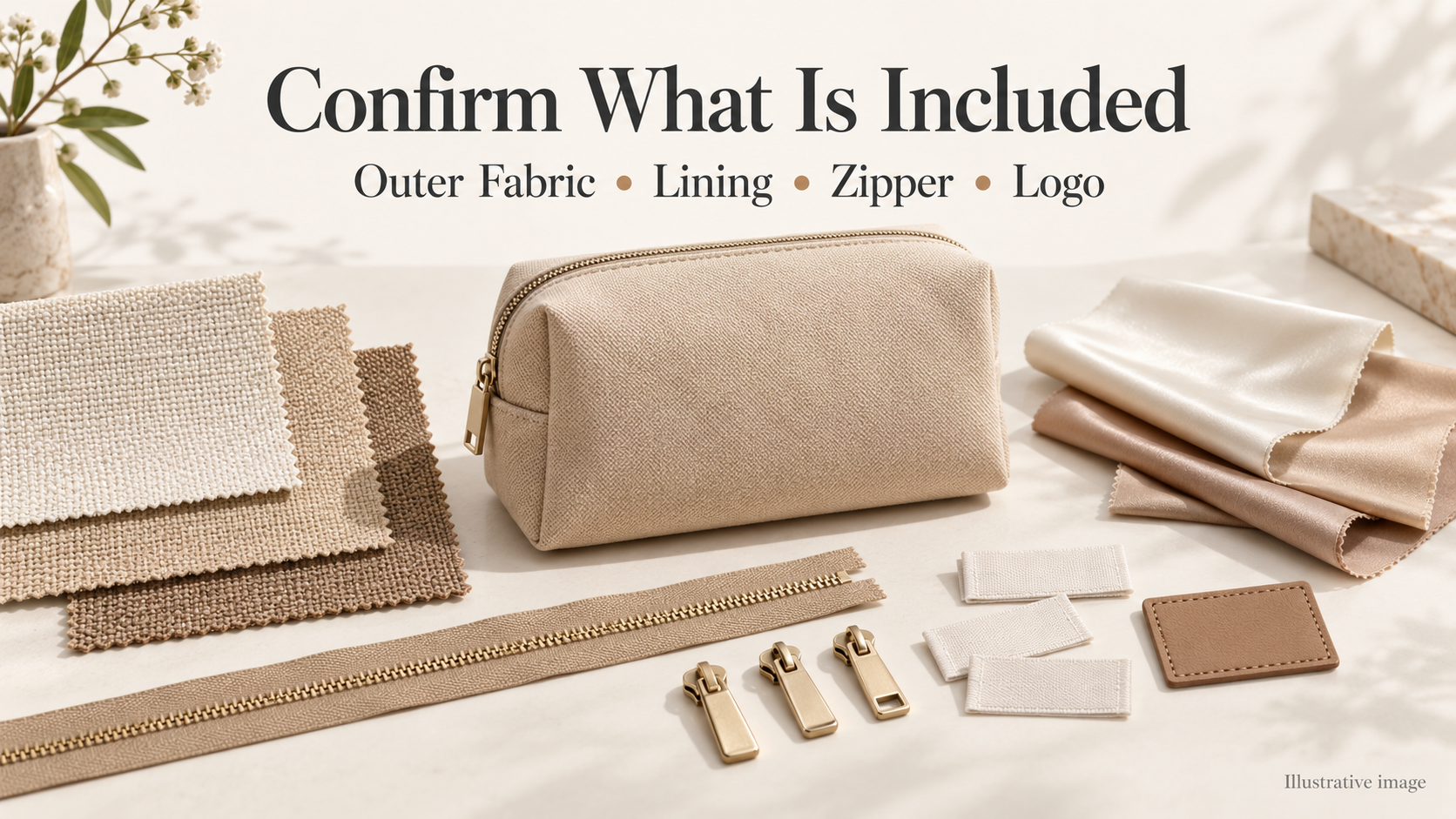
Ask which attributes will be fixed by a material reference or approved swatch. Depending on the construction, relevant details can include backing, finish, thickness, weight, color, or surface texture. Confirm which attributes need measurement and which need a physical reference.
For example, changing the backing of an outer material may change its stiffness and how a corner turns during sewing. A similar color alone does not make the replacement equivalent.
Ask: “What happens if the approved material becomes unavailable?” Require proposed substitutions to be identified for approval before use, with any effect on appearance, performance, cost, or timing explained.
What Sets the MOQ for My Configuration?
Ask what the MOQ applies to and which input creates the minimum. MOQ can vary by material, logo method, color split, custom hardware, and packaging configuration.
The useful question is not simply “Can you lower the MOQ?” Ask: “Would using an available material, standard zipper puller, or simpler packaging change the minimum for this design?” This separates a production constraint from a general sales policy.
For example, the bag assembly quantity may be acceptable while a custom printed lining requires a larger material purchase. Ask whether an available lining resolves the issue and how any unused custom material would be handled.
Before comparing offers: request the applicable minimum per style, color, decoration version, and packaging version. The low MOQ cosmetic bag sourcing guide provides additional context for evaluating those trade-offs.
How Will You Confirm the Logo Method?
Ask the supplier to evaluate your artwork on the proposed material and construction before confirming the decoration method. The technique should suit the surface, desired appearance, placement, and intended use.
Ask: “Will the logo be applied to flat panels or the assembled bag, and how will its final position be checked?” Access and assembly sequence can affect placement. Fine details also need evaluation in the actual process rather than approval from a digital mockup alone.
For example, embroidery on a soft panel may require backing that changes its feel. A printed mark near an edge needs a positioning reference that accounts for the sewn seam.
Request a decoration sample or relevant trial, identify the approved artwork version, and agree on placement and appearance criteria. Ask who owns any buyer-funded tooling and what reuse or storage terms apply.
What Exactly Will the Sample Approve?
Ask whether the sample is intended to approve shape, function, appearance, or the complete production specification. An early development sample may contain temporary materials or components; those differences should be disclosed.
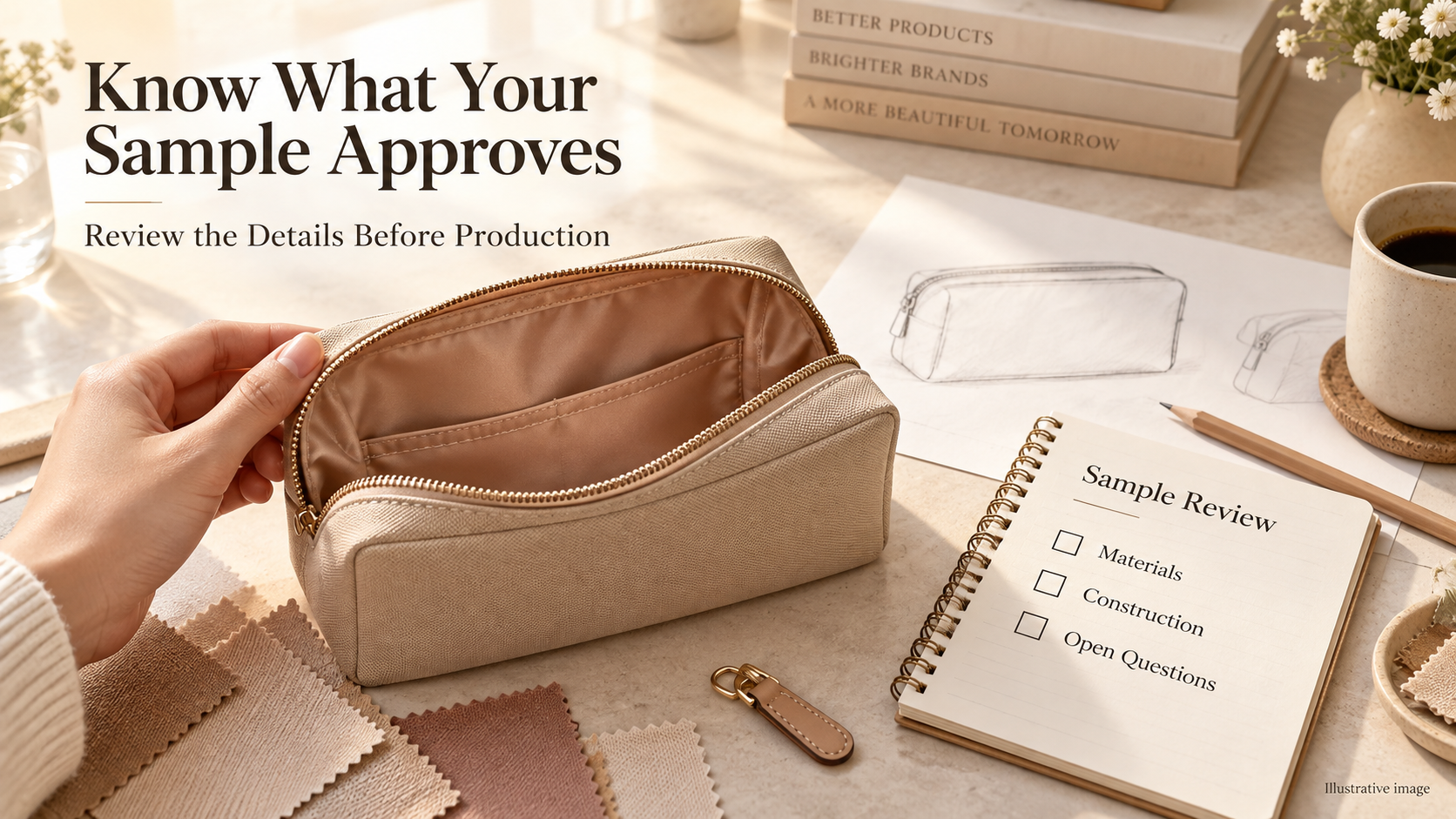
Ask: “Which details will differ from bulk production, how are revisions recorded, and what must be approved before production release?” Also clarify sample charges, the scope of revisions, and what happens when a change affects cost or timing.
For example, a sample made with a stock zipper might demonstrate the opening but not the final branded puller. Approval of the opening should not silently become approval of the substitute hardware.
Before approving: create a dated sample record identifying accepted features and unresolved items. Ask how the production team receives that record and how an obsolete sample or instruction is prevented from being used.
What Is Included in the Quotation?
Ask the supplier to connect its quotation to a specific product version and list the included work and exclusions. A lower unit price is not directly comparable if materials, packaging, inspection, or other requirements differ.
Clarify currency, quantity assumptions, decoration setup, tooling, sampling, labels, individual packaging, cartons, and any separately charged services. Ask which shipping arrangement the quotation assumes and what remains outside the quoted scope.
For example, one proposal may include a retail belly band and barcode application while another covers only the pouch. The difference should be visible before a purchasing decision.
Ask for quote validity and payment milestones in writing, including what changes would require a revised quotation. Use the guide to getting an accurate cosmetic bag quotation when you need to prepare a more complete pricing request.
When Does the Production Lead Time Start?
Ask the supplier to define the starting conditions, production milestones, and expected shipment readiness date. “Lead time” is ambiguous unless both parties understand what starts the clock and what the endpoint means.
Ask whether timing depends on final sample approval, payment, material availability, artwork confirmation, or packaging readiness. Separate production completion from dispatch and arrival at your destination.
For example, sewing may finish while a custom retail box is still awaiting approval. If the order must ship packed in that box, the packaging schedule becomes part of the delivery plan.
Ask which operations depend on external partners and how delays or requested changes will be communicated. Record your required arrival date alongside the supplier's proposed milestones, then identify who will review the schedule when an assumption changes.
How Will Quality Be Checked and Problems Resolved?
Ask for product-specific acceptance criteria and a documented process for identifying, correcting, and reviewing defects. “Strict QC” does not explain what will be checked or what happens when a bag fails.
Discuss dimensions, zipper operation, seam security, lining attachment, logo placement, appearance, cleanliness, and packing accuracy as relevant to the design. If sampling inspection is proposed, ask the inspection provider to explain the plan and its acceptance rules.
For example, a supplier may inspect zipper movement while the bag is empty, but your use case involves a filled pouch. Agree on a suitable functional check using representative contents.
Ask who can stop release, who authorizes rework, and whether corrected goods are reinspected. Clarify the evidence and notification process for problems discovered after arrival, along with the proposed remedy. Do not assume a general quality promise includes a particular refund or replacement arrangement.
Which Documents Apply to My Product and Market?
Ask which documents support the exact claims and requirements relevant to your proposed product. A management-system certificate, a factory assessment, and a product test report serve different purposes.
ISO develops standards but does not issue certification itself. Its certification guidance explains how to verify accredited certification through the relevant bodies or IAF CertSearch. Ask for the certificate holder, scope, covered site, and current status.
For product reports, ask whether the tested sample represents the proposed materials, colors, decoration, and components. For example, adding a printed coating can create questions that a report on undecorated fabric does not answer.
Identify the destination market, intended user, and product claims early. Ask a qualified testing or compliance provider to confirm applicable requirements rather than accepting a broad “compliant” statement as a complete assessment.
How Will Packaging and Reorders Be Controlled?
Ask how the supplier will preserve the approved presentation and specification through packing and future orders. Packaging and reorder control need written references, just as the bag itself does.
Confirm how bags will be folded or supported, which labels and inserts are included, and how product variants are separated and identified. Ask who verifies barcode artwork and packing instructions before release.
For example, compressing a structured pouch for shipment may affect its presentation. Request a packed sample or packing demonstration to check whether the proposed method suits the material and shape.
For reorders, ask which patterns, material references, artwork files, and component details will be retained. Confirm how discontinued inputs or price changes will be reported. An earlier successful order does not remove the need to confirm current materials and production conditions.
How Should I Compare the Answers?
Compare specificity, supporting evidence, and unresolved actions before comparing the supplier's confidence or speed. Use the same brief and record what each supplier has actually committed to.
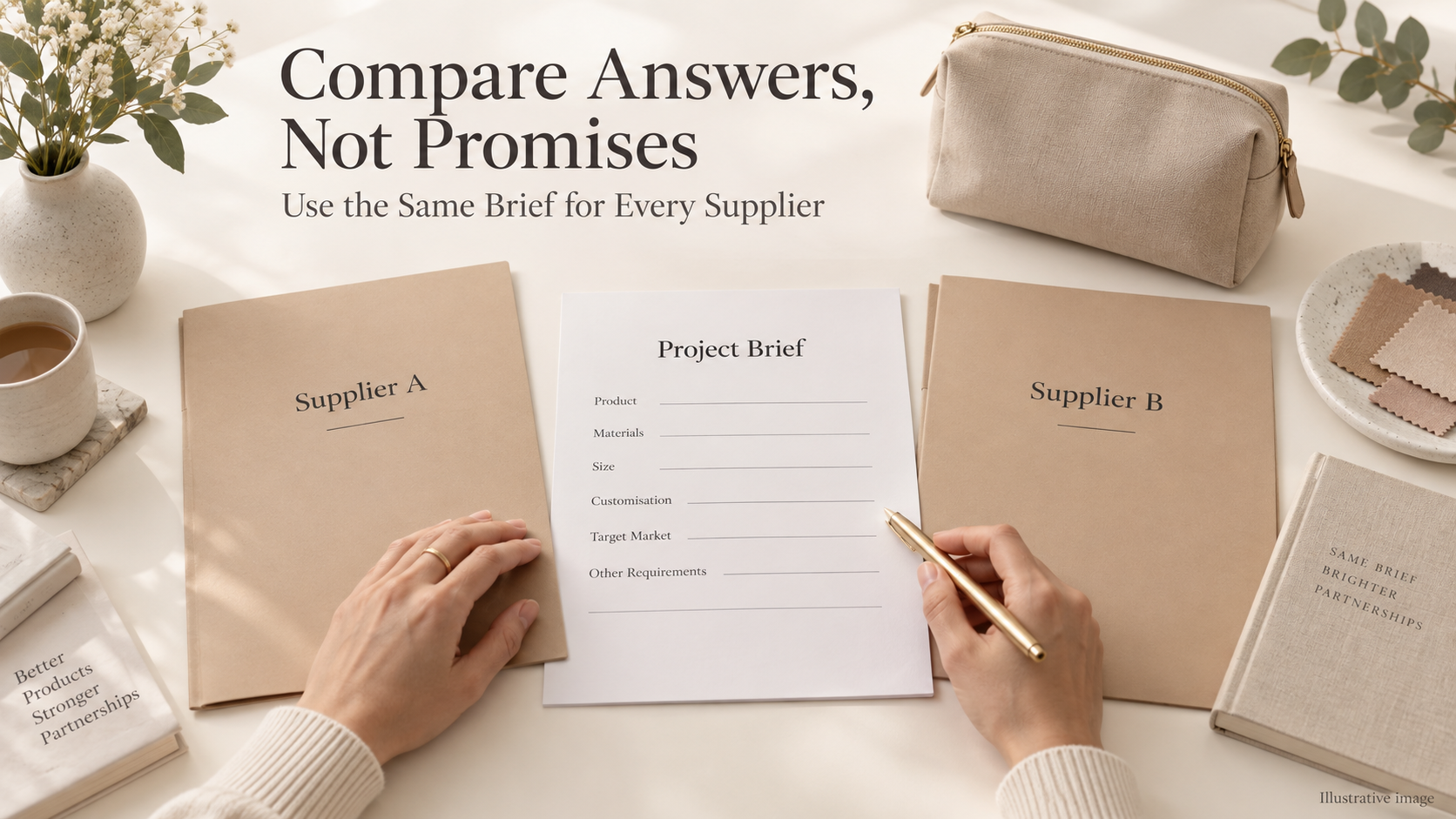
A useful response may be conditional: “We need to test the logo on this surface before confirming it.” That can support a purchasing decision when it identifies the test, responsible person, and next step. An unexplained promise leaves more uncertainty.
| Supplier response | Useful follow-up |
|---|---|
| “We can make anything.” | Ask which construction details need development or external support. |
| “This is our standard material.” | Request its reference, key attributes, and an approval swatch. |
| “MOQ is flexible.” | Ask what minimum applies to the exact color, logo, and packaging configuration. |
| “The sample is almost the same.” | List every proposed difference and the approval needed to close it. |
| “We inspect before shipment.” | Confirm criteria, inspection scope, defect handling, and release responsibility. |
| “Delivery will be fast.” | Request milestones, dependencies, and the meaning of the delivery endpoint. |
Classify each requirement as confirmed, pending evidence, or not suitable for the project. Do not let an attractive price compensate for an unresolved requirement that is essential to product function or launch timing.
Example Scenario: Comparing Proposals for a Skincare Gift Pouch
This is a hypothetical example, not a Bling Accessory Co. customer case. A skincare brand is comparing suppliers for a lined gift pouch with a printed logo and a retail belly band.
One proposal appears less expensive but describes only the outer material and general bag size. Another identifies the lining, packaging, sample assumptions, and points that require approval. The buyer cannot yet conclude that either proposal offers better value.
The buyer asks both suppliers to confirm the zipper opening against the product boxes, identify the quoted lining, and include the same belly band specification. The buyer also asks whether the decoration sample uses the final outer material.
After the responses are aligned, the buyer can compare equivalent scope and remaining risks. The practical lesson is to close differences in assumptions before choosing a supplier on price or apparent confidence.
Buyer Checklist Before Choosing a Supplier
- Send the same product brief and intended-use information to each shortlisted supplier.
- Confirm the manufacturing role, outsourced operations, and responsible contact.
- Record the proposed materials, components, and substitution approval process.
- Confirm MOQ conditions for the complete configuration.
- Define what each sample stage will approve and how revisions will be recorded.
- Compare quotations with the same inclusions, exclusions, and payment milestones.
- Agree on schedule assumptions and product-specific inspection criteria.
- Check relevant documentation and record packaging and reorder requirements.
- Resolve essential open questions before approving the supplier or releasing production.
Keep a decision record showing the requirement, supplier response, supporting evidence, and remaining action. Where an answer is conditional, assign a person and a confirmation point so it does not disappear between quotation, sampling, and production.
Frequently Asked Questions
Can I approach a supplier without a complete technical specification?
Yes. You can begin with reference images, intended use, approximate dimensions, quantity direction, and the products the bag must hold. Ask the supplier to identify the missing decisions and explain which ones affect feasibility or price. Treat any early quotation as conditional until materials, construction, decoration, and packaging have been defined well enough for a meaningful comparison.
Should I reveal my target budget when contacting suppliers?
You can share a budget direction if it helps the supplier assess practical options, but describe the scope that budget is intended to cover. Explain which requirements are essential and which can change. Ask the supplier to identify trade-offs explicitly, so a lower quotation does not result from an unapproved change to lining, hardware, packaging, or inspection scope.
Does a fast reply mean the supplier will manage production well?
No. Response speed is useful for communication, but it does not establish manufacturing capability or production control. Evaluate whether the reply addresses your actual specification, identifies constraints, and assigns follow-up actions. A supplier that needs time to check a material or construction detail may provide a more useful answer than one that immediately agrees without qualification.
What should I ask if the supplier offers an existing ODM design?
Ask which features are fixed, which can change, and how each modification affects sampling, MOQ, cost, and timing. Confirm whether the existing sample uses the same materials and components being offered. Also ask what usage or exclusivity terms apply to the design; selecting an existing style does not automatically mean it will be exclusive to your brand.
Is a small trial order enough to approve a supplier for future production?
A trial order can provide evidence about the configuration and conditions tested, but it does not establish every aspect of future performance. Review the delivered product, communication, documentation, and correction process. For a larger or modified order, reconfirm material availability, production planning, packaging, and inspection requirements rather than assuming the earlier arrangement transfers unchanged.
What should I do if a supplier cannot answer a technical question immediately?
Ask who will review the question and when a supported answer can be provided. Some issues require input from development, production, a component vendor, or a testing provider. The important distinction is whether the supplier follows through with a clear answer or keeps the issue vague. Record the question as unresolved until the relevant evidence or proposal is available.
Accuracy and Project Requirements
MOQ, pricing, sampling arrangements, production lead time, testing, certification, and packaging requirements must be confirmed for the actual material, quantity, product configuration, destination market, and current requirements. The questions in this guide provide a procurement framework; they do not certify a supplier or guarantee an order outcome. Manufacturing considerations should be checked against the proposed construction and production method.
Discuss Your Cosmetic Bag Project with Bling Accessory Co.
Share your reference style, intended use, material preferences, logo artwork, quantity direction, packaging needs, and destination market. Include the questions your team needs resolved, such as sample approval, configuration-specific MOQ, inspection criteria, or production scheduling, so the discussion starts with your actual purchasing requirements.
Author: Website Operations & Digital Marketing Manager.

-300x300.jpg)