How Do I Launch a Private Label Cosmetic Bag From Idea to Bulk Production?
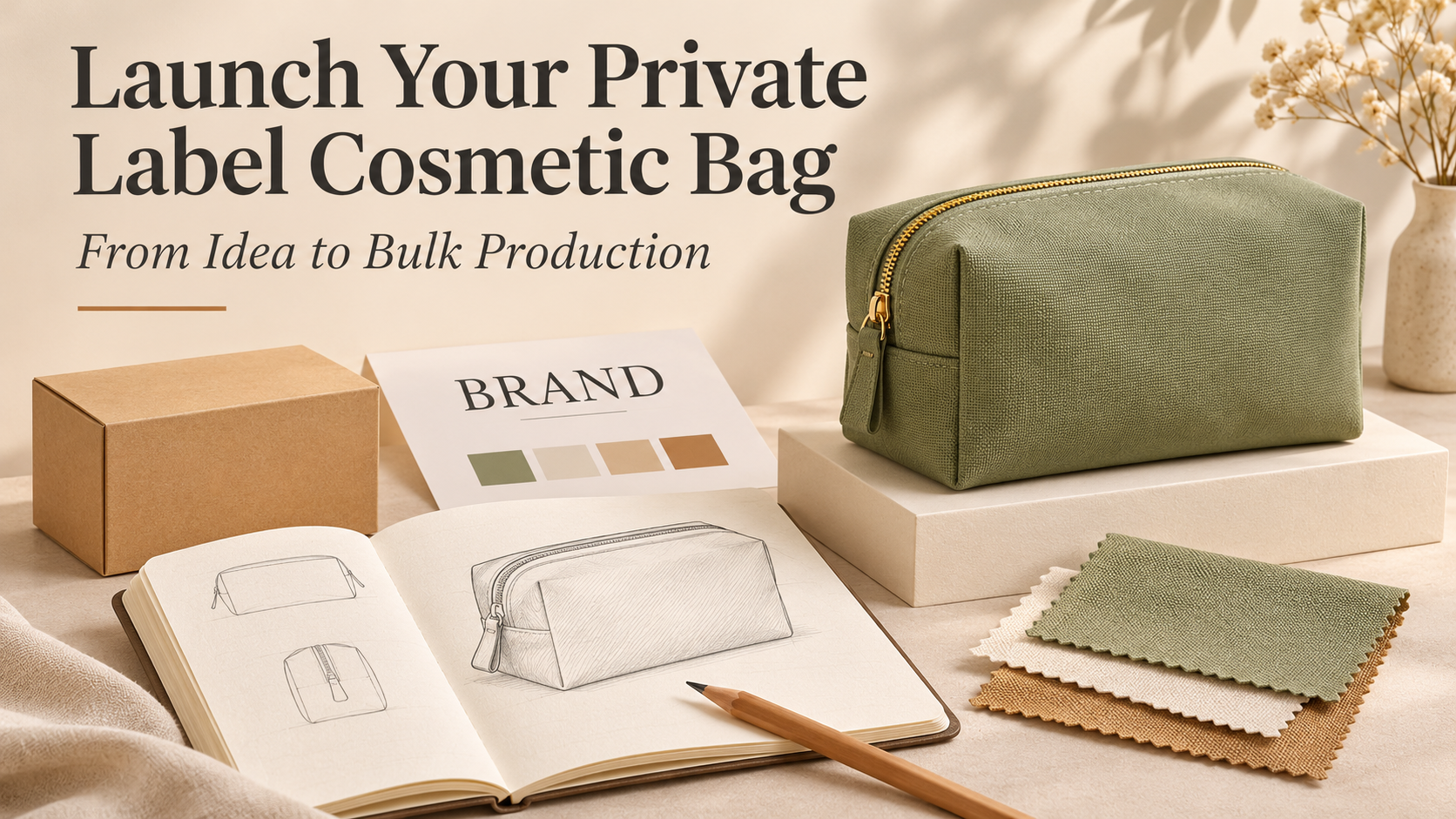
To launch a private label cosmetic bag, define the product’s purpose, agree a manufacturing specification, validate the design through sampling and authorize bulk production only when the essential decisions are closed. Branding is part of the project, but a logo alone does not tell a factory what materials to buy, how the bag should function or how finished goods will be accepted.
For beauty brands, retailers, gift-set businesses and wholesale buyers, the practical challenge is coordinating decisions across product development, purchasing, packaging and logistics. This guide explains the deliverables needed at each stage, the differences between development routes and the approvals that prevent unfinished design choices from reaching the production floor. It also shows how to distinguish a completed manufacturing order from inventory that is actually ready to sell.
Quick Answer
A private label cosmetic bag launch needs a documented brief, an agreed development route, a comparable quotation and samples that resolve the intended use, materials, construction and branding. Finalize packaging and required product information before authorizing the affected purchases or production steps. Release bulk manufacturing against an identified specification, approved references, quantity breakdown and quality plan. During production, require authorization for substitutions and track unresolved issues. Before shipment, review the agreed inspection evidence and delivery arrangements. After receipt, confirm usable inventory and accurate product listings before committing the goods to a customer-facing launch.
Buyer Snapshot: Decisions That Shape the Launch
| Decision | What to establish | Useful deliverable |
|---|---|---|
| Product purpose | Contents, use, customer and sales channel | Product brief |
| Development route | Existing design, modified design or new construction | Written scope of work |
| Commercial commitment | Variant quantities, minimums, charges and exclusions | Itemized quotation |
| Product validation | Fit, construction, materials and logo execution | Sample approval record |
| Packaging readiness | Protection, presentation, labels and packing configuration | Approved packing specification |
| Manufacturing release | Current documents, quality criteria and change authority | Written production authorization |
| Launch readiness | Accepted stock, fulfillment readiness and accurate listings | Receiving and launch checklist |
Table of Contents
- Create the product brief
- Choose a development route
- Select a manufacturer and define the quote
- Resolve the design through sampling
- Approve packaging and product information
- Authorize bulk production
- Control changes and quality
- Plan delivery and launch readiness
- Example scenario
- Buyer checklist
- Frequently asked questions
What Should a Private Label Cosmetic Bag Brief Include?
Describe the customer’s use case and the product requirements before selecting finishes. Private label means the bag is sold under your brand; it does not automatically mean that its construction is exclusive or newly designed.
Identify the intended contents, carrying method, opening access, approximate size, required compartments and expected cleaning method. Add the sales market, retail or gifting format, desired appearance and quantity plan. Mark each requirement as essential, preferred or still undecided.
For example, a pouch used as a beauty gift-set container must fit the actual products and remain presentable when packed. Exterior dimensions alone do not establish whether a tall bottle can pass through the opening.
Buyer action: Prepare a brief with reference images and representative contents or dimensions. Use the cosmetic bag category to identify possible formats, then explain the function your version must deliver.
Should I Customize an Existing Design or Develop a New Bag?
Reuse a suitable design when it meets the brief; commission new construction when an essential requirement cannot be achieved through limited changes. Ask the manufacturer to describe the actual development work rather than relying on an OEM or ODM label alone.
| Route | Suitable starting point | Questions to resolve |
|---|---|---|
| Brand an existing design | The current shape and function already fit the brief | Logo compatibility, available materials and branding limits |
| Modify an existing design | The base is useful but needs defined changes | Pattern changes, component sourcing and renewed fit checks |
| Develop new construction | A distinctive functional layout is necessary | Design responsibility, development stages and ownership terms |
An existing pattern can reduce some development work, but a material change may still alter stiffness, seam behavior or decoration suitability. None of these routes guarantees a particular MOQ or completion date.
For example, replacing a label differs substantially from adding a rigid divider and changing the closure path.
Buyer action: List what will remain unchanged, what must be developed and what each sample is intended to prove. Confirm any exclusivity or design-ownership arrangements explicitly instead of assuming private labeling provides them.
How Do I Select a Manufacturer and Establish the Commercial Scope?
Evaluate technical fit and compare quotations against the same documented requirements. Identify who handles sampling, manufacturing, decoration, QC and communication, including any subcontracted work relevant to the order.
Request a quotation that separates the bag specification, quantities by variant, packaging and development charges. Clarify which costs are included, which remain provisional and which depend on later approval. A unit price is not a complete project budget.
Material purchasing, custom colors, zipper components and printed packaging can impose separate minimums. A factory’s sewing minimum therefore may not describe the full purchasing commitment.
For example, a quote using available fabric cannot be evaluated as equivalent to a quote requiring a specially sourced material unless that difference is visible.
Buyer action: Send each shortlisted supplier the same custom cosmetic bag RFQ checklist. Ask for alternative specifications as separate options, not silent substitutions.
What Should Sampling Resolve Before I Commit to Production?
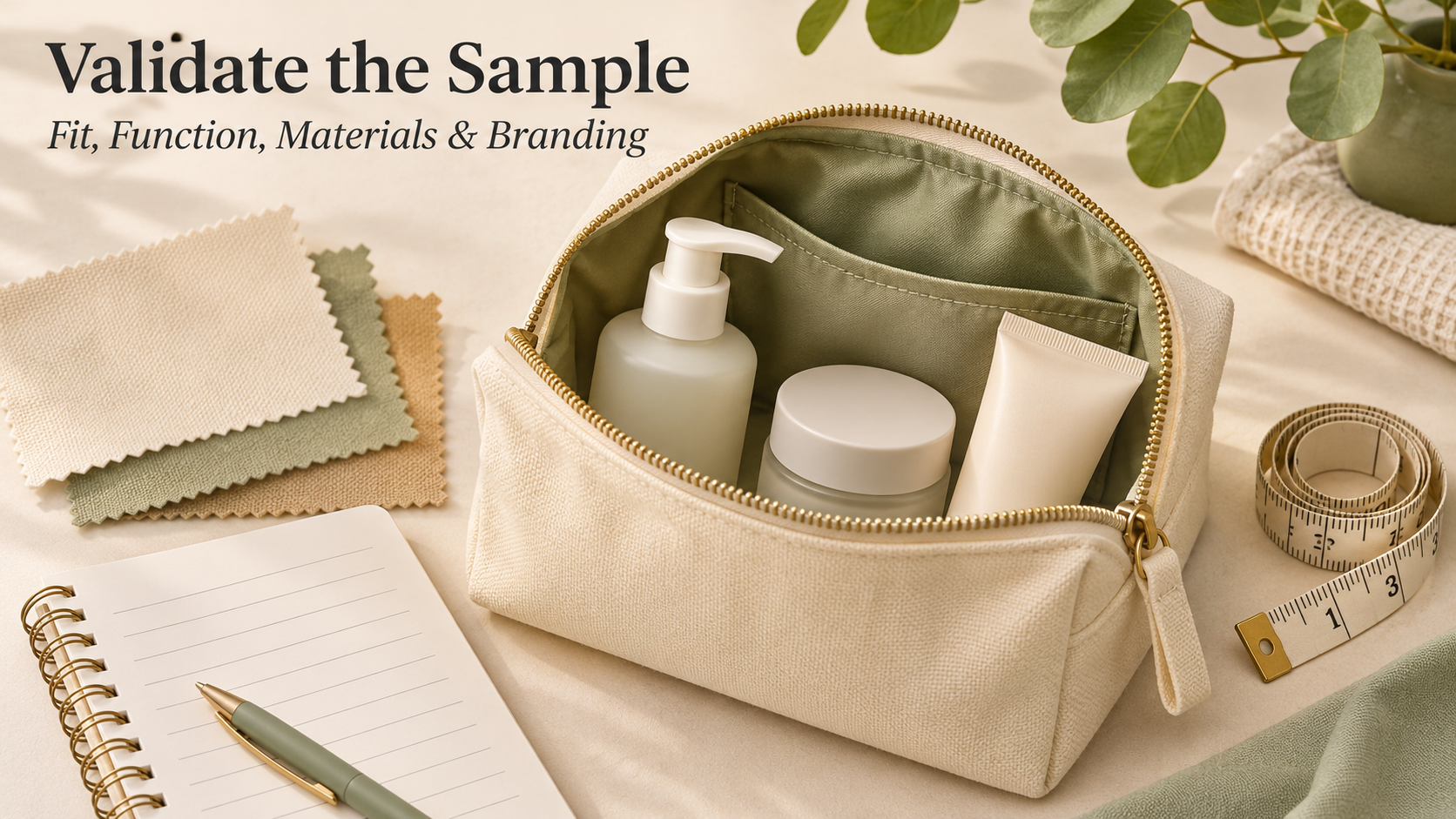
Use sampling to resolve defined questions and approve an identifiable product version. A shape prototype, decoration trial and production-reference sample may serve different purposes; agree those purposes before judging the result.
Check the bag with representative contents. Review opening access, closure operation, lining clearance, pocket usability, material feel and the finished appearance of the logo. Record temporary materials or missing components as limitations rather than assuming they are approved.
Manufacturing Insight: A Material Change Can Reopen the Fit Decision
A thicker shell, lining or reinforcement can change how an assembled pouch folds and how much usable space remains. A softer substitute may also alter its shape when filled. This is why approval should connect the construction to the actual material specification, not just the external silhouette.
For example, if a sample closes comfortably only when empty, review the loaded configuration before approving the pattern.
Buyer action: Consolidate feedback into a single revision record and name the final approver. Use the cosmetic bag sample approval checklist to document accepted features and unresolved items.
When Should I Approve Packaging and Product Information?
Develop packaging during sampling, then confirm final fit against the approved packing configuration before committing to printed materials. Packaging can affect both product appearance and the work needed at fulfillment.
State whether the pouch ships empty, folded, supported or filled with other products. Identify who performs gift-set assembly and who supplies labels, inserts and retail packaging. Confirm the relationship between each variant, its item identifier and its carton marking.
For example, a snug sleeve designed around an empty pouch may not suit a filled gift set. A packing method that looks neat initially may leave unwanted creases after compression.
Product descriptions should also follow the approved specification. Do not turn an unverified material or performance assumption into a retail claim.
Buyer action: Review a packed sample, final artwork and packing instructions together. Assign responsibility for destination-market information and any evidence needed to support product claims.
What Must Be Signed Off Before Bulk Production?
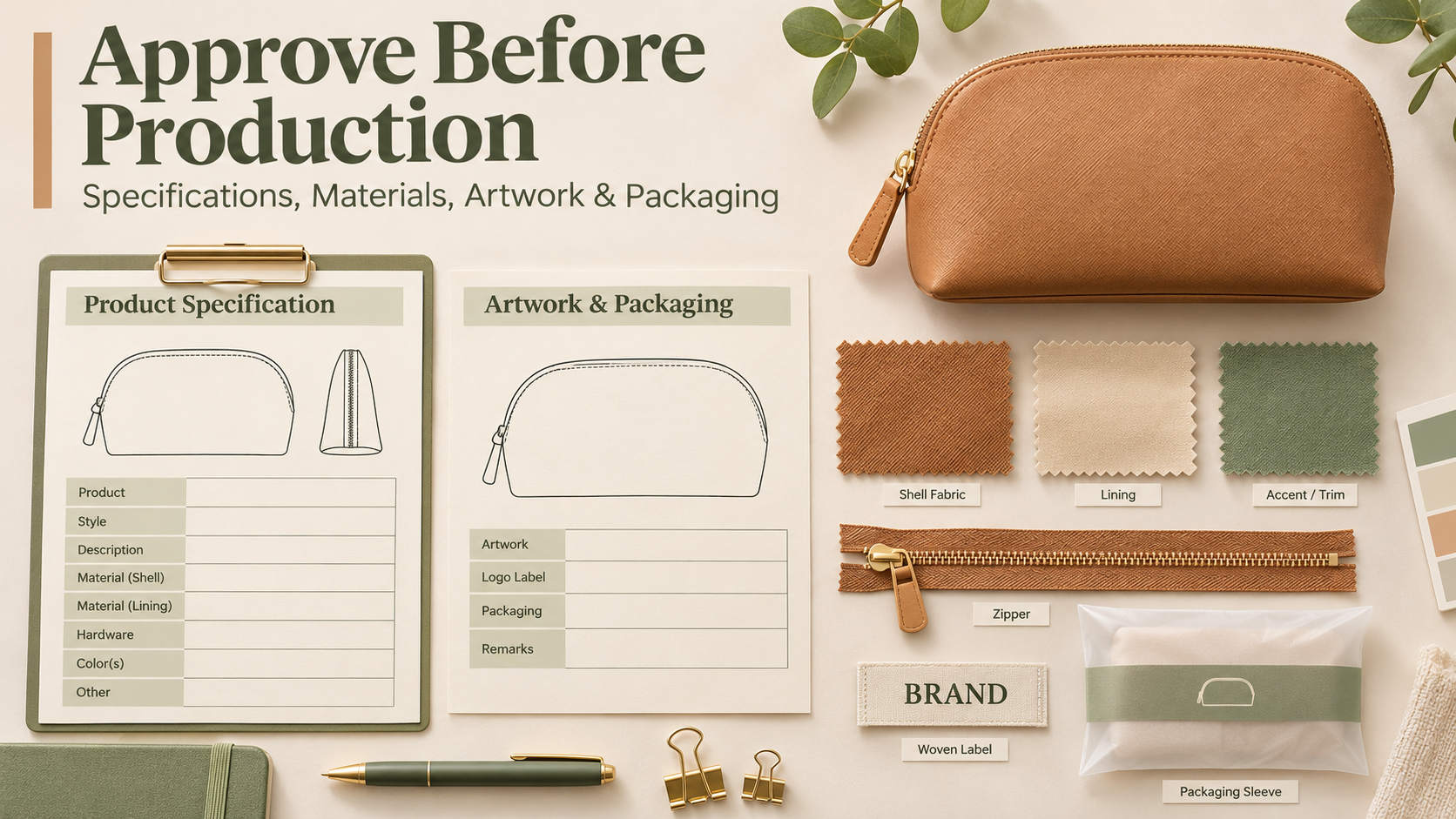
Authorize bulk production only against a consistent set of approved documents and references. Sample acceptance, material purchasing and permission to manufacture are related decisions, but they do not have to occur at the same time.
The production package should identify the current specification, bill of materials, artwork, packaging, variant quantities, inspection criteria and agreed commercial terms. A bill of materials is the component list that connects the design to what must be purchased and assembled.
If the sample and written specification disagree, resolve the conflict before release. Do not leave the production team to choose which reference takes priority.
- Product approval: What version and features are accepted?
- Purchasing approval: Which materials or packaging may be ordered?
- Production approval: Which styles and quantities may enter manufacturing?
- Shipment approval: Who may release the inspected goods for dispatch?
For example, reserving an available fabric may be authorized while final logo approval remains open. That limited permission should not be interpreted as approval to print or assemble the full order.
Buyer action: Issue a dated release stating the scope, document revisions and remaining restrictions. Confirm that the supplier acknowledges the same version.
How Should I Manage Production Changes and Quality Checks?
Agree checkpoints before production and require documented approval for changes that affect the accepted specification. Quality control should examine both incoming components and the assembled product.
Discuss checks for material identity, early production output, decoration, sewing, finished function and packing. Define relevant tolerances, defect criteria, inspection coverage and the response to failed checks with the responsible QC personnel.
A proposed change should identify the affected order, reason, technical impact, cost or schedule implications and required revalidation. “Equivalent material” is insufficient if the properties that matter have not been compared.
For example, changing the shell coating may require renewed logo-adhesion evaluation even when the color appears unchanged.
Buyer action: Maintain a change log and an open-issue list. Before dispatch, use the agreed pre-shipment quality control process to assess the identified goods and resolve findings; sampling does not establish that every unit is defect-free.
How Do I Build a Realistic Delivery and Launch Schedule?
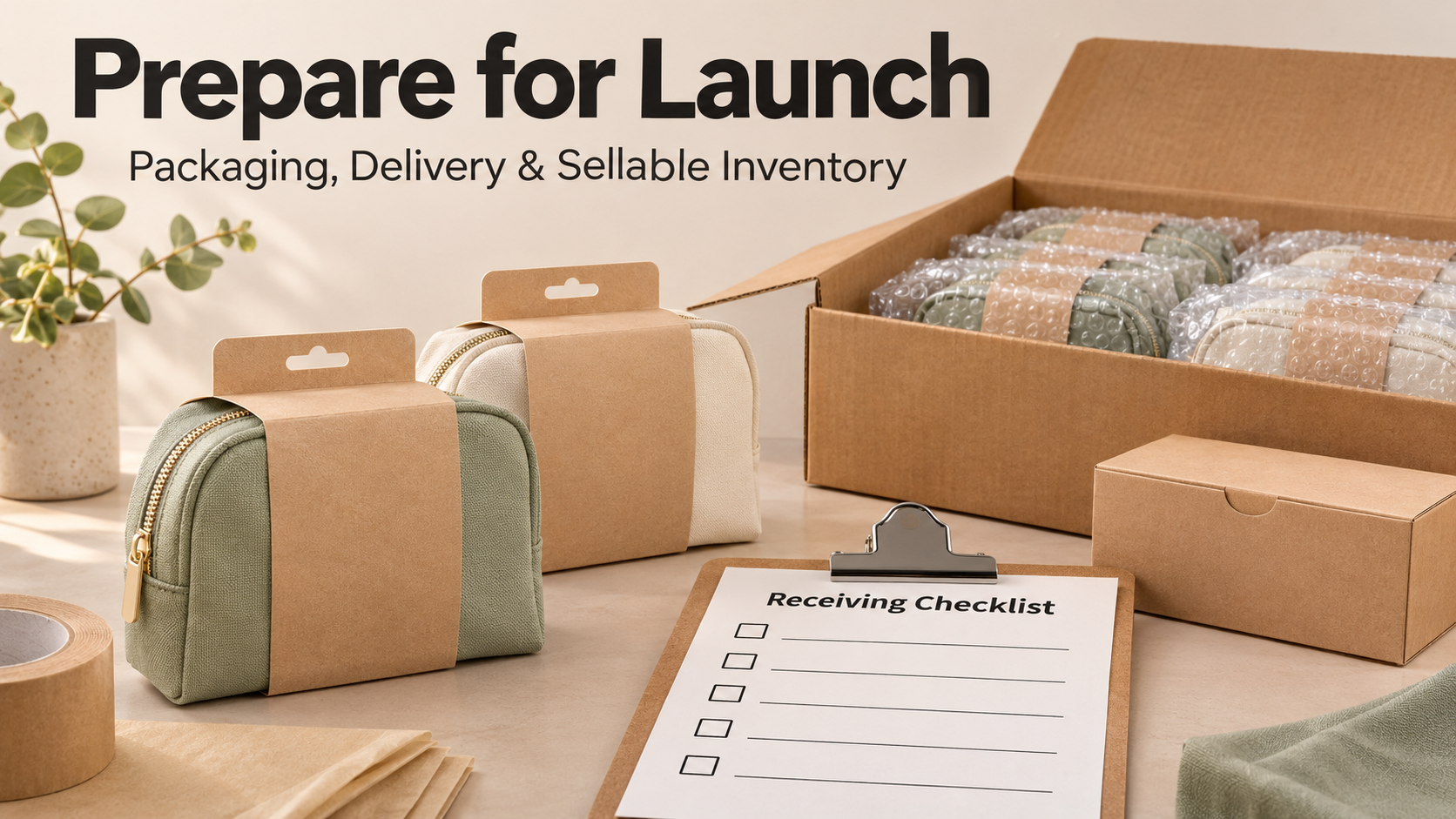
Work backward from the date inventory must be ready for fulfillment, using confirmed dependencies rather than a single manufacturing estimate. Include development, approvals, sourcing, production, inspection, possible correction, transport and receiving.
Ask what starts each lead-time estimate and what can pause it. A material-sourcing period may depend on color approval, while production scheduling may depend on components being available and agreed commercial conditions being met.
Confirm the delivery term, named place and applicable version. ICC’s Incoterms rules clarify delivery-related tasks, costs and risks between sellers and buyers. Record other project requirements explicitly in the order documents.
For example, a carton arriving at the warehouse may still require receiving checks, variant sorting or gift-set assembly before its contents become sellable stock.
Buyer action: Assign an owner to every handoff. Confirm received quantities and condition, fulfillment data and final product content before treating the launch date as operationally ready.
Example Scenario: A Gift Pouch With Unfinished Packing Decisions
This is a hypothetical example, not an actual customer project.
A beauty brand develops a reusable pouch for a boxed skincare set. The bag sample meets the appearance brief, but the team has not decided whether the factory or its fulfillment partner will insert the skincare products.
During the packing review, the brand discovers that the proposed retail sleeve fits the empty pouch but not the filled arrangement. Ordering printed sleeves immediately would commit the project to an unresolved configuration.
The buyer pauses sleeve purchasing, assigns assembly responsibility and reviews the filled pack. The resulting approval identifies the bag version, packing method, sleeve artwork and warehouse tasks before production and packaging commitments proceed.
The lesson is to resolve the handoff between product design and fulfillment before buying materials that depend on it. No particular saving, delivery improvement or sales result is assumed.
Buyer Checklist Before Authorizing the Order
- Document the intended use, contents, customer and destination market.
- Agree the development route, deliverables and responsibilities.
- Confirm the quotation’s assumptions, variant quantities and exclusions.
- Record the approved sample version and close essential corrections.
- Match the material list, construction details and artwork to that approval.
- Approve the actual packing configuration and final packaging files.
- Assign responsibility for testing, product information and supporting evidence.
- Agree QC criteria, change authorization and shipment-release responsibility.
- Confirm the written production release and schedule through warehouse readiness.
Frequently Asked Questions
Can I begin with only a sketch or reference photo?
Yes, a sketch or photo can start the discussion, provided you explain the intended function and the features you want to develop. It is not a complete manufacturing instruction. Ask the supplier to identify missing dimensions, materials and construction details, then agree who will prepare and approve the specification before it becomes the basis for purchasing or production.
How many colors should I launch with?
Choose the color range according to demand evidence, purchasing minimums and your ability to manage inventory by variant. Every additional color can introduce separate material availability, approval and stock-allocation decisions. Ask the manufacturer how the proposed split affects the order, then compare the total commitment with your launch plan rather than choosing colors only because they look attractive together.
What determines the MOQ for a private label cosmetic bag?
The practical MOQ depends on the construction and the materials, decoration, components and packaging being ordered. Some inputs may be available from stock; others may require a dedicated purchase or production run. Ask which requirement creates the minimum and whether changing that input alters the proposal. Do not assume the same minimum applies to every style, color or packaging arrangement.
Can I reserve materials before approving the final sample?
Yes, if both parties agree a limited purchasing authorization and understand the consequences of later design changes. Identify the material, quantity, approved reference and financial responsibility for unused stock. Keep that decision separate from permission to manufacture the finished bags. This approach may address availability concerns, but it does not remove the need to validate the final construction and branding.
Can I use prototype photos for my product listing?
You can prepare draft content with prototype images, but the published listing should accurately represent the version customers will receive. Changes to color, lining, logo placement, hardware or included packaging can make early photos misleading. Review images and descriptions against the final approved product, and replace or clearly qualify visuals that no longer match the goods offered for sale.
What should I retain for a repeat order?
Retain the final specification, material references, artwork, approved sample identification, packaging files, inspection criteria and authorized changes. Also keep information about issues discovered during production or after receipt. Before reordering, confirm that the supplier can still source the agreed inputs and reproduce the construction. A previous order number alone may not capture every decision needed to repeat the product accurately.
Accuracy Note
This guide describes a project-planning framework, not a fixed offer or a claim that every manufacturer follows the same process. Pricing, MOQ, sample time and production lead time require confirmation against the actual materials, quantities, customization and current schedule. Testing, labeling, certification and regulatory requirements must be assessed for the intended product and market. Mentioning these requirements does not imply that Bling Accessory Co. holds a particular certification or that a product has passed specific tests.
Turn Your Product Idea Into a Clear Manufacturing Brief
Share your reference images, intended contents, preferred materials, branding, quantity plan, packaging needs and destination market with Bling Accessory Co. Identify which details are fixed and which need development so the next discussion can focus on the decisions your project requires.
Author: Website Operations & Digital Marketing Manager
Last Updated: November 5, 2026