Which Logo Method Is Best for Custom Cosmetic Bags?
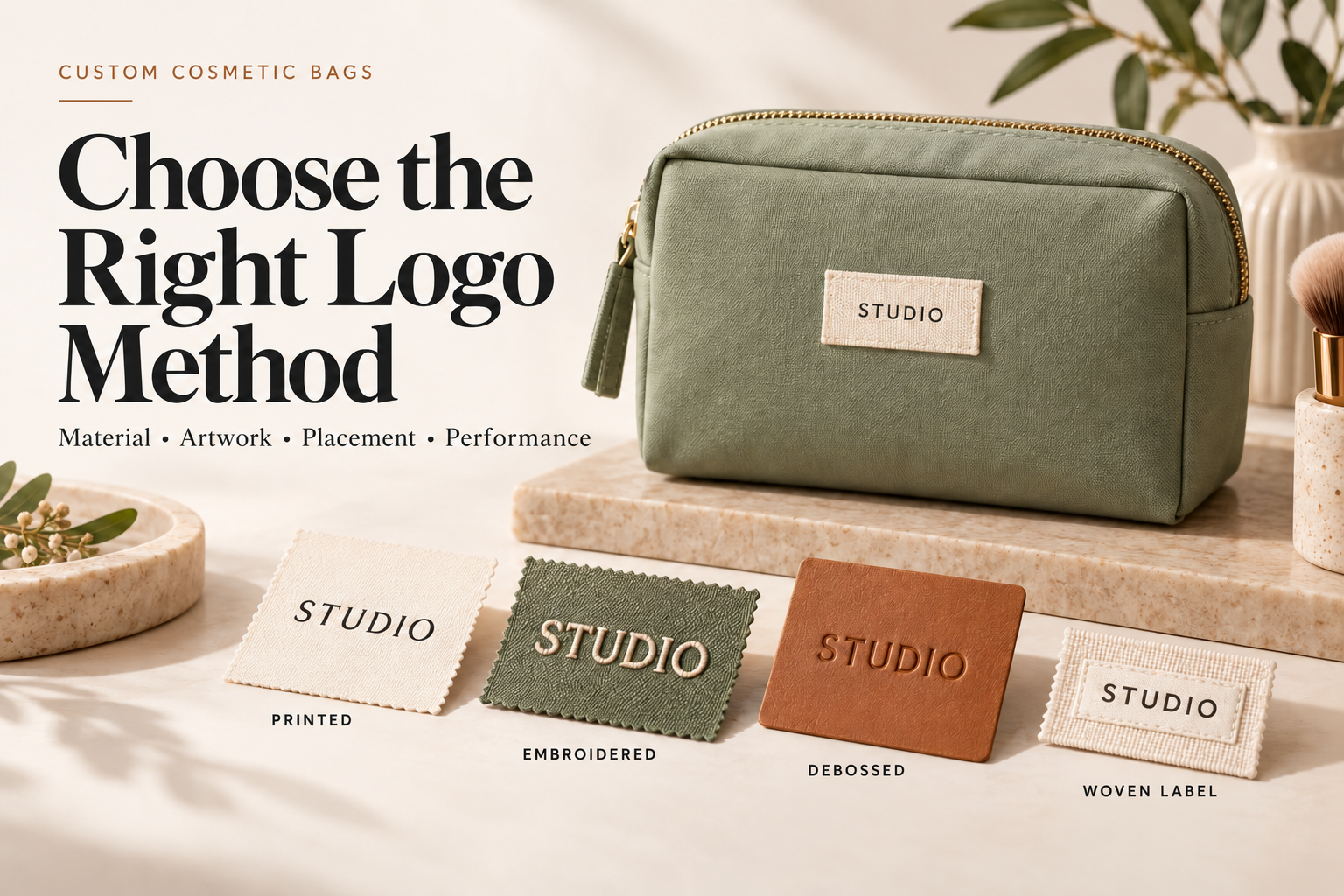
The best logo method for custom cosmetic bags is the one that reproduces your artwork clearly on the actual bag material and meets the intended use, appearance, and order requirements. Screen printing can suit simple solid-color artwork; embroidery adds thread texture; transfers can support detailed graphics; and debossing can create a recessed mark on suitable materials. Labels, patches, and metal plates provide other branding options when direct decoration is unsuitable.
For beauty brands, private label retailers, wholesalers, and promotional buyers, choosing from a digital mockup is not enough. Coatings, surface texture, lining, seams, and packing can change the result. This guide explains how to shortlist methods, compare production implications, and approve a representative sample before committing to bulk production.
Quick Answer
Choose the logo method after confirming the material, artwork size, placement, and care requirements. Consider screen printing for simple solid-color marks, a compatible transfer process for detailed graphics, embroidery for a textured finish, and debossing for subtle branding on suitable leather-look materials. Woven labels and patches can provide a separate branding surface; metal plates require secure attachment and appropriate support. None is universally cheapest or most durable. Request a decoration trial on the exact material, then review an assembled sample for readability, placement, appearance, and agreed performance checks before production approval.
Key Facts: Buyer Snapshot
| Decision factor | What to confirm |
|---|---|
| Material and finish | Exact fabric or film reference, coating, texture, backing, and color. |
| Artwork | Final size, line detail, lettering, colors, gradients, and permitted simplification. |
| Brand appearance | Flat, raised, recessed, metallic, tonal, or contrasting presentation. |
| Placement | Position relative to finished seams, folds, zipper, and usable panel area. |
| Use and care | Expected rubbing, flexing, residue, cleaning, and packing conditions. |
| Order conditions | Quantity per artwork version, setup charges, component MOQ, and repeat-order terms. |
| Approval evidence | Actual-material trial, finished sample, and documented acceptance criteria. |
Table of Contents
Which Logo Method Should I Shortlist for My Cosmetic Bag?
Shortlist methods by the required visual result, then eliminate options that do not suit the material or construction. The table below identifies practical starting points, not guaranteed compatibility or fixed price rankings.
| Method | Consider when | Check before approval |
|---|---|---|
| Screen printing | The design uses clear shapes, lettering, and solid colors. | Ink compatibility, edge definition, coverage, curing, and rubbing performance. |
| Heat-applied transfer | The artwork needs detailed or multicolor graphics. | Transfer type, adhesion, heat sensitivity, surface feel, and edge behavior. |
| Embroidery | Thread texture is part of the desired appearance. | Lettering clarity, backing, puckering, stiffness, and the inside finish. |
| Debossing or embossing | The material can support a recessed or raised mark. | Definition, depth consistency, material response, and visibility. |
| Foil stamping | A metallic surface accent is required. | Foil compatibility, coverage, fine gaps, flexing, and rubbing. |
| Woven label or separate patch | The bag surface needs an independent branding area. | Readability, edge finish, attachment, thickness, and placement. |
| Metal logo plate | A rigid decorative component fits the product design. | Attachment security, backing protection, edges, finish, and packing marks. |
For example, a simple wordmark on a smooth textile panel may justify comparing printing with a woven label. A soft textured pouch may instead call for embroidery or a separately attached branding element.
Buyer action: Select the intended bag format from the cosmetic bag collection, then ask the manufacturer to explain which methods suit its actual panel construction.
How Does the Bag Material Change the Choice?
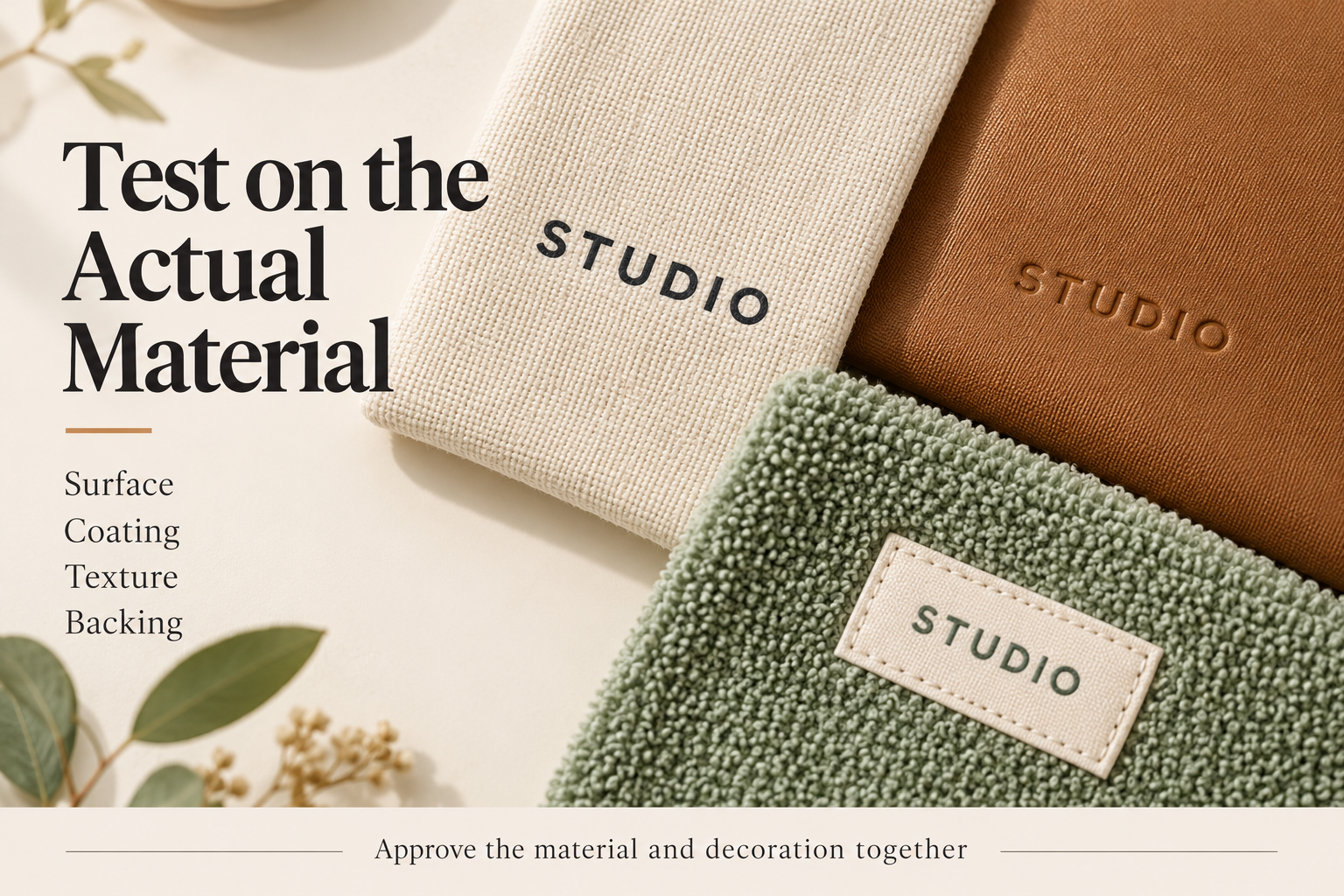
The surface receiving the logo matters as much as the fiber or material name. A coated nylon and an uncoated nylon should not be treated as identical printing substrates. Similar-looking leather-look materials can also respond differently to heat or pressure.
Smooth woven fabrics
Printing, transfers, embroidery, or labels may be candidates, depending on the finish and structure. Ask the supplier to identify the ink, adhesive, or stitching approach it proposes for the selected material.
Coated fabrics and leather-look surfaces
Trial the actual coating before approving printing, foil, or debossing. Look for unwanted shine, distortion, surface damage, weak adhesion, or loss of definition. A successful trial on another coating does not settle the current choice.
Terry, velvet, and other textured surfaces
Surface pile can interfere with small details. Embroidery may require suitable backing or topping, while a label or patch creates a different surface for the artwork. Madeira's topping guidance explains how these aids can support embroidery on raised textile surfaces.
Clear films and heat-sensitive materials
Assess film distortion, marks, decoration visibility from both sides, and compatibility with the chosen process. STAHLS' fabric guidance also highlights the need for caution and testing with heat-sensitive nylon.
Buyer action: Provide the precise material reference and finish. Use the cosmetic bag materials guide to clarify the shell, coating, and backing before requesting decoration samples.
Which Methods Suit Fine Details, Gradients, or Subtle Branding?
Compare the artwork at its intended production size, not enlarged on a screen. Fine lettering, narrow gaps, gradients, and tonal effects create different reproduction challenges.
For detailed multicolor graphics, ask about a compatible digital or transfer process. “Heat transfer” describes a broad application category; it does not identify one universal ink, adhesive, or finish.
For conventional dye-sublimation, suitable white or light-colored polyester is a typical starting point, as described in Epson's textile-printing overview. Specialized treatments and other systems require separate assessment. Do not assume sublimation is interchangeable with every transfer method.
For subtle branding, compare a tonal print with a debossed mark on a suitable surface. Debossing creates a recessed impression; embossing creates a raised one. Foil adds a separate decorative finish and should be evaluated separately.
For example, tiny lettering that looks sharp in a vector file may close up when stitched or pressed into a textured surface. Enlarging the mark or approving a simplified artwork version may be more effective than changing the entire bag.
Buyer action: Send editable vector artwork where available, with text converted to outlines, plus a visual reference. Supply final dimensions and color references. A PDF file is not necessarily vector artwork; ask the supplier to confirm usability and submit any modifications for approval.
How Does Logo Placement Affect Manufacturing?
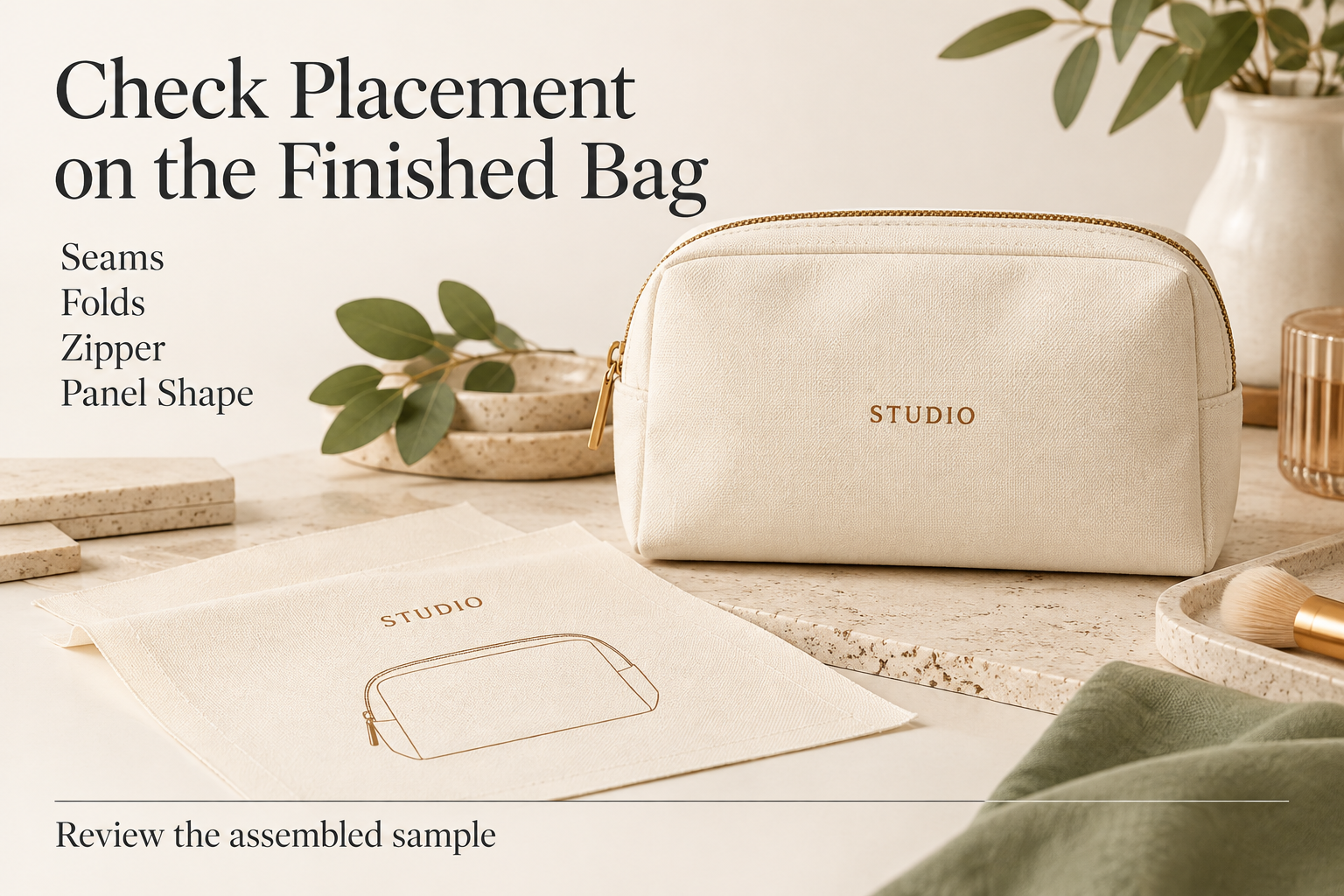
Define placement against the finished bag and confirm when decoration happens during assembly. Some methods are easier to apply to a flat panel before sewing; others may be possible after assembly if access and support are adequate.
Seam allowances, curved panels, padding, and zipper installation can change the visible area. A mark centered on the cut panel may not appear centered once the pouch is filled or viewed from the front.
Embroidery can leave backing and thread on the reverse side. A metal plate may need reinforcement or a concealed attachment. These details affect lining and assembly planning rather than artwork alone.
For example, placing a rigid plate beside a fold may create pressure marks during packing. Moving it to a supported area or changing the branding element may resolve the issue.
Buyer action: Specify the viewing orientation, artwork dimensions, reference edges, and agreed placement tolerance. Review an assembled sample both empty and filled, then confirm that packaging does not press the logo against adjacent surfaces.
How Should I Compare Logo Costs and MOQ?
Compare complete decoration proposals for the same bag, artwork, and order split. There is no dependable price ranking based only on the method name.
Screen preparation, embroidery digitizing, stamping dies, custom molds, and component sourcing can create different setup costs. Artwork size, color separation, stitch complexity, placement count, attachment labor, and rejects can affect recurring production cost.
Labels, patches, and metal plates may have supplier minimums separate from the bag's sewing MOQ. A small bag order does not automatically eliminate those component commitments.
For example, a separate patch may solve a difficult printing surface but introduce edge-finishing and attachment work. A method with a lower setup charge may still have a higher application cost for the proposed quantity.
Buyer action: Ask the quote to separate development, tooling, components, application, and sampling. Confirm minimums per artwork version, whether setup can be reused, and what changes would require another charge. Do not assume sampling or tooling fees will be refunded.
What Should I Check Before Approving a Logo Sample?
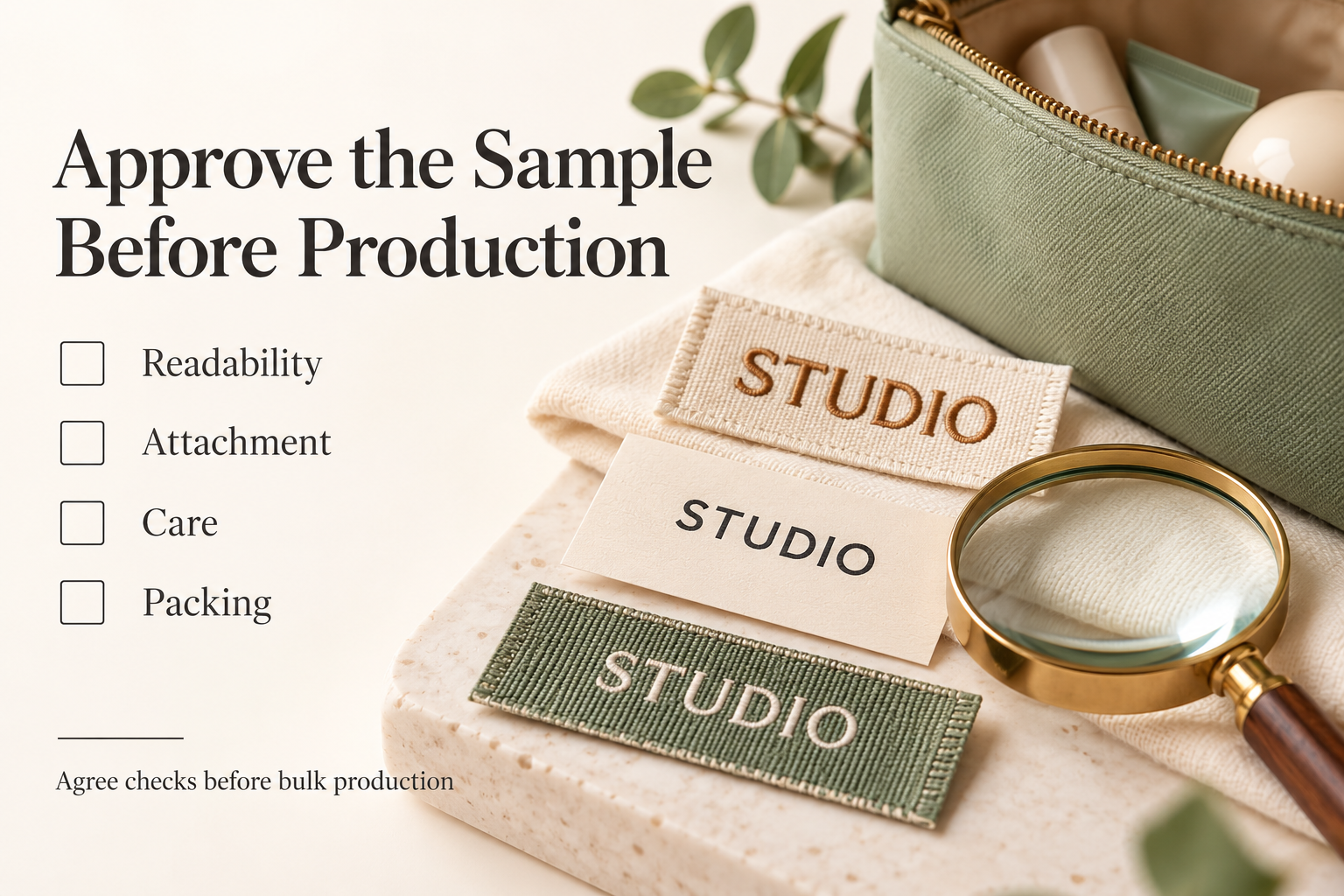
Approve both an actual-material decoration trial and a representative assembled sample. The trial helps isolate the process; the finished sample shows placement, construction, and interaction with the lining and packaging.
- Readability: Check small letters, fine gaps, outline clarity, and color contrast at normal viewing distance.
- Surface appearance: Look for inconsistent coverage, unwanted gloss, distortion, puckering, or visible adhesive.
- Attachment: Inspect label stitching, patch edges, plate security, and concealed backing.
- Use conditions: Agree relevant rubbing, flexing, cleaning, or residue checks and their acceptance criteria.
- Packing behavior: Check for impressions, transfer to adjacent surfaces, creasing, and abrasion after the proposed packing method.
- Repeatability: Confirm how production will be checked against the approved artwork, position, color, and finish.
For example, a transfer can look satisfactory immediately after application yet still need evaluation after the specified conditioning and care procedure. Follow the selected process requirements rather than inventing a universal test routine.
Buyer action: Record the artwork revision, material reference, process, sample approval, and inspection criteria. Practical sample checks do not replace formal testing needed to support specific product claims or market requirements.
Example Scenario: Choosing Branding for a Textured Pouch
This is a hypothetical sourcing example, not a customer case study. A beauty brand plans a textured cosmetic pouch with a small wordmark and wants a soft, understated appearance.
The buyer compares direct embroidery with a woven label using the same artwork size and intended location. The embroidery trial is reviewed for lettering clarity, surface distortion, and reverse-side finish. The label trial is reviewed for legibility, edge quality, attachment, and whether its proportions suit the pouch.
If the fine wordmark becomes unclear in embroidery, the buyer can approve a simplified version or select the label. If the label interrupts the intended design, a larger embroidered mark may deserve another trial.
The final choice follows the assembled sample, intended care conditions, and comparable quotation. The method is selected because it meets the brief, not because one technique is universally more premium.
Buyer Checklist for a Logo RFQ
- Bag style, intended use, and destination market.
- Exact outer material, coating, texture, backing, and color reference.
- Editable artwork and a visual reference for the intended appearance.
- Final logo dimensions, colors, and any acceptable simplification.
- Placement measured from finished reference points.
- Order quantity split by bag color and artwork version.
- Desired surface feel, cleaning method, and relevant durability expectations.
- Packaging method and any risk of contact with adjacent surfaces.
- Sample requirements, acceptance criteria, and approval responsibility.
Include these details in the custom cosmetic bag RFQ checklist so the supplier can assess decoration together with the complete product.
Frequently Asked Questions
Which logo method is usually the cheapest?
There is no universal cheapest method. A simple print can be worth quoting for uncomplicated artwork, but material preparation, setup, order split, and application labor can change the comparison. Ask suppliers to quote the same logo size, location, bag material, and quantity. Separate initial development charges from recurring costs before deciding which proposal suits the order.
Is embroidery more durable than printing?
Not automatically. Embroidery avoids some print-related failure modes, but it can introduce thread snagging, puckering, backing issues, or damage around dense stitching. Printing performance depends on the ink or transfer system and its compatibility with the substrate. Compare the actual samples under agreed use and care conditions rather than selecting by a general durability ranking.
Can I put a detailed logo on a clear cosmetic bag?
Possibly, but the film and decoration process must be assessed together. Confirm the exact material, surface treatment, artwork size, and required visibility from both sides. Ask whether an opaque underlayer or another construction detail is needed. Review an actual-film trial for clarity, adhesion, distortion, and appearance before approving the assembled clear pouch.
Can I use debossing on every PU cosmetic bag?
No. The result depends on the coating, backing, thickness, surface texture, artwork, and process conditions. A material can produce a weak impression, lose definition, or show unwanted surface change. Ask for a trial on the intended material and inspect the finished pouch. If the result is unsuitable, compare tonal printing or an attached label instead.
Can a logo be added after the bag is fully sewn?
Sometimes, provided the chosen method has enough access and support at the intended location. Seams, padding, lining, and zippers can make pressing, stitching, or attaching hardware difficult. Tell the supplier whether the bags are already assembled. For new production, agree the decoration sequence early so the finished construction does not block the selected method.
Will the same brand color look identical across all methods?
Not necessarily. Printed ink, embroidery thread, foil, and plated metal reflect light differently, while the base material affects the perceived result. Provide a physical or standardized color reference and agree an acceptable match for each process. Approve samples under consistent viewing conditions rather than relying only on a monitor or a photograph.
Accuracy and Project Confirmation
Logo compatibility, pricing, MOQ, sample time, and production lead time must be confirmed for the actual material, artwork, quantity split, construction, and packaging. Testing, certification, and product claims require review against the destination market and current requirements. This guide does not establish that every method is available for every Bling Accessory Co. product or that a particular sample has passed testing.
Discuss the Right Logo Method for Your Project
Send Bling Accessory Co. your logo artwork, intended size and placement, bag reference, material details, quantity split, and packaging needs. Include the appearance and care requirements that matter most so the discussion can focus on suitable decoration options.
Author: Website Operations & Digital Marketing Manager
Last updated: October 21, 2026