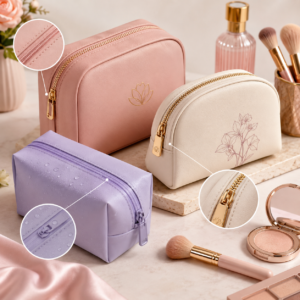
What Is the Best Material for a Custom Cosmetic Bag?
The best material for a custom cosmetic bag is the material system that fits its intended use: the outer shell, lining, reinforcement, and closures must work together. Polyester or nylon can suit lightweight travel pouches; PU-coated fabric can suit a leather-look finish; cotton canvas can suit a textured woven aesthetic; and clear films can make contents visible. None is automatically right for every order.
For beauty brands, private label retailers, promotional buyers, and wholesale sourcing teams, the decision should start with what the bag will carry, how it will be cleaned, and which claims the finished product must support. This guide explains how to shortlist materials, specify the differences that matter, and evaluate a sample before committing to production.
Quick Answer
Choose cosmetic bag materials by use case, then verify the exact grade in a finished sample. Consider polyester or nylon for lightweight daily use, PU-coated fabric for a leather-look surface, cotton canvas for a natural woven appearance, and TPU or PVC film when visibility is essential. Specify the lining separately if cosmetic residue and cleaning are priorities. Material names alone do not establish waterproofness, durability, recycled content, or regulatory suitability. Ask the supplier to confirm composition, coating, thickness or fabric weight, logo compatibility, care instructions, and project-specific MOQ before approving the material.
Key Facts: Buyer Snapshot
| Decision factor | What to confirm |
|---|---|
| Use and contents | Daily makeup, travel toiletries, brushes, or a gift set; intended load and opening access. |
| Cleaning | Expected residue, permitted cleaning method, and appearance after cleaning. |
| Material specification | Composition, construction, coating, backing, color, and agreed weight or thickness. |
| Bag construction | Lining, seam finish, reinforcement, closure, and filled shape. |
| Branding | Logo process, artwork size, placement, and performance on the selected surface. |
| Claims and documentation | Evidence for material content, recycled claims, and intended performance statements. |
| Order feasibility | Material availability, color split, MOQ, sampling scope, packaging, and current lead time. |
Table of Contents
- Which material suits each use case?
- What should a material specification include?
- How should I choose the lining?
- How do logos and construction affect selection?
- What should I check in a sample?
- How should I assess recycled materials?
- How do materials affect cost and MOQ?
- Example scenario
- Buyer checklist
- Frequently asked questions
What Is the Best Material for a Custom Cosmetic Bag by Use Case?
Start with the bag's main job, then compare candidate materials under the same specification. A travel pouch needs different priorities from a decorative gift pouch. The following options are starting points for sampling, not universal performance rankings.
| Use case and candidate | Selection condition |
|---|---|
| Daily or travel pouch: polyester or nylon | Assess the exact weave, finish, lining, and filled weight. Neither fiber name guarantees abrasion resistance or water resistance. |
| Leather-look retail pouch: PU-coated fabric | Approve surface feel, backing, fold behavior, cleaning method, and coating performance. |
| Textured woven pouch: cotton canvas | Confirm fiber content, color transfer, care requirements, and whether a separate lining is needed. |
| Visible contents: TPU or PVC film | Compare clarity, flexibility, surface marks, seam construction, and market-specific documentation. |
| Soft gift presentation: velvet or terry | Check surface snagging, logo visibility, cleaning, and compatibility with the contents and lining. |
| Recycled-content brief: documented recycled textile | Confirm which component contains recycled material and assess performance independently. |
For example, a gift pouch may use a soft exterior while its lining handles routine cosmetic residue. A travel organizer may instead prioritize low bulk and an opening that remains accessible when filled.
Buyer action: Rank your essential requirements before selecting swatches. Use the cosmetic bag collection to identify the intended format, then request materials suitable for that construction.
What Should a Cosmetic Bag Material Specification Include?
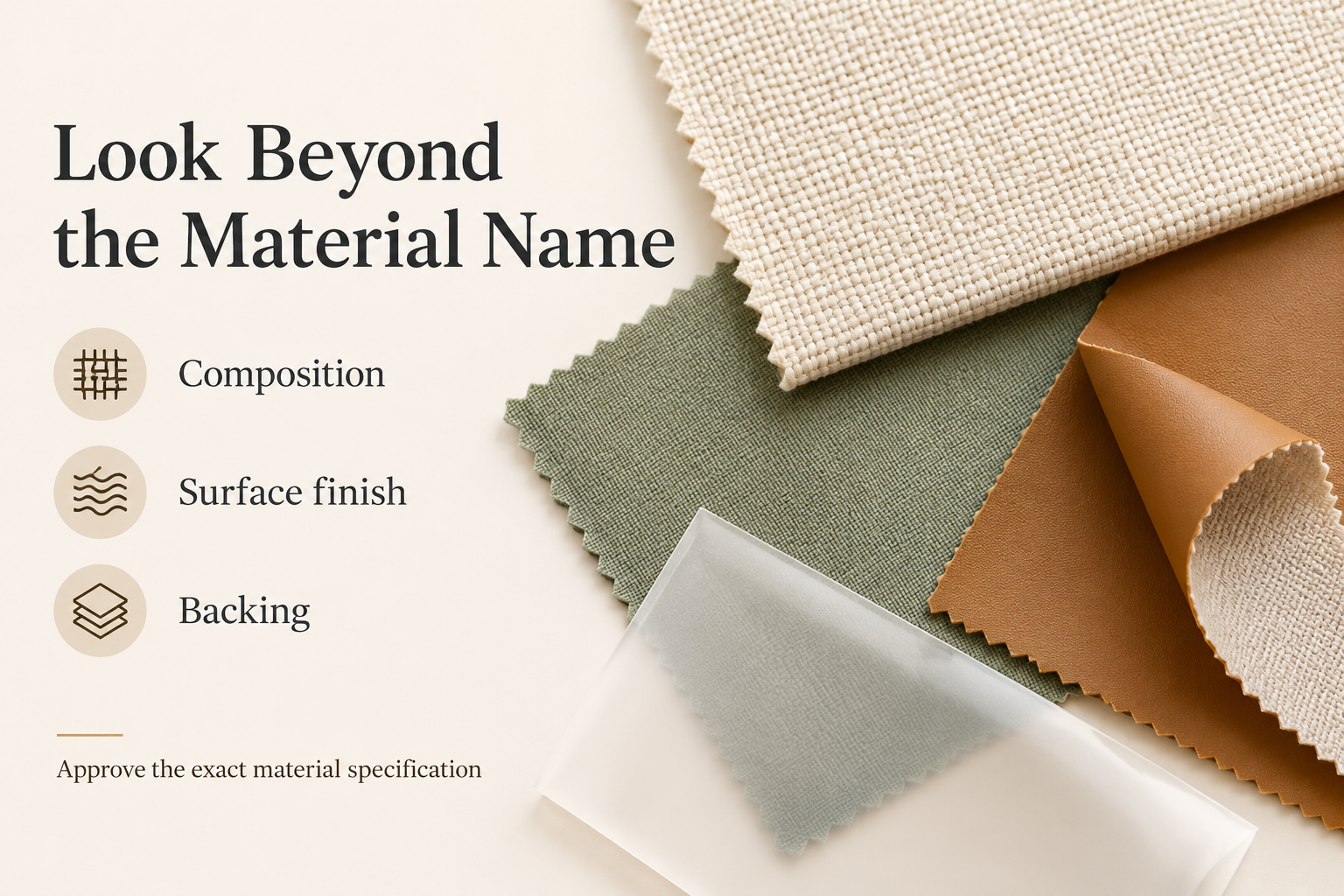
Specify the material's composition and construction, not just its commercial name. Cotton, polyester, and nylon describe fibers; canvas describes a fabric construction; PU describes a polymer used in coatings; and RPET refers to recycled PET feedstock. These labels answer different questions.
A description such as “premium canvas” does not define fiber content, finish, or weight. Similarly, a PU-coated material needs a backing specification. Denier, where used, describes yarn linear density; it is not a complete durability rating for the finished bag.
For example, similar-looking swatches can behave differently at a folded edge or around a curved zipper because their coatings, backings, and stiffness differ.
Buyer action: Record the supplier's material reference, composition, applicable weight or thickness, finish, backing, and color reference. Require written approval for substitutions so repeat orders remain tied to the approved specification.
How Should I Choose the Lining for Spills and Cleaning?
Choose the lining around the residue and cleaning method the user is likely to encounter. The exterior may serve a visual purpose while the interior needs to release powder, tolerate the agreed wiping method, or protect exposed seam allowances.
Define whether “easy to clean” means removing dry powder, wiping a small cream spill, or washing the entire bag. These are different requirements. A water-resistant surface does not establish that liquid cannot escape through seams or a zipper.
For example, a coated lining may look clean after wiping but still leave residue trapped at an internal binding. A care instruction must therefore reflect the assembled bag, including its reinforcement, logo, and hardware.
Buyer action: Give the supplier representative residue types and the intended care method. Ask for a finished sample with the proposed lining and assess the corners, seams, and zipper area as well as the flat surface.
How Do Logo Methods and Bag Construction Affect Material Choice?
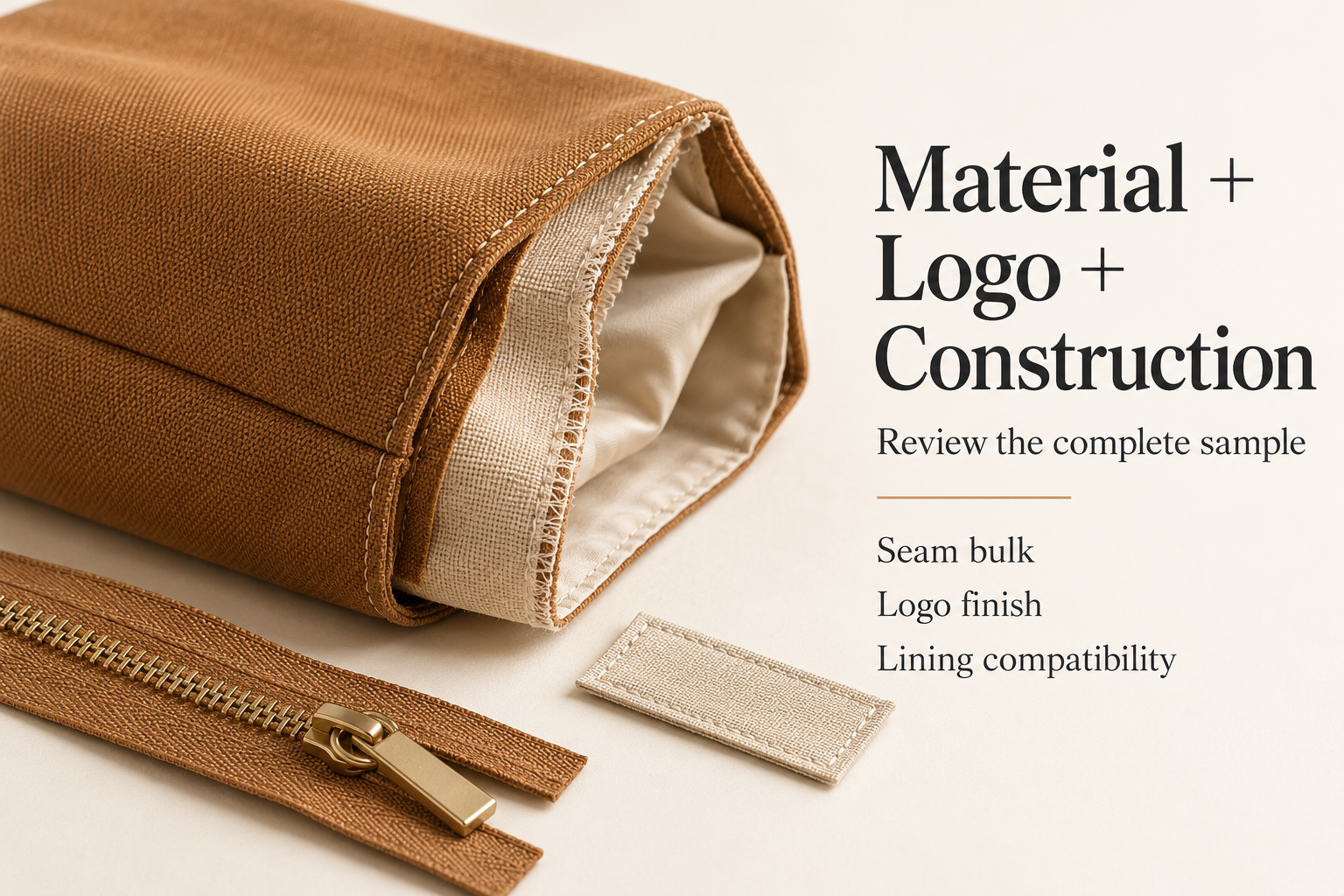
Approve the material, logo process, and construction together. A fabric that looks suitable as a flat swatch may not produce the intended result after printing, folding, stitching, and turning.
At a gusset corner, folded shell material, lining, and reinforcement create a stack of layers. Increasing shell thickness can change seam bulk and the finished shape. Changing stiffness can also affect the opening and how the pouch packs.
Branding introduces further conditions. Heat-based decoration needs a trial on the selected coating; embroidery may require backing; and a raised or looped surface can obscure fine artwork. Clear film requires particular attention to surface marks and visible seam details.
For example, switching from smooth fabric to terry while retaining a finely detailed logo may require a different decoration method or a label.
Buyer action: Request the actual artwork on the proposed material and a sewn sample using the intended layer construction. Approve logo appearance and placement on the assembled pouch, not only on a loose test panel.
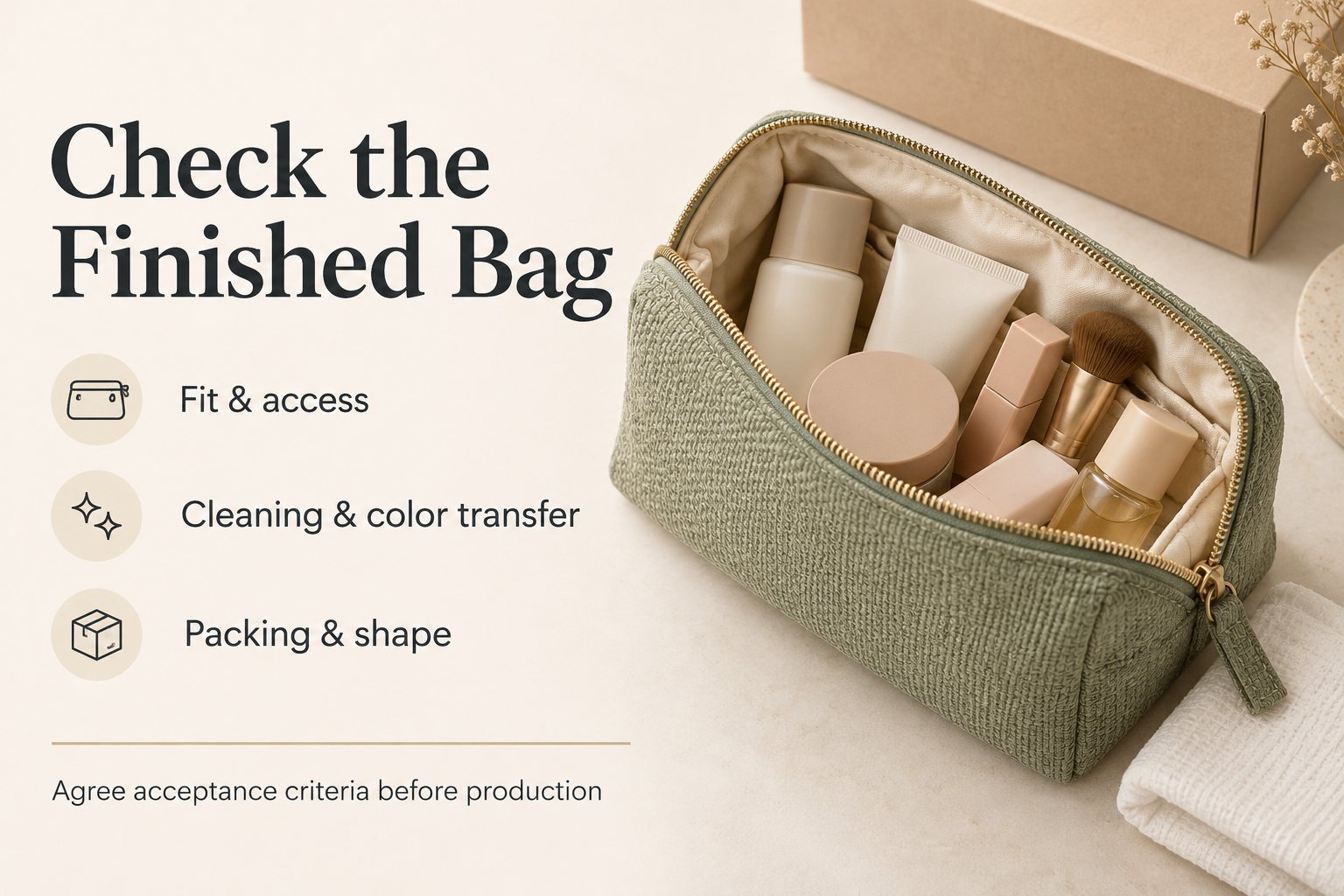
Evaluate a complete sample against written acceptance criteria. Swatches help with color and texture, but they cannot show whether the assembled bag closes properly, holds its intended contents, or remains presentable after packing.
- Fit and access: Insert the intended products and check the opening, closure, pocket access, and loaded shape.
- Cleaning: Use agreed representative residue and cleaning conditions; record staining, surface change, and residue at seams.
- Color transfer: Agree how to assess transfer to pale lining or adjacent items under relevant dry or damp conditions.
- Construction: Inspect zipper ends, handles, folded corners, exposed backing, and areas of repeated flexing.
- Packing: Unpack the sample after the proposed packing method and inspect creases, surface impressions, and shape recovery.
For example, a sample that looks acceptable empty may pull at the zipper when filled with the intended bottles. That finding can require a pattern change rather than a stronger outer fabric.
Buyer action: Record the sample revision and approval conditions. Practical buyer checks help refine the design; they do not replace laboratory testing needed to support specific performance or compliance claims.
How Should I Assess Recycled Cosmetic Bag Materials?
Evaluate recycled content and product performance as separate requirements. A recycled textile still needs an appropriate construction, finish, lining, and care specification. Its feedstock description does not establish how the finished bag will perform.
Textile Exchange's Recycled Claim Standard and Global Recycled Standard address recycled materials and chain of custody. A supplier's general certification statement does not, by itself, establish the claim you can make for a particular finished order.
For example, recycled content in the shell does not automatically describe the lining, zipper, thread, or packaging. Nor does recycled content alone prove that the whole bag has a lower environmental impact than every alternative.
Buyer action: Request the composition and supporting documentation relevant to the actual order. Confirm claim wording, component scope, and current labeling requirements before printing packaging or publishing product descriptions.
How Do Materials Affect Price, MOQ, and Lead Time?
Compare materials within the same bag specification and order conditions. There is no dependable universal price ranking based only on names such as nylon, canvas, or PU.
Material grade, usable width, cutting layout, backing, finish, color availability, and waste can affect consumption and cost. Custom dyeing, coating, printing, or specialist trims can introduce upstream minimums and sourcing steps.
For example, an available fabric color may suit a trial order more readily than a specially developed finish. That possibility must be checked against current stock, repeat-order availability, and the supplier's actual production plan.
Buyer action: Request alternatives with identical dimensions, lining, logo, packaging, and quantity split. The custom cosmetic bag cost factors guide explains the other specification choices that belong in that comparison.
Example Scenario: Choosing a Material for a Beauty Gift Pouch
This is a hypothetical sourcing example, not a customer case study. A beauty brand wants a pouch that presents well in a gift set and remains useful for everyday makeup.
The buyer shortlists a cotton canvas exterior and a PU-coated exterior, each with a separately specified lining. Both options use the same dimensions, contents, logo size, and packing format so the comparison isolates meaningful differences.
If the canvas sample meets the visual brief but its proposed lining retains residue, the buyer can revise the lining before rejecting the shell. If the PU-coated sample shows unwanted packing impressions, the buyer can evaluate a different grade or packing method.
The decision follows the agreed sample results, documented material specification, and comparable quote. Neither material is selected solely because its category sounds more premium.
Buyer Checklist: What Should I Send in the Material Brief?
- Intended use, target buyer, and the actual products the bag must hold.
- Bag dimensions, opening style, pockets, and desired filled shape.
- Preferred shell appearance and any acceptable material alternatives.
- Lining requirements, expected residue, and intended cleaning method.
- Logo artwork, placement, size, and preferred decoration process.
- Order quantity, color split, packaging, and required delivery window.
- Destination market and any required material or product claims.
- Sample acceptance criteria and the process for approving substitutions.
The custom cosmetic bag RFQ checklist provides the wider project information needed alongside the material brief.
Frequently Asked Questions
Is nylon better than polyester for a cosmetic bag?
Neither is automatically better. Compare the actual fabric construction, finish, weight, backing, and complete bag design. A fiber name cannot establish the result of abrasion, cleaning, or loaded-use checks. Ask for comparable samples with the same dimensions, lining, zipper, and branding, then choose against your priorities for feel, bulk, care, appearance, and cost.
Is PU leather a waterproof cosmetic bag material?
A PU-coated surface does not establish that a finished cosmetic bag is waterproof. Seams, zipper openings, and construction can allow water to pass even when the main surface resists wetting. Specify the intended exposure and the exact performance claim. Request suitable finished-product evidence before describing the bag as waterproof, and confirm the permitted cleaning method separately.
Can cotton canvas cosmetic bags be washed?
Only recommend washing when the complete bag has been evaluated for that care method. The shell is only part of the product: dyes, lining, reinforcement, logo decoration, and hardware also matter. Ask the supplier to confirm a care procedure and assess the sample afterward for dimensional change, color transfer, appearance, and closure function before approving care instructions.
Should I choose TPU or PVC for a clear cosmetic bag?
Compare the exact film grades against the same requirements rather than choosing by acronym alone. Evaluate clarity, flexibility, surface marking, folding behavior, construction, and the documentation needed for your intended market. Neither name proves regulatory compliance or environmental superiority. Ask for a sewn or otherwise assembled sample using the proposed film, zipper, and edge treatment before approving the choice.
Does recycled polyester mean the entire cosmetic bag is recycled?
No. A recycled polyester shell does not establish the composition of the lining, zipper, reinforcement, thread, or packaging. Ask which components contain recycled material and obtain documentation supporting the specific claim for the order. Keep consumer-facing wording aligned with that scope, and confirm any certification or labeling rules before applying a logo or statement to the product.
Can I change materials after approving the sample?
You can request a change, but it should trigger a review of the affected specification and approvals. Different thickness, stiffness, coating, or backing can alter sewing, logo results, dimensions, and packing behavior. Ask whether a new sample is needed and obtain updated pricing, MOQ, and scheduling information. Keep the final approved material reference attached to the production specification.
Accuracy and Project Confirmation
Material suitability, price, MOQ, sample time, and production lead time must be confirmed for the actual specification, quantity, color split, packaging, and current sourcing conditions. Testing, certification, and product claims must be checked against the intended market and current requirements. This guide does not establish certification or test results for any Bling Accessory Co. product.
Discuss the Material Requirements for Your Project
Share your intended use, bag dimensions, preferred appearance, cleaning needs, logo, quantity, and destination market with Bling Accessory Co. Include reference photos or swatches so the discussion starts with a clear material brief.
Author: Website Operations & Digital Marketing Manager
Last updated: October 15, 2026