How Can I Verify That a Cosmetic Bag Supplier Is a Real Factory?
To verify that a cosmetic bag supplier is a real factory, connect its business identity to an operating production site and then connect that site to your proposed order. A website, workshop photograph, or attractive sample provides only part of that evidence. Beauty brands, private label businesses, wholesalers, and sourcing teams also need to establish who controls production and who will resolve quality problems.
This guide explains what to request, how to cross-check the answers, and when an independent visit is useful. It focuses on supplier verification before an OEM or ODM order: legal identity, production visibility, sample traceability, outsourced processes, quality records, and a documented decision about whether to proceed.
Quick Answer
Verify a cosmetic bag supplier by matching its registered business identity with the production address, reviewing a live workshop walkthrough, and tracing a relevant sample through development and manufacturing records. Ask which processes happen in-house, which are subcontracted, and who controls inspection and corrections. Check claimed certificates with their issuers and assess whether their scope covers the relevant entity and site. For an important order, commission an independent factory assessment. No single document proves manufacturing capability: the strongest evidence is a consistent connection between the supplier, the facility, the product, and the people responsible for delivery.
Buyer Snapshot: What Should You Verify?
| Decision factor | Evidence to request |
|---|---|
| Business identity | Registered entity details and an explanation of trading names. |
| Production location | Operating address connected to a live visit or independent assessment. |
| Manufacturing role | Written allocation of in-house and subcontracted processes. |
| Product capability | Relevant sample, revision history, and construction explanation. |
| Quality control | Inspection criteria, traceable records, and correction responsibility. |
| Documentation | Certificate or report issuer, scope, site, and current status. |
| Order readiness | Approved specifications, production plan, and resolved identity discrepancies. |
Table of Contents
- What evidence proves that a cosmetic bag supplier is a real factory?
- Which business details should match?
- What should a live factory tour show?
- Which technical questions reveal manufacturing capability?
- How can you trace a sample to bulk production?
- How should you check certificates and quality records?
- When should you commission an independent assessment?
- Example scenario: resolving an unclear manufacturing claim
- Buyer verification checklist
- Frequently asked questions
- Discuss your project
What Evidence Proves That a Cosmetic Bag Supplier Is a Real Factory?
Look for connected evidence of an operating facility under the supplier's ownership or operational control, with capabilities relevant to your bag. Registration establishes an entity; workshop access establishes visibility; production records help connect the two to actual work. None is conclusive alone.
A manufacturer may use a separate export company or specialist subcontractors. That arrangement needs disclosure, but it does not automatically invalidate factory status. Ask who operates the cutting and sewing lines, employs or manages production staff, approves changes, and accepts responsibility for defects.
For example, a supplier may sew pouches internally while buying printed fabric from another facility. Verify the sewing operation and the controls applied to incoming printed panels. Do not assume that a printing partner must belong to the same company.
Write down the entities, locations, and process owners in a supplier file. If you are still deciding which business model suits your project, the factory versus trading company comparison addresses that separate decision.
Which Business Details Should Match Before You Place an Order?
The quoted supplier, contracting entity, production site, and proposed payment recipient should form an explainable, documented relationship. Exact names can differ for legitimate reasons, including a brand name or separate export entity. Unexplained differences require follow-up.
Request the registered name in its original language, registration identifier, operating address, and the name used on quotations. Check registration information through the relevant official registry or a qualified local verification provider. A registered manufacturing activity is useful context but does not establish that a workshop is currently operating.
For example, an English brand name may differ from the local entity's registered name. Ask for a written mapping and supporting records instead of treating the English website name as the legal identity. Where another entity receives payment, independently confirm its role through an established company contact.
Keep a dated record of these checks. Redacted documents can protect unrelated customer information, but they still need enough identifying detail to support the relationship being verified.
What Should a Live Factory Tour Show?
A useful walkthrough follows a relevant product through actual work areas and lets you ask unscripted questions. Request a continuous route where practical, starting with the location identity and moving through material storage, cutting, sewing, finishing, inspection, and packing.

Privacy restrictions, safety rules, and production schedules may limit filming. Agree on an alternative, such as an assessor's visit or a later view of the relevant operation. An idle machine does not establish deception, just as a busy workshop does not establish ownership.
Ask the host to explain a visible work-in-progress item: what operation was completed, what happens next, and how workers identify its specification. For a lined pouch, ask where the lining is assembled and when the zipper is attached. The explanation should correspond to what you can see.
Record unanswered questions and request follow-up evidence. Avoid demanding access to other customers' confidential designs; a neutral sample or redacted production traveler can demonstrate the same process.
Which Technical Questions Reveal Manufacturing Capability?
Ask how your exact material, structure, and decoration affect the production sequence and inspection points. Relevant answers expose practical understanding, although a knowledgeable sourcing company can answer well too. Combine technical discussion with site and document checks.
Can the supplier explain construction choices?
For a pouch with a thick shell and lining, ask how the seam stack affects corner turning, zipper alignment, and finished shape. A useful response identifies the construction constraint and proposes a sample check. A general promise of neat stitching does not explain how that outcome will be achieved.
The cosmetic bag category provides product context for defining the style you want assessed. Use your own reference and intended contents to establish which capability matters.
Can the supplier explain the logo sequence?
Ask whether the logo will be applied to flat panels or the assembled bag, and why. Access, artwork placement, material response, and assembly order can affect that choice. For example, decoration near a seam needs a positioning reference that remains meaningful after sewing.
Request a marked sample showing the proposed placement and ask who approves the decorated components before assembly. If a specialist applies the logo, establish who checks incoming work and who manages rejected pieces.
Can the supplier explain its MOQ and schedule?
MOQ can depend on material purchase quantities, custom colors, hardware, decoration setup, and packaging. Ask which component constrains your project and whether an available alternative changes that constraint. The low MOQ sourcing guide explores quantity planning in more detail.
A useful production plan separates material readiness, sample approval, assembly, outsourced operations, inspection, and packing. Ask what must be confirmed before the quoted lead time begins. Neither a low MOQ nor a fast promise establishes factory status.
How Can You Trace a Sample to Bulk Production?
Connect the approved sample to a documented specification, revision history, and identified production location. A polished sample demonstrates the condition of that sample; it does not show who made it or whether the same construction will be reproduced.
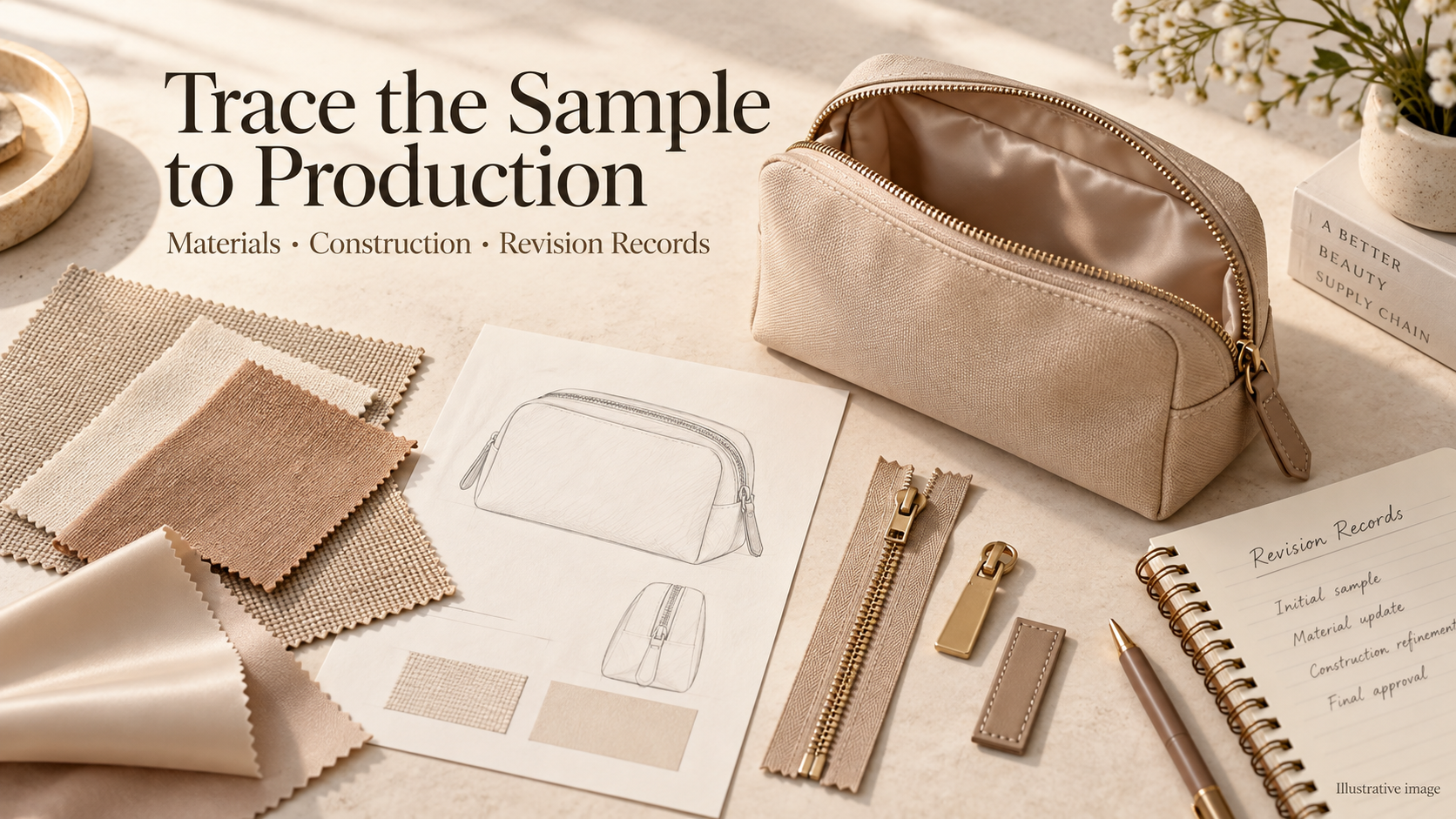
Ask whether a sample room, production line, or external maker produced the sample. Separate sample development can be reasonable. The key question is how approved details transfer to the people making the order.
Request a sample identifier, material references, finished dimensions, agreed tolerances, logo position, hardware details, and packaging instructions. Record substitutions and unresolved points explicitly. A pre-production approval should not depend on memory or scattered chat messages.
For example, a stock zipper used during development may differ from the proposed bulk zipper. Ask for approval of the final component and any resulting fit changes before production proceeds. Use the custom cosmetic bag RFQ checklist to organize the project specification.
Have both parties retain the agreed reference or an equivalent controlled record. Confirm how operators receive the latest version and how obsolete instructions are withdrawn.
How Should You Check Certificates and Quality Records?
Verify what each document covers, who issued it, and whether it applies to the entity, site, or product you are evaluating. A management-system certificate, an inspection record, and a product test report answer different questions.
Verify certification with the issuer
ISO develops standards but does not issue certification itself. Its certification guidance explains how to check accredited certification through IAF CertSearch or the relevant certification and accreditation bodies.
Review the holder's name, covered location, scope, certificate identifier, and current status. If a database search is inconclusive, contact the issuer through independently located contact details. A certificate screenshot alone is insufficient evidence of current status or relevance to your order.
Connect QC records to actual work
Ask for a redacted inspection record showing the product reference, inspection stage, acceptance criteria, findings, and disposition of defects. Check whether rejected work was corrected and reinspected. A blank checklist shows an intended procedure; a completed, traceable record shows an instance of its use.
For a cosmetic pouch, useful review points can include dimensions, zipper operation, seam security, lining attachment, logo position, cleanliness, and packaging accuracy. Agree on the criteria for your product rather than assuming a supplier's standard checklist covers your needs.
Check the relevance of test reports
A report applies to the identified sample and tests reported. Ask whether the tested material, color, coating, components, and construction represent the proposed order. An unrelated report cannot substantiate your bag's requirements merely because the supplier sells both products.
For example, a report on an undecorated material may leave questions about added printing or hardware. Ask the testing provider what additional evaluation is appropriate for the finished configuration and destination market.
When Should You Commission an Independent Factory Assessment?
Use an independent assessment when unresolved questions or the consequences of failure justify a closer review. Relevant factors include project complexity, customization, delivery sensitivity, quality requirements, and how much reliable evidence you already have.
Define the assessment scope yourself: entity-to-site connection, relevant operations, subcontracting, sample controls, production readiness, and QC implementation. A factory assessment evaluates a facility and its systems; a pre-shipment inspection evaluates an order at a particular stage. They are complementary checks.
| Finding | Buyer decision |
|---|---|
| Identity, site, and product evidence align. | Continue to sample and project approval; retain records. |
| An export entity differs from the factory entity. | Clarify and verify the relationship before approval. |
| Logo work is outsourced and disclosed. | Confirm incoming checks and correction responsibility. |
| A live view is unavailable for a stated reason. | Arrange alternative evidence or an independent visit. |
| Material contradictions remain unresolved. | Pause supplier approval until the evidence is reconciled. |
| Critical documents cannot be authenticated. | Do not treat the associated claims as verified. |
For example, an assessor may confirm sewing capability while identifying that your proposed construction needs further development. Record the finding as a capability condition, not a complete pass. Assign each corrective action an owner and require evidence of closure.
Example Scenario: Resolving an Unclear Manufacturing Claim
This is a hypothetical sourcing example, not a Bling Accessory Co. customer case. A beauty brand is considering a lined pouch with a printed logo and retail packaging. The supplier describes itself as a factory, but its quotation uses an export-company name.
The buyer requests the relationship between the entities and a live review of the proposed sewing facility. During the review, the supplier explains that printing happens at a specialist partner and shows how printed panels are checked before assembly.
The sample record also lists temporary hardware. Instead of treating the sample as final approval, the buyer requests the proposed bulk component and a revised specification. An assessor is asked to examine the entity-to-site connection and the transfer of sample instructions to production.
The decision remains conditional until those questions are resolved. This example illustrates the value of following a particular order through the evidence instead of accepting or rejecting a supplier based on its marketing label.
Buyer Verification Checklist Before Supplier Approval
- Record the registered entity, trading name, and proposed contracting party.
- Connect the operating address to current production evidence.
- Document the relationship between the supplier, factory, and payment recipient.
- Identify in-house operations and disclosed subcontractors.
- Discuss construction and decoration using your actual product brief.
- Trace the sample to its specification, revisions, and intended production site.
- Check claimed certificates with their issuers and review document scope.
- Agree on inspection criteria and responsibility for corrections.
- Close critical discrepancies before approving the supplier and production plan.
Keep a simple evidence log with the claim, supporting record, verification date, reviewer, and unresolved action. Update it if the entity, facility, material, or subcontracting arrangement changes. Factory verification is tied to the arrangement you checked.
Frequently Asked Questions
Does a business license prove that a supplier owns a factory?
No. A business license helps identify a registered entity, but it does not by itself establish current factory ownership, operational control, or production capability. Check the relationship between the entity and the workshop separately. Registration details, a live or independent site review, and relevant production records should support a consistent explanation of who makes your bags.
Can a real manufacturer outsource printing or embroidery?
Yes. A manufacturer can use specialist partners for selected operations while performing other production steps internally. Ask which work is outsourced, where it happens, and how quality is checked before components return to assembly. The decision should depend on disclosed responsibilities and verifiable controls, including how rejected work is corrected, rather than an assumption that every process must be in-house.
Is a factory video enough if I cannot travel?
No. A video is useful supporting evidence, especially when it is live and allows relevant questions, but it does not independently establish ownership or order allocation. Combine it with entity checks, product records, and an explanation of subcontracting. If significant questions remain, appoint an independent assessor with a scope focused on your proposed product and production site.
Does an ISO certificate guarantee the quality of my cosmetic bags?
No. A certificate must be interpreted according to the system and scope it covers; it is not a substitute for approving your product specification or inspecting your order. Verify the certificate's status and applicability, then separately agree on materials, construction, acceptance criteria, and corrective action. Any required product testing must also match the relevant product configuration.
Can a trading company still be a suitable supplier?
Yes. A trading company may provide useful sourcing, coordination, and inspection services. The practical question is whether its role is disclosed and whether it can demonstrate control over the work it coordinates. Ask who manufactures the bag, who approves changes, and who resolves defects. Evaluate that arrangement against your project needs instead of assuming factory status alone determines supplier quality.
Should I approve a supplier after receiving a good sample?
A good sample supports product evaluation, but supplier approval should also cover identity, manufacturing responsibility, and repeatability. Confirm who made the sample, which components are final, and where bulk production will occur. Before release, document the approved specification and inspection plan. Keep unresolved substitutions or production limitations visible rather than allowing sample appearance to override them.
Accuracy and Project Requirements
MOQ, pricing, sample timing, production lead time, testing, and documentation must be confirmed for the actual materials, quantity, configuration, destination market, and current requirements. This guide provides a procurement framework, not a certification of any supplier. General manufacturing considerations require confirmation against the proposed construction and production method.
Discuss Your Cosmetic Bag Project with Bling Accessory Co.
Share your reference style, intended use, material preferences, logo artwork, quantity, packaging requirements, and destination market. Include the factory-verification documents or production questions your sourcing team needs addressed so the discussion covers both product feasibility and supplier qualification.
Author: Website Operations & Digital Marketing Manager.