How Much Does a Custom Cosmetic Bag Cost Per Unit?
There is no single reliable price for a custom cosmetic bag without a defined specification and order quantity. The quoted unit price depends on the bag’s materials, dimensions, construction, logo, packaging, and production conditions. Your first-order budget per bag may also include development charges and delivery costs that are outside that quotation.
For beauty brands, private label businesses, retailers, and wholesale buyers, understanding custom cosmetic bag cost per unit starts with defining what the price includes. This guide explains how to separate the supplier’s selling price from additional project expenses, allocate one-time charges, and build a consistent budget. It also shows what to confirm before treating an early estimate as a usable purchasing figure.
Quick Answer
A custom cosmetic bag’s unit price must be quoted for a specific design, material, logo, quantity split, and packaging plan. To estimate your first-order budget per bag, add the finished-goods charge to required project expenses not already included, then divide by the agreed order quantity. Add applicable delivery costs separately if you need a destination-based budget. Keep estimates and conditional credits visible rather than treating them as confirmed amounts. Request a dated quotation with clear inclusions, exclusions, and validity. A generic price range cannot establish what your particular bag will cost.

Buyer Snapshot: What Determines a Usable Price?
| Decision factor | What to establish |
|---|---|
| Product definition | Dimensions, materials, lining, zipper, structure, and intended use. |
| Branding | Logo method, artwork, size, placement, and any separate setup charges. |
| Quantity | Accepted order quantity and allocation by color, size, and version. |
| Packaging | Individual presentation, protective packing, labels, and carton plan. |
| Project expenses | Sample, tooling, testing, inspection, and other required additional charges. |
| Delivery boundary | Named destination, shipping scope, and costs remaining with the buyer. |
| Quotation status | Currency, validity, assumptions, exclusions, and unresolved items. |
Table of Contents
- Define the per-unit cost
- Request an early budget estimate
- Understand product cost drivers
- Account for quantity and variants
- Allocate sample and setup charges
- Include packaging and delivery
- Evaluate cost-saving alternatives
- Prepare a usable quotation request
- Example scenario
- Buyer checklist
- Frequently asked questions
What Does Custom Cosmetic Bag Cost Per Unit Actually Mean?
It can mean the supplier’s price per bag or your broader budget per bag, so define the scope first. These figures serve different purchasing decisions.
| Price view | What it represents |
|---|---|
| Quoted unit price | The supplier’s selling price per bag for the stated specification, quantity, and included services. |
| First-order project budget per bag | Finished goods plus required additional project charges, allocated over the agreed quantity. |
| Destination-based budget per bag | The defined project budget plus applicable buyer-paid costs to reach the chosen destination. |
For example, a quotation may include a printed logo but exclude artwork setup and sample delivery. The price is not necessarily misleading, but it is incomplete for estimating the cash required to launch.
Buyer action: Label each figure by scope. Do not describe an origin-based bag price as a delivered cost unless the required delivery expenses are included.
Can I Get a Useful Price Before Finalizing Every Detail?
Yes, if the supplier states the assumptions behind the estimate. An early budget can support design decisions, but it should not be treated as a final production quotation.
Provide a reference image, approximate dimensions, intended contents, target quantity, material preference, logo concept, and packaging needs. Ask the supplier to identify unresolved choices and price alternatives separately.
For example, an existing ODM pouch and a new OEM structure may provide different development routes. An existing design does not remove the need to confirm its materials, customization, and production conditions.
Buyer action: Use the cosmetic bag collection to identify a format, then request a budget tied to a written set of assumptions.
Which Product Choices Change the Quoted Unit Price?
The price changes with material consumption, component selection, production operations, and the checks needed for the agreed product. A material name alone cannot explain the finished-bag price.
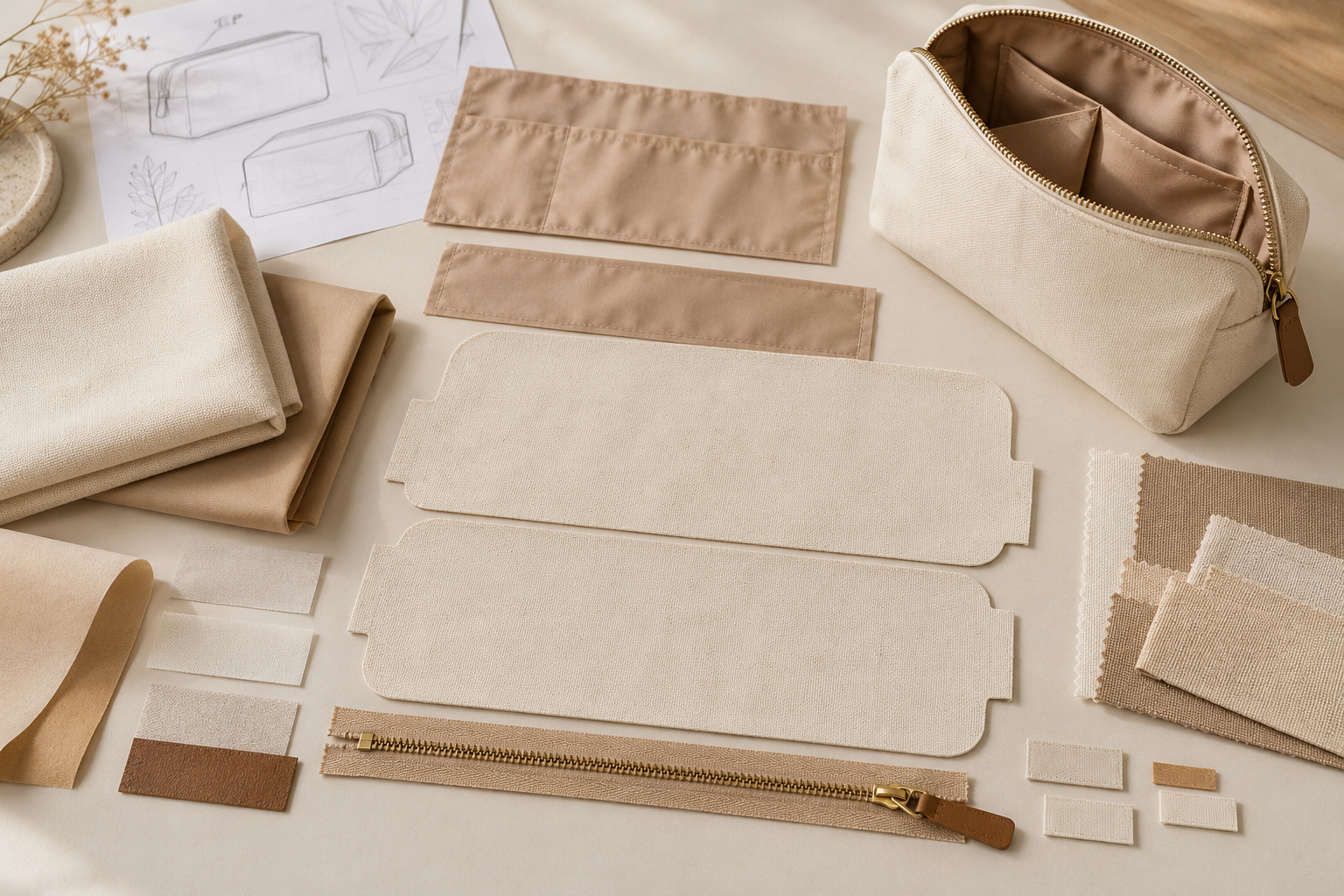
Outer material, lining, reinforcement, zipper, and hardware form a connected construction. Adding a divider introduces material and assembly work; changing reinforcement may affect how corners and zipper ends are sewn.
Cutting efficiency also matters. Material width, pattern layout, directional prints, and matching requirements can change usable yield. A smaller bag is not automatically cheaper if its details require more operations.
Logo choices need similar context. Artwork size, placement, surface compatibility, and production sequence affect the work required. A method suitable for a flat panel may need a different approach on an assembled pouch.
For example, placing decoration near a curved seam can require extra positioning checks. The approved appearance should be evaluated on the finished sample, not only on artwork.
Buyer action: Request identifiable materials and construction details. For a broader explanation, see what affects the price of custom cosmetic bags.
How Do Quantity and Color Splits Affect Per-Unit Cost?
Quantity can change purchasing and setup economics, but price reductions are not automatic or proportional. Ask for quantity-based quotations using an unchanged specification.
A larger combined order may still contain separate material colors, artwork versions, or packaging requirements. Those variants can create distinct purchasing commitments and production preparation.
For example, a supplier may price a consolidated color run differently from an order spread across several custom colors. The total number of bags does not describe the entire production requirement.
Buyer action: Compare the total payable amount as well as the unit price. A lower price per bag is useful only if the additional inventory and component commitments fit your demand plan.
How Should I Spread Sample and Setup Charges Across an Order?
For a first-order purchasing budget, allocate required additional project charges over the agreed order quantity. Keep this budgeting view separate from the supplier’s quoted unit price.

First-order project budget per bag = (finished-goods charge + required additional project charges) ÷ agreed order quantity.
Include a charge only once. State which costs remain outside the calculation and mark unconfirmed amounts as estimates.
Additional charges may include sampling, tooling, artwork preparation, testing, or separately arranged inspection. Some may already be included in the goods price. Conditional sample credits should remain separate until their conditions are confirmed.
If different variants have different prices, calculate each variant’s goods charge before totaling the order. Allocate variant-specific charges to the relevant variant; document the basis used for shared charges.
For example, a custom logo tool used for only part of the order should not disappear inside an unexplained average. Keep its cost visible when evaluating that version.
Buyer action: Show first-order and potential reorder budgets separately. Do not spread a current payment across hypothetical future orders simply to make the first order look cheaper. This worksheet is a procurement budget, not an accounting valuation policy.
How Do Packaging and Delivery Change the Budget?
Packaging can affect both the goods price and shipping requirements; delivery adds costs according to the agreed scope. Calculate these using the actual packing plan.

A belly band, protective sleeve, dust bag, and rigid box involve different purchases and packing operations. Custom packaging may also require buying more units than the finished-bag order uses.
For example, a rigid box can change carton dimensions and freight calculations even when the bag itself is unchanged. Ask for the proposed carton count, packed dimensions, and weight before relying on a shipping estimate.
Confirm the delivery term, named place, rule edition, and included services. The ICC’s Incoterms® guidance explains how these rules allocate delivery-related tasks, costs, and risks.
Buyer action: Add applicable buyer-paid transport, destination, and import-related charges to the same defined budget boundary, without duplicating included charges. Have the relevant logistics or import professional confirm destination-specific items rather than applying a generic percentage.
How Can I Reduce Cost Without Changing the Product’s Purpose?
Ask for separately quoted alternatives that preserve the features your customer needs. Cost reduction should make a defined change visible rather than silently reducing the specification.
Possible alternatives include available material colors, a shared lining, standard hardware, fewer decorative versions, or simpler packaging. Their effect depends on which purchases and operations actually drive the quote.
For example, removing a decorative puller may save little if the main expense comes from a complex internal organizer. Ask the developer to identify the relevant operation before deciding what to change.
Buyer action: Compare the original and revised samples for fit, zipper access, shape, appearance, and protection. Accept savings only after the revised product meets the agreed requirements.
What Should I Send to Obtain a Usable Unit Quote?
Send enough information to define the product, quantity, and commercial scope being priced. Mark undecided features clearly so the supplier can distinguish estimates from confirmed requirements.
Include dimensions, reference design, outer material, lining, zipper, logo artwork and method, quantity by variant, packaging, destination, and required arrival date. Add inspection or documentation requirements that may affect the proposal.
For example, “logo included” remains ambiguous if the supplier has not seen the artwork or confirmed the method. Request a dated quote linked to the specification revision.
Buyer action: Prepare your brief with the custom cosmetic bag RFQ checklist. Ask the supplier to identify inclusions, exclusions, validity, and conditions that could change the price.
Example Scenario: The Same Bag With Different First-Order Budgets
This is a hypothetical example, not a customer case or a reported project result.
A beauty brand receives a quote for a lined pouch with its logo. The quoted unit price covers the approved bag and protective packing, while sample development and a custom retail box are separate.
The buyer builds a first-order budget by adding the required development and packaging charges to the goods total. It then adds separately quoted delivery expenses for its chosen destination.
The resulting budget per bag is higher than the supplier’s bag-only price because it covers a wider scope. For a later order, some development charges might not recur, but materials, packaging, quantity, and delivery costs still require reconfirmation.
Buyer Checklist Before Accepting a Unit Price
- The quote identifies the product specification and revision.
- Quantity and color or artwork allocations are confirmed.
- Logo, labels, individual packing, and cartons are clearly included or excluded.
- Sample, setup, tooling, and inspection charges are disclosed.
- Conditional credits are separated from confirmed reductions.
- Excess material or packaging commitments remain visible.
- Currency, validity, payment conditions, and delivery scope are recorded.
- The budget counts each charge once and labels uncertain costs.
- The approved sample represents the specification used for the final price.
Frequently Asked Questions
Can I get a price from a reference photograph?
You can request an initial estimate, but a photograph does not establish dimensions, material specifications, lining, internal construction, or order quantity. Ask the supplier to list the assumptions behind its response. Treat that figure as provisional until the product and commercial scope are confirmed. A sample or written specification may reveal details that change the quote.
Is the logo normally included in the unit price?
There is no universal inclusion rule. A supplier may include an agreed logo application in the bag price while charging separately for setup, tooling, or a special component. Confirm the artwork, method, placement, and number of versions. The phrase “custom logo” alone does not establish which production work or development charges are covered.
Will ordering more always lower the price per bag?
No. A larger order may change setup allocation or purchasing conditions, but the result depends on the specification and production arrangement. Separate variants may retain their own minimums or preparation requirements. Request comparable quantity options in writing and review the total commitment. Buying unwanted stock to obtain a lower unit price can make the project less suitable for your budget.
Why can the sample price be much higher than the bulk unit price?
A sample charge may cover development, pattern work, component sourcing, and individual preparation rather than simply the physical bag. Bulk pricing applies to a different production arrangement and an agreed quantity. Ask what the sample fee includes, whether revisions are covered, and whether any credit applies to production. Do not assume that a sample charge predicts the bulk unit price.
Does a higher price mean better quality?
Not by itself. A higher quote may reflect different materials, more operations, additional services, or a different commercial arrangement. Evaluate quality against the approved specification and representative sample, then confirm production checks. Compare prices only after understanding those differences. Neither the highest nor the lowest quotation establishes whether the supplier will meet your actual requirements.
Should I divide the budget by ordered units or sellable units?
For an initial procurement comparison, use the agreed order quantity and label that basis. For a later commercial review, you may also examine costs against units actually available for sale or campaign use. Keep samples, retained units, and confirmed losses visible. Do not invent a defect allowance or silently switch the denominator when comparing supplier offers.
Accuracy and Project Requirements
This guide does not provide a confirmed Bling Accessory Co. price or a universal market price range. Unit pricing, MOQ, sample timing, lead time, packaging, testing, and delivery costs must be confirmed for the actual materials, quantity, destination, and current requirements. Budget formulas illustrate purchasing comparisons; they do not replace project quotations or destination-specific professional advice.
Request a Unit Price for Your Cosmetic Bag Specification
Send Bling Accessory Co. your reference design, dimensions, preferred materials, logo artwork, quantity by variant, packaging requirements, destination, and required arrival date. Identify essential features and acceptable alternatives so the proposal can address your budget clearly.
Author: Website Operations & Digital Marketing Manager
Last updated: October 1, 2026