How Can I Reduce Custom Cosmetic Bag Costs Without Sacrificing Quality?
Reduce custom cosmetic bag costs by removing unnecessary purchasing, production and packaging complexity while keeping the product’s required performance unchanged. Start with a clear specification and ask the supplier to price specific alternatives. A lower quotation is useful only when you understand what changed and can verify that the revised bag still meets your requirements.
For beauty brands, private label businesses, wholesalers and promotional buyers, the challenge is deciding which details create customer value and which mainly create expense. Decorative hardware, fragmented color orders, difficult construction and oversized packaging deserve review. Closure reliability, usable capacity and agreed material performance need protection. This guide provides a practical way to compare options, test proposed changes and approve savings without quietly accepting a weaker product.
Quick Answer
To reduce custom cosmetic bag costs without sacrificing quality, define the features that must remain unchanged, then request separately priced alternatives for materials, construction, components, branding and packaging. Consider available material options, shared trims, fewer unnecessary operations and more efficient packing. Compare each option using the same quantity, delivery scope and acceptance criteria. Keep sampling and relevant QC checks in place, because an unverified substitution can create rework or returns. Approve a revised specification only after the changed sample meets the agreed requirements. Evaluate total order cost and inventory exposure, not just the quoted price per bag.
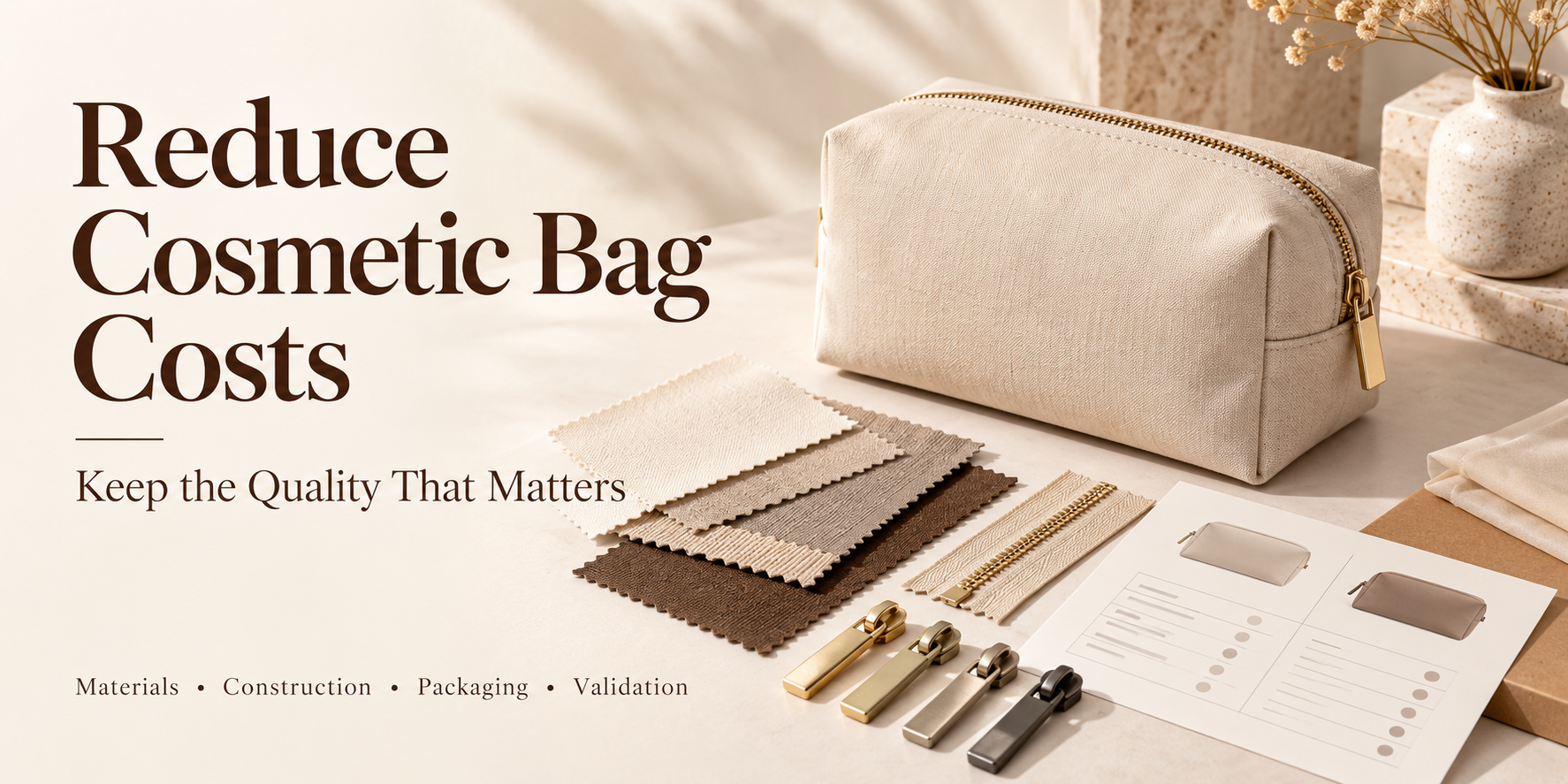
Buyer Snapshot: Where Should Cost Reduction Begin?
| Area to review | Potential cost-saving route | Requirement to protect |
|---|---|---|
| Materials | An available specification or shared material | Appearance, function and relevant performance |
| Construction | Remove an unnecessary panel, trim or operation | Usable capacity, seam integrity and shape |
| Components | Use suitable standard or shared components | Compatibility and closure reliability |
| Variations | Consolidate compatible colors or trims | Required assortment and SKU identification |
| Branding | Reduce redundant decoration or custom tooling | Legibility, finish and brand presentation |
| Packaging | Remove excess space or unnecessary layers | Protection and receiving requirements |
| Development and QC | Prevent avoidable revisions and specification errors | Verification and traceable approval |
Table of Contents
Which Custom Cosmetic Bag Costs Should I Target First?
Target costs that can change without undermining the bag’s intended use or agreed presentation. Define those protected requirements before asking for a lower price.
For a travel organizer, secure storage and convenient access may be essential. For a retail gift pouch, the finish and packed appearance may also be purchase-critical. Quality is not a universal list of premium features; it is conformance to the requirements established for that product.
Separate proposed changes into three groups: requirements that must remain, details that can change after validation, and features that can be removed because they serve no necessary purpose.
For example, a decorative external tab may be optional, while reinforcement at a carrying handle may support a required function. Removing both under a general instruction to “simplify the bag” would treat different risks as equivalent.
Buyer action: Ask the manufacturer to identify the purchase or operation affected by each proposal. Use the custom cosmetic bag price factors guide to organize the discussion, then request project-specific evidence rather than assuming a universal cost ranking.
How Can I Change Materials Without Downgrading Performance?

Compare alternative material specifications against the same required performance, rather than selecting solely by material price. An available color or finish may be worth evaluating before changing the material grade.
Ask whether the current proposal requires special sourcing, custom coloring or a separate upstream purchase. An available alternative may avoid some of those requirements, but availability, repeat-order continuity and actual pricing must be confirmed.
Document composition, surface finish, backing and relevant thickness or weight specifications. A broad description such as “PU” or “polyester” does not establish that two materials behave alike.
Manufacturing insight: The material purchase price is only part of its effect on the finished bag. Stiffness, thickness and surface behavior can influence sewing, turning, decoration and packing. A lower-priced material may require an additional backing or a different process, reducing the expected saving.
For example, a softer substitute may need added support to retain the approved shape. The useful comparison is the cost and performance of the completed construction, not the shell material in isolation.
Buyer action: Request identified swatches and, where behavior could change, a revised finished sample. Confirm that any applicable performance evidence relates to the proposed material and finished-product requirements.
Which Construction Changes Can Reduce Manufacturing Work?
Review operations that add complexity without providing required function. Potential candidates include decorative seams, redundant compartments and trim arrangements that require extra handling.
A construction change is useful only if it actually removes work or consumption. Replacing a sewn pocket with a bonded component, for example, changes the process rather than automatically reducing cost. Ask what operation disappears, what replaces it and what new validation is needed.
Manufacturing insight: Material consumption depends partly on how pattern pieces fit across the usable material width. Print direction, fabric grain and surface orientation can restrict that layout. A small dimensional change may improve cutting yield, have no meaningful effect, or make it worse.
Do not assume that making the bag slightly smaller produces proportional savings. The revised pattern still needs to hold the intended contents and work with the zipper, lining and packaging.
For example, combining decorative panels may remove a seam, but removing a gusset could reduce usable depth. Those proposals require different functional checks.
Buyer action: Ask the supplier to explain the operation or cutting-layout change and provide a revised sample. When considering another structure within the cosmetic bag range, compare loaded capacity and access rather than external appearance alone.
Can Standard Components and Fewer Variations Reduce Cost?
They can reduce purchasing fragmentation or setup requirements when the components are compatible and the supplier can consolidate them. The saving must be demonstrated in the revised quotation.
Review whether different styles can share a lining, zipper specification, label or packing component. Shared components may simplify purchasing, but matching color names or appearance does not prove that the specifications are interchangeable.
Ask where minimum quantities apply: finished style, shell color, trim finish, custom puller or printed packaging. Consolidating finished-bag quantities does not necessarily combine separate upstream minimums.
For example, several exterior colors might use the same approved lining while keeping individual SKU labels. That proposal preserves the visible assortment while reducing component variation, if the supplier confirms a purchasing benefit.
Buyer action: Request a component-sharing proposal with the affected SKUs and quantities. Do not increase the total order merely to obtain a lower unit price; compare the additional cash commitment and unsold inventory exposure.
How Can I Simplify Branding Without Weakening Presentation?
Keep the branding features that matter to the product’s identity and review redundant decoration first. A bag does not necessarily need a custom puller, metal plate, printed logo and branded packaging at the same time.
Compare setup or tooling charges separately from recurring decoration and attachment costs. For repeat orders, confirm whether existing tools remain usable and whether any changes would require new preparation.
No logo method is always the cheapest suitable option. Artwork detail, material compatibility, decoration size, quantity and finish requirements can change the result. A method that works on a flat panel may also be harder to apply after assembly.
For example, retaining an approved front logo while replacing an ornamental custom puller with a suitable standard puller may preserve brand recognition. The revised closure still needs a functional check.
Buyer action: Compare decorated samples at the intended size and location. Approve the appearance and relevant durability requirements before treating a lower decoration quote as a saving.
How Can Packaging and Production Planning Reduce Total Cost?
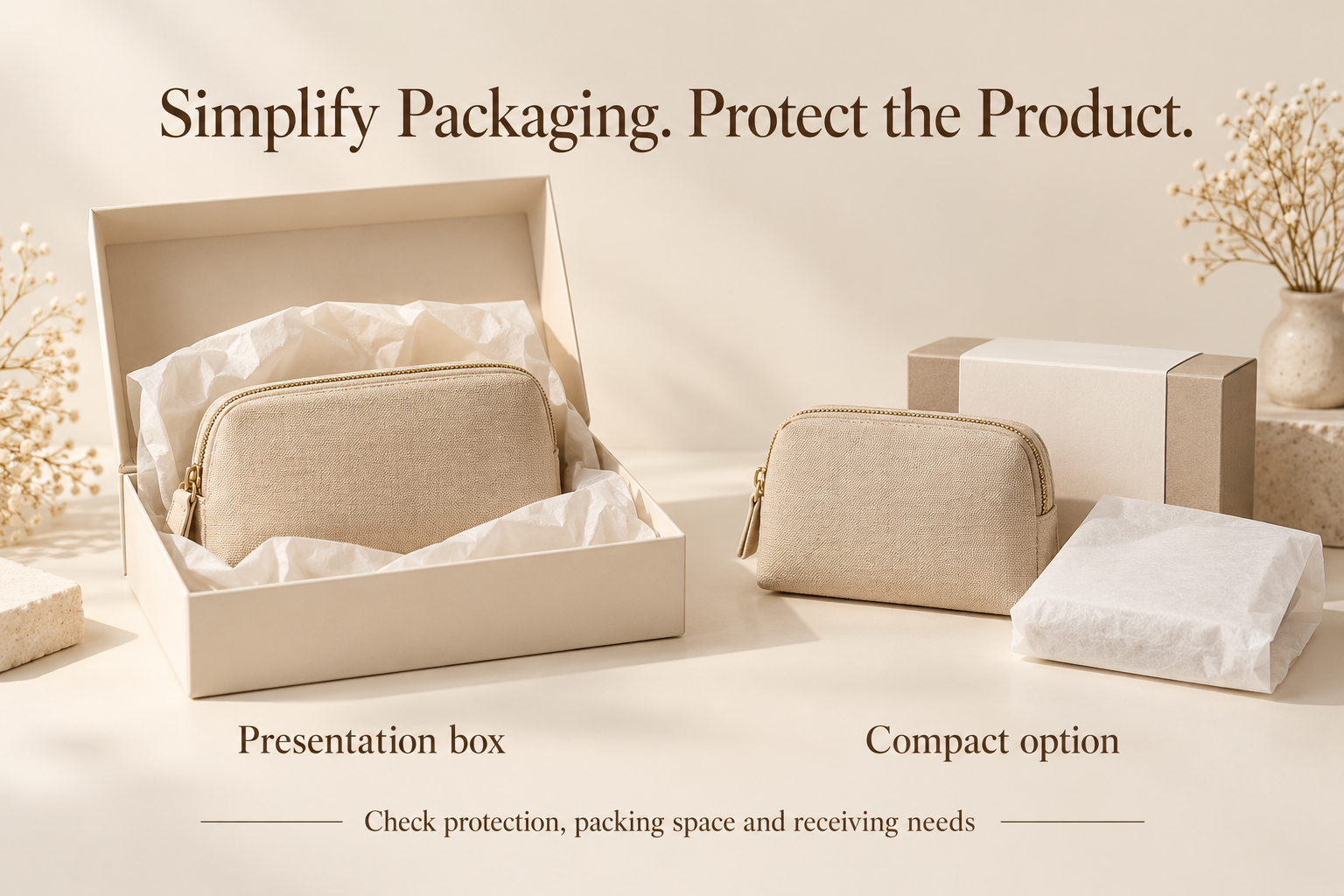
Review excess packing space and prevent avoidable changes after materials or production work have been committed. These opportunities may reduce total expenditure without changing the bag’s core construction.
Compare packaging in the condition actually required by the sales channel. A retail display format, a wholesale carton and an e-commerce shipment may need different protection and identification. Removing a box is not a saving if the replacement creates damage or extra repacking.
Ask for the proposed carton dimensions, weight, packing quantity and shipping quotation. A smaller package does not guarantee a lower freight charge; the result depends on the carrier, service and shipment characteristics.
For a soft pouch, a flatter packing arrangement may be feasible. For a structured case, compression could create lasting distortion. Review the packed sample and its condition after unpacking before accepting the change.
Planning also affects avoidable expenditure. Consolidated feedback, confirmed artwork and coordinated packaging approval can prevent contradictory instructions. Ask whether a design change arrives before or after purchasing, cutting or decoration has started.
Buyer action: Establish approval milestones and a written change process. Provide a complete custom cosmetic bag RFQ so packaging, quantities and delivery requirements are included in the initial comparison.
How Do I Verify That a Cheaper Option Still Meets Quality Requirements?
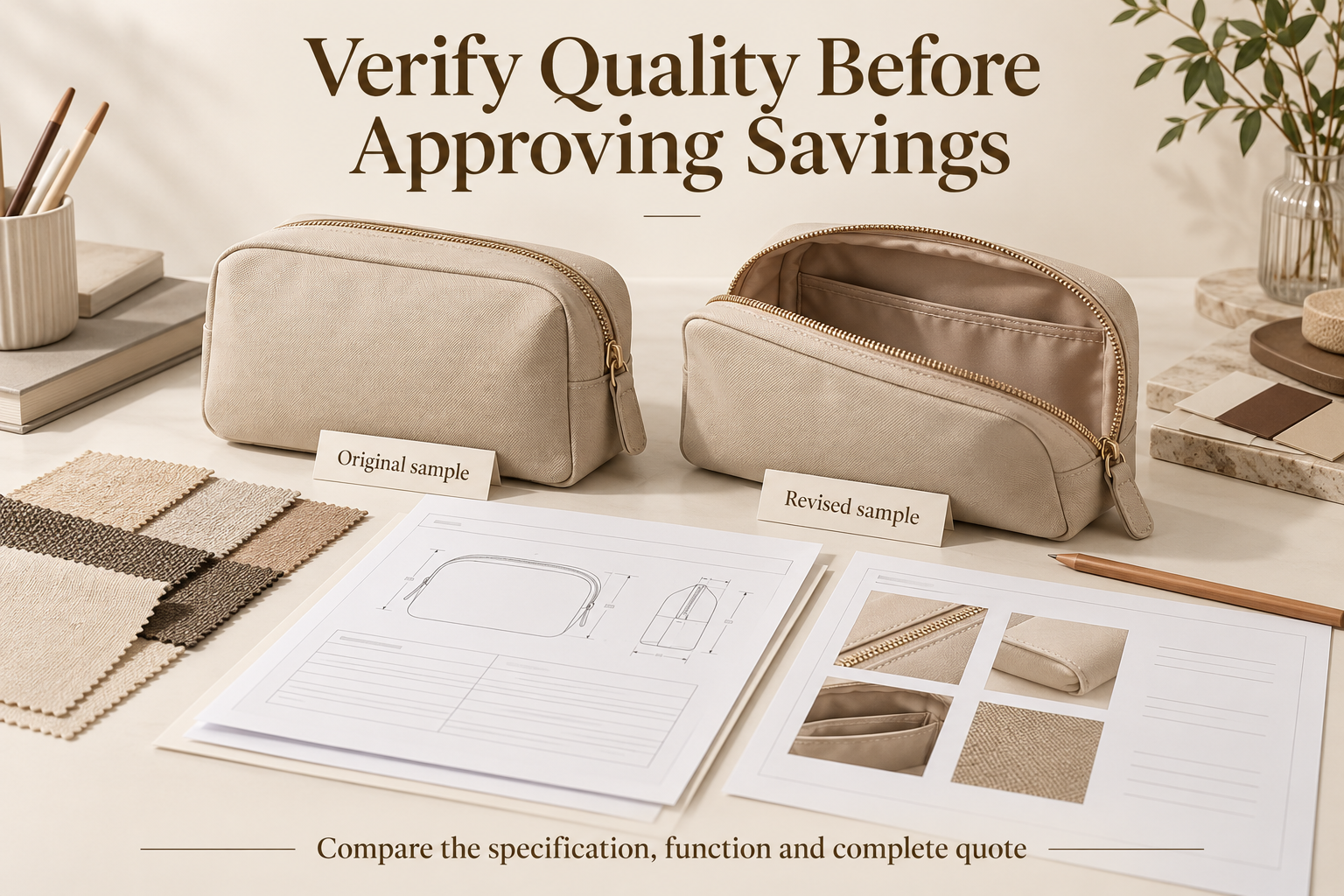
Compare the baseline and proposed option using the same acceptance criteria, then confirm the complete cost difference. Record specification changes explicitly so a price reduction cannot conceal an unapproved downgrade.
Begin with separately quoted alternatives where practical. If several changes are bundled together, request enough detail to understand their effects and validate their interactions in the final sample.
| Proposed change | Cost evidence to request | Quality check before approval |
|---|---|---|
| Available shell material | Updated specification and completed-bag quotation | Appearance, shape, decoration compatibility and required performance |
| Simplified panel construction | Explanation of removed operations and revised price | Loaded fit, access, seam integrity and finish |
| Standard zipper puller | Separate tooling and recurring component differences | Compatibility, grip, operation and appearance |
| Shared lining across styles | Confirmed purchasing benefit and applicable quantities | Fit, visibility of contents, finish and zipper clearance |
| More compact packaging | Packaging price and revised shipment quotation | Protection, unpacked condition and receiving compatibility |
Compare the complete commercial scope
Use the same currency, order quantity, specification revision, delivery scope and quote-validity assumptions. Separate recurring product costs from development, tooling, testing, inspection and transport charges. Avoid counting a charge again if it is already included elsewhere.
A useful comparison is the difference in total expenditure for the same required quantity of acceptable goods. If an option requires buying additional stock, show that commitment separately instead of presenting the lower unit price as an automatic project saving.
Protect verification activities
Do not assume that removing inspection reduces overall cost. ASQ’s cost-of-quality framework distinguishes prevention and appraisal activities from costs caused by failures. Reducing an inspection charge can leave the buyer exposed to rework, sorting or customer complaints.
Buyer action: Keep the relevant checks in the revised cosmetic bag QC plan. Approve the new sample and specification together, and identify which reference the production team must follow.
Example Scenario: Reducing Complexity While Protecting Function
This is a hypothetical sourcing scenario, not a reported customer project or a measured savings claim.
A beauty brand is developing a cosmetic pouch with a lined main compartment, a front logo, an ornamental custom puller and an individual presentation box. Its budget is under pressure, but the pouch must still hold the intended skincare set and maintain the approved appearance.
The buyer asks for a standard puller option and a simpler packaging proposal while retaining the approved shell, lining and construction. The supplier is asked to separate tooling changes, recurring costs and packing assumptions.
The buyer checks the alternative puller for operation and handling. The packaging is evaluated with the bag in its intended packed condition, including protection of the decorated surface and product identification.
If both options meet the requirements and the complete quotation shows a genuine reduction, the buyer can approve them. If the packaging causes deformation or transfers marks to the bag, that option needs revision regardless of its quoted price.
Buyer Checklist Before Approving a Cost Reduction
- Define the baseline: Identify the current sample, specification and quotation.
- Protect essential requirements: Record the function, appearance and performance that must remain.
- Describe each change: State the component, material or operation being revised.
- Verify the cost mechanism: Ask which purchase, setup or production activity becomes less expensive.
- Check quantity conditions: Confirm upstream minimums, color splits and extra inventory commitments.
- Compare full scope: Include relevant development, packaging, inspection and delivery charges without double counting.
- Validate the changed sample: Recheck the characteristics affected by the proposal.
- Update production documents: Issue the approved specification and reference sample together.
- Review delivered results: Track actual defects, repacking and other costs before repeating the option.
Frequently Asked Questions
Should I tell the supplier my target price?
Yes, provided you also define the required product and what the target includes. Explain whether it covers the bag alone or also packaging, development and delivery. A target without a quality baseline may produce unsuitable substitutions. Ask the supplier to identify feasible changes and exclusions rather than simply confirm that the number can be reached.
Is an existing ODM design always cheaper than a new OEM design?
No. An existing design may reduce development work, but substantial changes to its materials, dimensions, structure or hardware can remove that advantage. Compare the actual proposal, including sampling, tooling and recurring production costs. An existing design is useful when it already fits the product brief closely enough that customization does not effectively create a new construction.
Will a larger order always reduce my total cost?
No. A larger order may reduce the quoted price per bag while increasing total expenditure and inventory exposure. Compare the cash required, storage needs and realistic demand for each variant. Ask whether compatible styles can share components instead. That may address purchasing fragmentation without requiring you to buy more finished products than the business can reasonably use.
Can I remove the lining to save money?
Only if the revised construction still meets the product’s requirements. Lining can affect internal finish, seam coverage, feel and interaction with the contents. Removing it may expose areas that require another finishing method. Request a finished sample and a complete revised quote, because the replacement seam treatment or structural changes may reduce the expected saving.
Should I change manufacturers to obtain a lower price?
Consider a supplier change only after checking equivalent specifications and the costs of transition. A lower quotation may exclude work or use different assumptions. Compare development, sampling, quality verification, tooling arrangements and delivery scope alongside the recurring price. Keep the decision evidence-based; neither a current relationship nor a new discount establishes the better overall option by itself.
Can a repeat order use the same specification without another review?
A repeat order should still confirm that the materials, components, artwork and production requirements remain unchanged. Availability or sourcing may have changed since the previous order. Ask the supplier to disclose substitutions before purchasing or production. The extent of resampling should follow the significance of those changes and the evidence needed to confirm that the approved requirements remain satisfied.
Accuracy Note
Cost-saving opportunities depend on the actual specification, materials, quantities, color splits, decoration methods, packaging, delivery requirements and current supplier conditions. This guide does not provide a price quotation, guaranteed saving, MOQ or lead-time commitment. Applicable testing, certification and regulatory requirements must be confirmed for the finished product, destination market and current requirements before production release.
Discuss Your Cost Target and Product Requirements
Send Bling Accessory Co. your reference design, intended use, dimensions, material requirements, logo, quantity, packaging needs and destination. Identify the features that must stay unchanged and the details you are willing to review.
Author: Website Operations & Digital Marketing Manager
Last Updated: October 31, 2026