

What Certifications Should a Cosmetic Bag Manufacturer Have?
A cosmetic bag manufacturer should provide evidence that matches your product, destination market, and purchasing requirements. There is no universal certificate package that makes every cosmetic bag suitable for every buyer. A quality management certificate, social audit, material certification, and laboratory report answer different questions and cannot automatically replace one another.
For beauty brands, private label retailers, wholesalers, and sourcing teams, the practical challenge is deciding which documents matter and whether they cover the actual factory and order. A genuine certificate can still be irrelevant if it belongs to another site or covers only a fabric that will not be used. This guide explains what to request, how to verify it, and how to connect documentation with material approval and production control.
Quick Answer
Ask a cosmetic bag manufacturer for documents matched to your order, not a generic collection of certification logos. ISO 9001 can support quality management assessment; SMETA or amfori BSCI reports can support social due diligence; OEKO-TEX STANDARD 100 may support textile harmful-substance requirements; and RCS or GRS documentation may support recycled-content claims. Product testing and legally required documents depend on the destination market, materials, intended users, and product features. Verify the legal entity, production site, scope, status, and connection to your specification. No single certificate proves that every bag or shipment complies.
Key Facts: Buyer Snapshot
| Decision factor | What the buyer should establish |
|---|---|
| Destination and intended user | Identify the sales market, product category, and whether children are intended users. |
| Factory identity | Match the documented entity and site to the actual manufacturing arrangement. |
| Quality management | Review relevant management system certification alongside actual QC procedures. |
| Social due diligence | Review audit scope, findings, corrective actions, and buyer acceptance requirements. |
| Materials and claims | Confirm which components and claims are covered by supporting documents. |
| Product testing | Connect the tested sample, methods, and results to the current specification. |
| Production changes | Define when substitutions require document review, approval, or further testing. |
Table of Contents
- Which certifications matter for my order?
- What does ISO 9001 establish?
- Are social audits certifications?
- When do material certifications matter?
- Which compliance documents should I request?
- How do I verify documents?
- What changes require another review?
- Example scenario
- Buyer checklist
- Frequently asked questions
Which Certifications Should a Cosmetic Bag Manufacturer Have for My Order?
Build the document request around legal obligations, buyer requirements, and product claims. A retailer may require a particular social audit, while a recycled-content project needs traceability evidence. Neither requirement removes the need to evaluate product safety.
Define the bag first: an empty adult makeup pouch, a children's accessory, and a bag with electrical features may require different assessments. Use the cosmetic bag collection to identify the intended format, then document its materials and use.
| Evidence | Useful for | Does not automatically prove |
|---|---|---|
| ISO 9001 certificate | Quality management within the stated scope. | Product safety or defect-free shipments. |
| SMETA or amfori BSCI audit report | Site-level social due diligence. | Chemical compliance of a cosmetic bag. |
| OEKO-TEX STANDARD 100 certification | Harmful-substance assessment of covered textile articles. | Coverage of an unlisted finished bag or later modification. |
| RCS or GRS documentation | Recycled-material and chain-of-custody claims within scope. | That every component is recycled. |
| Laboratory test report | Results for identified samples and test methods. | Compliance with every rule in every market. |
Buyer action: Mark each requested document as legally required, contractually required, or supporting a voluntary claim. Ask your compliance adviser or testing laboratory to resolve uncertain applicability before ordering tests.
What Does ISO 9001 Tell Me About a Supplier?
ISO 9001 concerns quality management systems, not certification of each cosmetic bag. Its relevance depends on the activities, organization, and sites within the certificate's scope.
A useful review connects that scope with everyday controls: specification approval, incoming material checks, handling of nonconforming goods, and corrective action. A certificate covering a trading operation does not by itself establish coverage of the subcontracted sewing factory.
For example, if your order is produced at a different address from the certificate, request clarification and any applicable site schedule before accepting it.
Buyer action: Check the entity, site, scope, standard edition, and current status with the issuer or an appropriate verification database. ISO explains that certification is performed by external certification bodies; ISO itself does not issue these certificates.
When Do OEKO-TEX, RCS, or GRS Documents Matter?
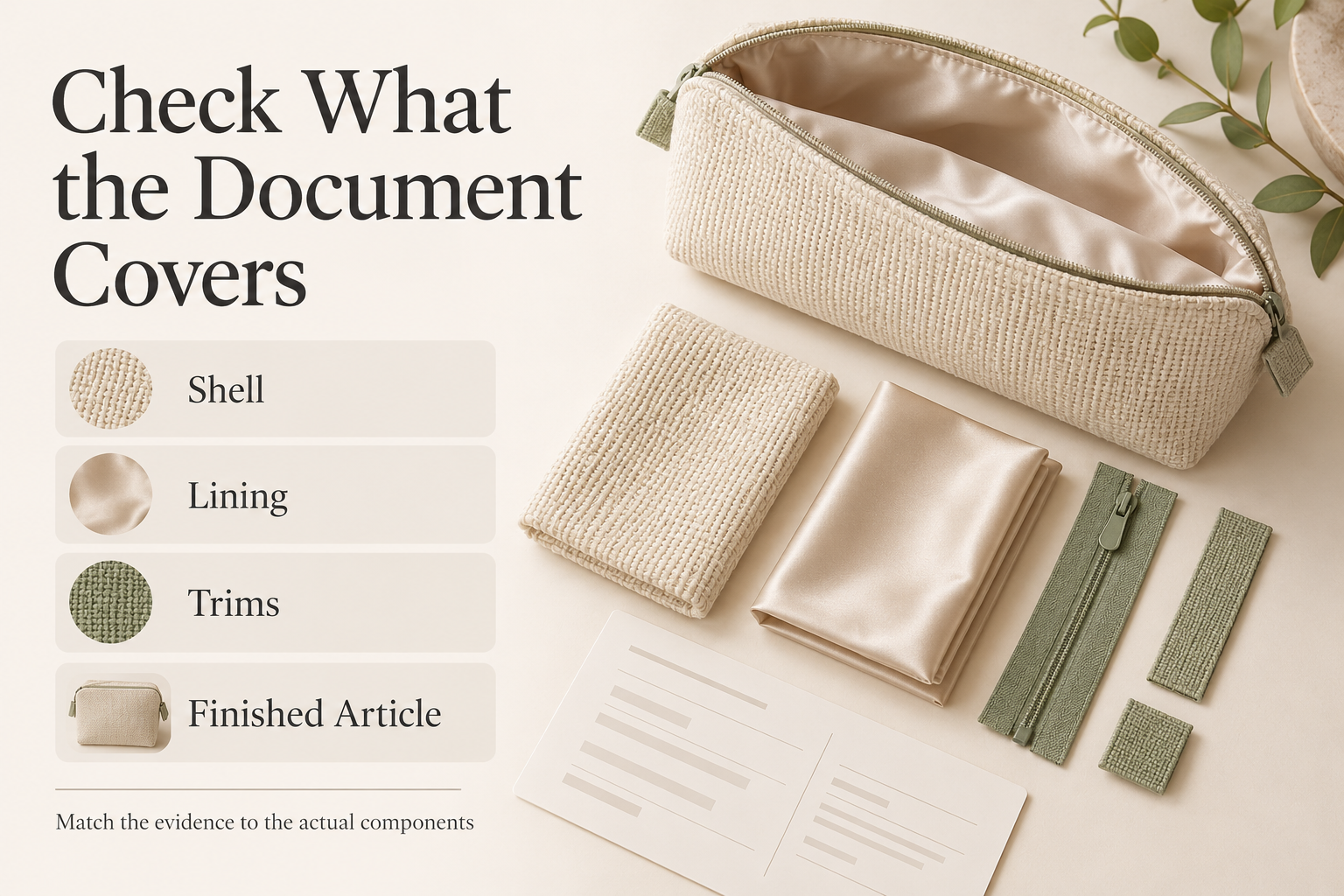
Request material certification when it supports a defined sourcing requirement or claim. The important question is which article, component, and supply-chain activity the document covers.
OEKO-TEX STANDARD 100
OEKO-TEX STANDARD 100 addresses textiles tested for harmful substances. Verify the certificate or label number through the scheme's Label Check and review the covered articles. A certified shell fabric does not automatically establish finished-bag certification after adding a different lining, zipper, print, or decoration.
RCS and GRS
Textile Exchange's RCS and GRS address recycled materials and chain of custody. A scope certificate identifies certified activities and products; order-related traceability documentation is also needed where required by the applicable scheme.
For example, recycled polyester in the exterior does not mean the foam, zipper, thread, or packaging is recycled. Confirm current scheme and transition rules before approving certification language or label artwork.
Buyer action: Map the claimed material to your bill of materials and request the supporting supply-chain records. The cosmetic bag materials guide helps define the components that need to be identified.
Which Product Compliance Documents Should I Request?
Request a market-specific compliance assessment and the evidence it identifies. There is no universal “cosmetic bag compliance certificate.” Confirm the destination, intended user, materials, features, and sales claims before choosing a test package.
European Union: chemical restrictions and product classification
REACH restrictions can apply to substances in articles. Ask which applicable restrictions the evidence addresses and which components were assessed. A report labeled “REACH” is not proof that every relevant obligation has been covered.
CE marking applies only to products covered by legislation requiring it. An ordinary empty cosmetic pouch does not require CE marking merely because it is sold in the EU. Additional features or a different classification can change the assessment; other product-safety obligations may still apply.
United States: intended age and applicable rules
Under CPSC guidance, children's products subject to applicable children's product safety rules require testing and certification as specified by those rules. For imported products requiring a Children's Product Certificate, the importer has certification responsibilities. Do not treat a laboratory report alone as the CPC.
For example, changing a general-use pouch into a product marketed primarily to children can require a new classification review.
Buyer action: Ask your laboratory or compliance adviser to identify the applicable requirements, evidence, labeling, and responsible parties. These examples are not an exhaustive market-access checklist.
How Can I Verify That a Certificate or Report Is Relevant?
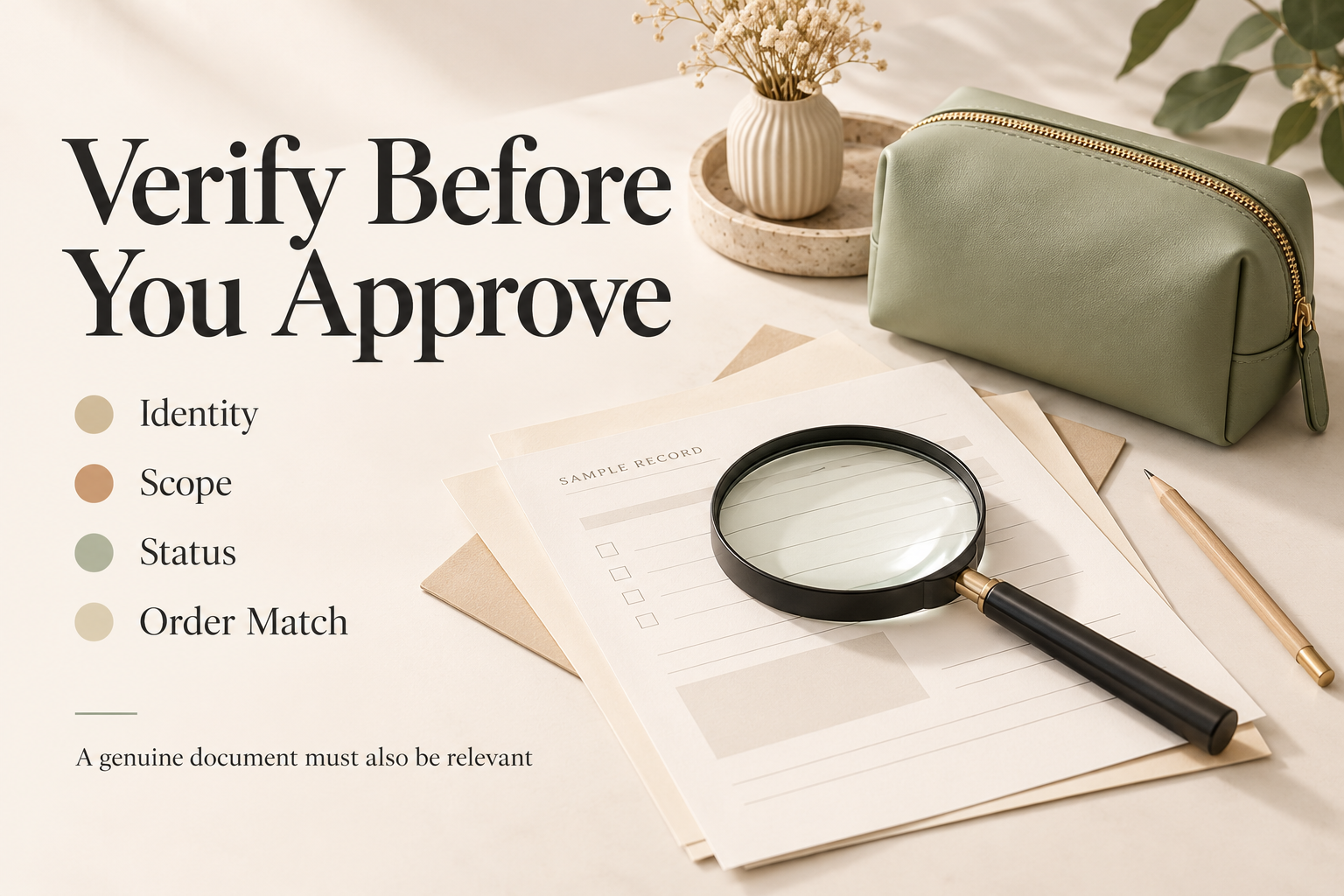
Check authenticity and applicability separately. A genuine document can still refer to another site, another material, or a previous product revision.
- Identify the document: Obtain the complete certificate, report, or authorized platform record, including relevant schedules.
- Match the holder: Compare legal names and addresses with the contracting and manufacturing arrangement.
- Read the scope: Identify covered activities, products, sites, and exclusions.
- Verify status: Use the issuing organization, scheme database, or independently obtained contact details.
- Match the sample: For test reports, review photographs, material references, colors, sample descriptions, and methods.
- Resolve gaps: Request an explanation or further evidence where the proposed order differs.
For example, a report for unprinted fabric cannot automatically establish the performance of a finished pouch with a new printed logo.
Buyer action: Maintain a document register showing the requirement, evidence, scope, unresolved questions, and approval owner. If a database search is inconclusive, contact the issuer before treating the document as invalid or accepting it.
What Production Changes Can Make Existing Evidence Insufficient?
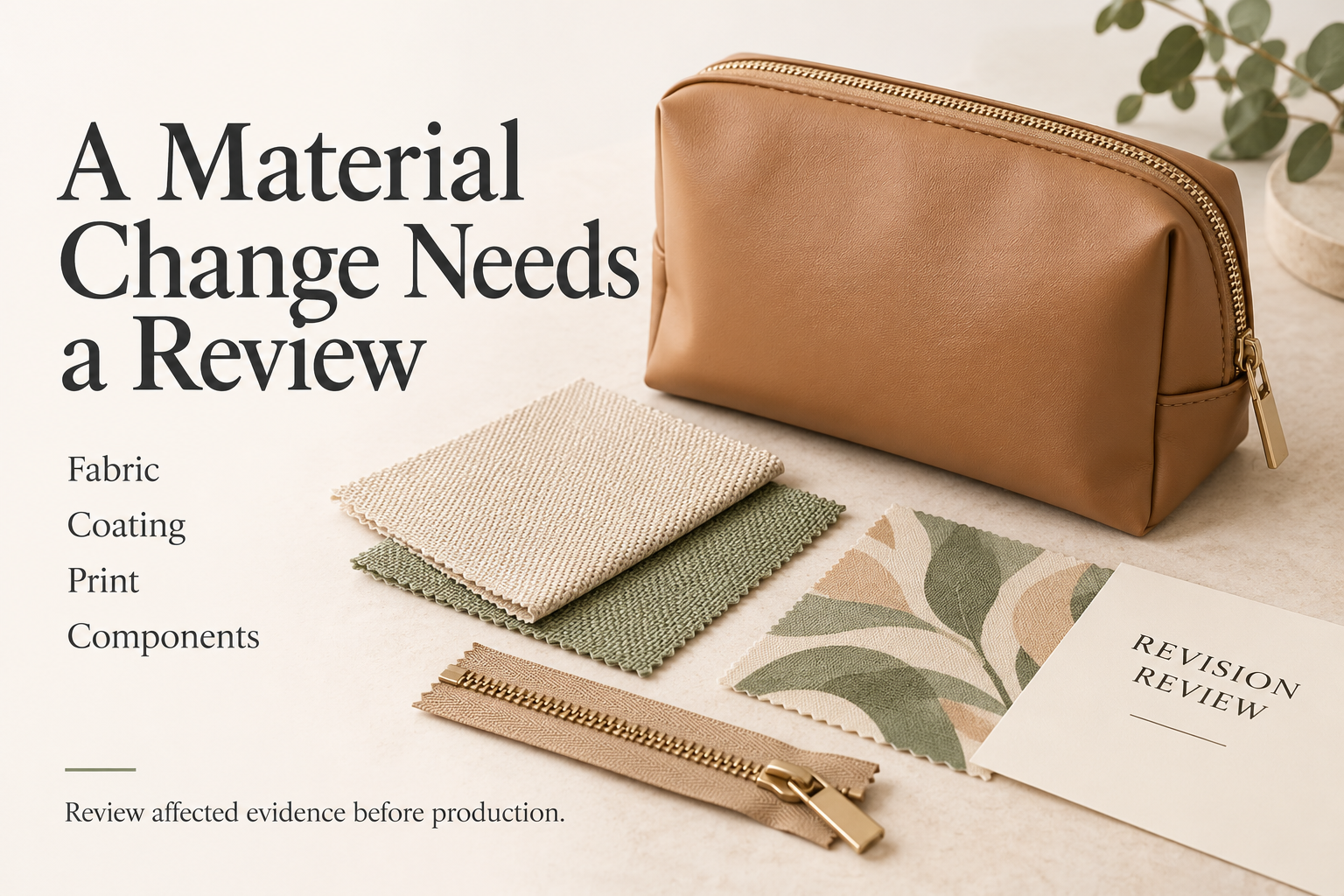
Changes to materials, decoration, components, or production arrangements should trigger a review of affected evidence. Further testing is not automatically necessary for every change, but the decision should be documented by the appropriate technical or compliance owner.
A bill of materials should identify the shell, coating, lining, foam, zipper, hardware, thread, logo process, and relevant packaging. This lets the team connect reports to the actual components being purchased.
For example, an upstream material MOQ may lead to a proposed fabric substitution. A new coating formulation or printing ink may fall outside the evidence used for the approved sample. Moving decoration to another subcontractor may also affect traceability or audit coverage.
Buyer action: Require approval before substitutions. Record material references and sample revisions, and ask what evidence must be updated before production proceeds. Include document review and any required testing in the project schedule.
Example Scenario: A Recycled Cosmetic Pouch Order
This is a hypothetical procurement example, not a customer case study. A beauty brand plans an adult-use pouch with a recycled polyester shell, a printed logo, and conventional lining.
The supplier provides a social audit report, a recycled-material scope certificate, and an earlier fabric test report. These documents address different issues; none should be used as a substitute for the others.
The buyer checks whether the audit covers the production site, whether the certified supply-chain scope supports the intended recycled claim, and whether the test evidence is relevant to the selected fabric and decoration. The lining and trims remain part of the product assessment.
If the logo ink changes after sampling, the buyer asks for a review of the affected evidence before approving production. Approval follows the documented project requirements, rather than the number of logos in a supplier presentation.
Buyer Checklist Before Supplier Approval
- Define the destination market, intended users, product features, and claims.
- Separate legal requirements from retailer requirements and voluntary certifications.
- Confirm the contracting entity, production site, and subcontracting arrangement.
- Verify certificate scope and current status through appropriate channels.
- Review audit findings and corrective actions, not just membership or summary badges.
- Match test reports to materials, colors, decorations, and product revisions.
- Check traceability and claim permissions for certified or recycled materials.
- Agree who approves substitutions and decides whether evidence needs updating.
- Record document responsibilities, costs, and approval steps before production.
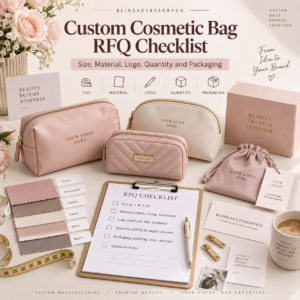
Include these requirements in the custom cosmetic bag RFQ checklist so suppliers quote against the same evidence and testing expectations.
Frequently Asked Questions
Is ISO 9001 mandatory for every cosmetic bag factory?
No universal rule requires every cosmetic bag factory to hold ISO 9001 certification. It may be a buyer or contractual requirement, and it can support assessment of quality management. Confirm any applicable local obligations separately. Even when certification is required, review its scope and the factory's actual production controls rather than treating it as finished-product approval.
Can I accept a certificate issued to the fabric supplier?
Yes, when it is relevant supporting evidence for the fabric being purchased, but it does not automatically certify the bag manufacturer or finished product. Match the material reference and covered scope, then review other components and manufacturing steps. Printing, coating, lining, hardware, and product assembly may create additional evidence requirements or affect the claim you can make.
Does a test report from SGS or another laboratory mean the factory is certified?
No. A laboratory test report records results for identified samples and methods; it is different from factory certification. Read the document type, sample description, tested requirements, and results. Verify authenticity with the issuing organization when necessary, and check the laboratory's relevant accreditation or regulatory acceptance where your market or purchasing specification requires it.
Does a cosmetic bag need a CE certificate for Europe?
An ordinary empty cosmetic pouch does not need CE marking simply because it will be sold in Europe. CE applies where specific legislation requires it. Electrical features, toy classification, or another regulated function can change the assessment. Determine the correct product category and applicable safety obligations before requesting CE-related documents or placing a mark on the product.
Do product test reports expire after a fixed period?
There is no single validity period that applies to every test report. A report describes the samples and methods used at the time of testing. Its continued relevance depends on product changes, updated requirements, and buyer policies. A retailer may impose its own recency rule, so confirm acceptance criteria instead of assuming every report has the same expiry date.
Can a supplier with fewer certifications still be suitable?
Yes, if it meets the requirements that actually apply to your order and provides adequate evidence of capability and control. More certificates do not automatically mean better product fit. However, a missing mandatory document or buyer-required certification is a real gap. Resolve that gap through appropriate evidence or corrective action before approving the relevant purchase or claim.
Compliance and Accuracy Note
Requirements vary by destination, intended user, materials, product features, claims, and current rules. Confirm the project-specific compliance plan with a qualified adviser or appropriate laboratory. Testing costs, MOQ, sample time, and production lead time must be confirmed against the actual specification and order. Mentioning a certification or audit in this article does not mean Bling Accessory Co. holds it or that any particular product is certified.
Send Bling Accessory Co. your destination market, intended users, bag specification, material preferences, quantity, and any retailer audit or testing requirements. Include the claims you plan to make so the documentation discussion starts with the actual order.
Author: Website Operations & Digital Marketing Manager
Last updated: October 16, 2026


Are SMETA and amfori BSCI Factory Certifications?
Treat them as social auditing frameworks and review their audit records. A statement such as “Sedex certified” is not a substitute for the underlying evidence. Sedex identifies SMETA as a methodology rather than a certification.
Request the relevant site report, audit date, scope, findings, and corrective-action status through an authorized sharing process. Your buyer's responsible-sourcing policy determines whether the evidence is acceptable; membership or a platform screenshot alone does not establish the site's audit outcome.
For example, an audit of a supplier's main facility may not cover a separate workshop that will carry out your order.
Buyer action: Confirm the actual production site and any subcontracting. Ask which findings remain open and how remediation is being verified, rather than relying only on a summary rating.