Cosmetic Bag Size Guide: How to Choose the Right Bag Size for Travel, Storage, and Custom Orders
Choosing the right cosmetic bag size is not just a matter of preference. It affects how much you can pack, how well your products stay organized, how easily the bag fits inside a suitcase or tote, and how appealing the finished product looks to customers. In retail, wholesale, and private label sourcing, the wrong size can create complaints about bulkiness, wasted space, weak usability, or poor perceived value. The right size, by contrast, makes a cosmetic bag feel practical, premium, and purpose-built.
- What cosmetic bag size actually means
- Common cosmetic bag sizes and dimensions
- How to choose the right size by use case
- Packing strategy by size
- How materials and design affect perceived size
- Wholesale and custom sizing strategy
- Common sizing mistakes to avoid
- Internal link structure and topic cluster plan
- FAQ
What cosmetic bag size actually means
When people hear “cosmetic bag size,” they often think only in terms of length, width, and height. Those measurements matter, but in practice the usable size of a cosmetic bag is determined by much more than the external dimensions printed on a spec sheet. Opening style, wall thickness, gusset depth, zipper placement, lining stiffness, shape retention, and internal organization all influence how the bag performs in real life.
A small pouch with a soft body may hold more than a rigid-looking case of the same dimensions. A structured box-shaped bag can look compact but swallow a surprising number of items because its walls stand upright and protect the interior space. A round barrel pouch may seem smaller than a rectangular pouch until you account for the curved profile and the way it creates depth in the center. That is why good sizing decisions must balance visual proportions, storage capacity, packing efficiency, and brand positioning.
For B2B buyers, this matters even more. A customer may judge a bag by shelf presence, giftability, or how “full” it looks in packaging photography. A travel buyer may judge it by how well it sits beside toiletries inside a carry-on. A beauty brand may judge it by whether the size supports the brand story, price point, and target demographic. A custom manufacturer must therefore think beyond simple dimensions and design the product as a complete user experience.
Common cosmetic bag sizes and dimensions
There is no universal sizing standard for cosmetic bags, but most products fall into a few practical categories. These categories help buyers understand positioning before they request samples or finalize OEM specifications. The following breakdown is not a strict industry regulation; it is a practical sourcing framework that works well for retail planning, product development, and catalog structure.
| Size category | Typical dimensions | Best for | Common buyer expectation |
|---|---|---|---|
| Mini / small pouch | About 12–18 cm wide, 8–12 cm high, 3–7 cm deep | Lip products, compact powder, sample items, small daily essentials | Light, cute, easy to toss in a handbag |
| Medium cosmetic bag | About 18–24 cm wide, 10–15 cm high, 6–10 cm deep | Daily makeup routine, skincare minis, brushes, travel essentials | Most versatile size for retail and gifting |
| Large travel cosmetic bag | About 24–32 cm wide, 15–20 cm high, 10–16 cm deep | Long trips, family travel, beauty kits, complete toiletry sets | Maximum capacity without feeling like luggage |
| Structured vanity case | Often box-like, with rigid or semi-rigid walls | Premium gifting, professional makeup sets, display appeal | Looks upscale, protects contents, strong shelf presence |
Many brands build their assortment around these size bands because they make product planning easier. For example, a brand may offer a mini pouch for handbags, a medium organizer for daily beauty use, and a large travel case for weekend trips. That assortment strategy creates a natural upsell ladder and reduces the chance that customers choose the wrong product simply because there was only one option available.
On the factory side, these size categories also help streamline quotation, sampling, and packaging. A supplier can adjust zipper length, side gusset depth, lining type, handle placement, and logo placement based on the size category. If you are comparing products on the Bling Accessory Co. site, the Puffer Handle Pouch, Flat-Grain Barrel Pouch, and Drawstring Bucket Bag each illustrate a different proportion strategy that can be used to serve different size expectations.
How to choose the right cosmetic bag size by use case
The best size is always linked to the way the bag will actually be used. A cosmetic bag should not be specified in a vacuum. Instead, it should be designed for a person, a routine, and a storage context. That means considering whether the user is packing for everyday use, a short commute, a flight, a gym visit, a business trip, or a long vacation. It also means thinking about whether the bag is carrying only makeup, or a broader mix of skincare, hair accessories, tools, and personal care items.
1) Everyday handbag use
For an everyday handbag pouch, compact sizing is usually best. Users want quick access to a few key items such as lipstick, pressed powder, concealer, hand cream, or a small mirror. If the bag is too large, it becomes awkward inside smaller handbags and tends to create clutter. If it is too tiny, the user has to force items in or leave important products behind.
Good everyday sizes are often in the mini or small category. Soft pouches are popular here because they compress easily and adapt to different handbag shapes. A slim profile matters more than maximum volume. This is also a strong category for trend-driven products because consumers often buy these bags as impulse purchases, gifts, or matching accessories. The Mini Pouch category is especially relevant for this use case. citeturn546124search2
2) Travel and weekend trips
For travel, the bag should be large enough to hold the user’s actual routine but still compact enough to fit into luggage. Travel users often need to pack cleanser, moisturizer, sunscreen, foundation, mascara, brushes, hair ties, and toiletries. A medium or large cosmetic bag works best here, especially one with a boxy shape that stands upright and keeps items visible.
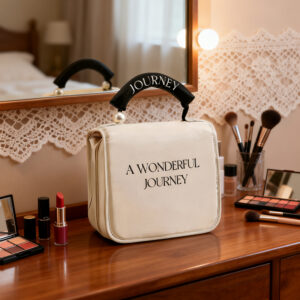
Travel bags also benefit from wipe-clean linings, structured corners, and secure zipper closures because liquids, powders, and toiletries can leak during transit. The Puffer Handle Pouch is a good example of a travel-ready silhouette because it balances a soft exterior with a structured interior and an easy-carry handle. For buyers who need more volume, the Flat-Grain Barrel Pouch shows how a cylindrical shape can improve usable space while maintaining a compact footprint.
3) Professional makeup kits
Professional users need bigger, more organized cases. They may carry multiple brushes, complexion products, palettes, setting sprays, tools, and backup items. In this scenario, size is not just about capacity; it is about workflow. A case that opens too narrowly or collapses under its own weight will slow the user down. A case with a wider opening, firmer base, and better visibility becomes much more effective.
For this group, medium-to-large structured cases often outperform tiny pouches. Interior dividers, brush sleeves, elastic loops, or segmented compartments can make a large case feel better organized rather than simply oversized. In many markets, this is the category where customers are willing to pay more because the perceived functionality is immediately visible.
4) Retail gifting and promotional sets
When cosmetic bags are used as gift-with-purchase items, PR packages, or promotional bundles, the size is often determined by the contents of the set rather than by a single end user. A brand may need the bag to fit a curated assortment of products while leaving enough empty space to look premium in photos. In these cases, the bag should not be too tight, or the set will look crowded. It should also not be too large, or the contents may appear sparse and low-value.
Packaging strategy matters here. A well-sized cosmetic bag can become part of the gift presentation itself, making the whole set feel more complete. This is one reason why promotional and packing-oriented categories matter in the broader product ecosystem, including the Packing&Promo bag page and related product pages.
5) Teen, lifestyle, and trend-led segments
In trend-led segments, size is often connected to style. Consumers may want a bag that looks fashionable, soft, textured, or playful rather than purely functional. In this environment, a slightly smaller but visually distinctive bag can outperform a larger generic organizer. The Trend Bag category reflects this broader opportunity, where design language and perceived lifestyle value can be as important as absolute storage volume.
Packing strategy by cosmetic bag size
Choosing the right size also means understanding what will actually go inside the bag. Many buyers overestimate how much space they need because they measure products only by count rather than by shape. A bottle that stands upright, a flat palette, a thick brush roll, and a narrow lipstick all consume space differently. A good size guide should therefore be based on categories of items rather than just item totals.
Mini bags
A mini cosmetic bag works best when it carries a limited capsule of items. Typical contents might include one lipstick, one concealer, a compact, a small hand cream, and a few hair ties. These are lightweight and easy to access. Mini bags are ideal when the user does not want to search through a large organizer. They are also good for selling as add-on items near checkout because the perceived value is high relative to their size.
Medium bags
Medium bags are often the most practical because they strike a balance between portability and storage. They usually fit daily beauty routines without becoming cluttered. A medium bag can hold base makeup, a few complexion products, small skincare items, and basic accessories while still remaining manageable inside a tote or suitcase. This size is often the “best seller” in many assortments because it suits the widest range of consumers.
Large bags
Large bags are the best option for travelers and users who want one organizer to replace several smaller pouches. However, a large bag must be carefully structured. If the interior is just a single open cavity, the user may waste space or struggle to find items. Large bags benefit from pockets, brush slots, elastic loops, or at minimum a strong rectangular base that keeps the contents upright. Otherwise, the user may perceive the product as bulky rather than useful.
How materials and design affect perceived size
Size is not experienced in isolation. It is experienced through the material and the structural form. Two cosmetic bags with the same measurements can feel completely different depending on whether they are made from canvas, nylon, PVC, PU, quilted polyester, or structured fabric with foam support.
Soft materials make the bag feel more flexible and forgiving, which can be useful for compact storage. Structured materials make the bag feel more premium and controlled, which can improve shelf impact. A bag with a thick lining may take up slightly more space, but it also protects the contents better and feels more substantial. A clear PVC style may make the bag appear larger because the contents are visible, while a dense woven style can feel more compact and luxurious.
Shape also changes the size perception. Boxy silhouettes generally maximize usable volume. Barrel shapes can feel compact while still offering strong storage depth. Flat pouches are easy to pack but less likely to support large items. Handle-top styles may feel easier to carry even when they are not physically larger, simply because the user can move them with one hand. This is why product pages such as the Puffer Handle Pouch and the Drawstring Bucket Bag are useful references for proportion and portability.
Why opening style matters
The opening style directly affects how large a bag feels in daily use. A wide zip opening creates a generous access point and reduces the frustration of digging through the interior. A narrow top opening may reduce perceived size even if the bag is physically large. For travel bags especially, a wide opening increases usability because users can identify and remove products quickly while standing at a sink, hotel counter, or vanity table.
Why base structure matters
A flat base is one of the simplest ways to make a cosmetic bag more efficient. It helps the bag stand upright, improves visibility, and reduces wasted space in corners. Bags without a good base often collapse when placed on a counter, which makes them feel smaller and less premium. Buyers who care about functionality should therefore ask suppliers about base reinforcement, foam, cardboard support, or other shaping methods during sampling.
Wholesale and custom sizing strategy
For wholesale buyers, size is a commercial decision as much as a design decision. The right size affects carton loading, freight efficiency, MOQ planning, retail price positioning, and the final customer satisfaction rate. A smaller product can ship more efficiently, but a larger product may support a higher retail price and stronger brand perception. A successful assortment usually includes more than one size so that a brand can serve multiple price points.
When sourcing custom cosmetic bags, a good factory partner should be able to adjust dimensions according to target market needs. Brands in the mass market may prioritize compact, affordable designs. Premium brands may prioritize stronger structure, more refined proportion, and better logo placement. Promotional buyers may prioritize fast production and a size that works with gift sets. E-commerce brands may prioritize shipping efficiency and camera-friendly proportions. These differences should be clarified before sampling begins.
Bling Accessory Co. positions itself as an OEM/ODM manufacturer focused on custom cosmetic bags and related fashion beauty accessories, with additional assortment depth across categories like cosmetics, trend bags, hair accessories, packing/promo bags, and travel accessories in the site navigation. That breadth matters because sizing decisions can be informed by adjacent product categories rather than being made in isolation.
What to ask a supplier about size
- What are the exact outer dimensions and usable internal dimensions?
- How much depth does the bag lose after lining and padding are added?
- Does the shape change when the bag is empty versus filled?
- Can the factory adjust the height, base width, zipper length, or gusset depth?
- How will the size affect carton loading and shipping cost?
- Is the bag intended to be a handbag pouch, travel organizer, or retail gift item?
These questions are simple, but they prevent many common sourcing mistakes. Buyers who skip them often end up with products that are technically well made but commercially weak because the size does not match the market use case. The right supplier should be able to translate these questions into prototype revisions quickly.
Common cosmetic bag sizing mistakes to avoid
Even experienced buyers make sizing mistakes when they focus too much on aesthetics or cost and not enough on user behavior. The following issues appear repeatedly in product development and should be checked early in the process.
1) Choosing a bag that is too small for realistic use
This is one of the most common failures. The bag may look cute, elegant, or trend-driven, but if it cannot hold the essentials, users will stop trusting it. The product may still sell as an accessory, but it will not perform as a daily organizer. A bag that is too small often leads to product returns, poor reviews, and weak repeat purchase rates.
2) Oversizing the bag for the target customer
The opposite mistake is also common. A bag that is too large can feel awkward in a handbag or look wasteful on a shelf. Users may feel that they are paying for volume they do not need. Oversized products can also raise shipping costs and reduce retail efficiency. In a crowded market, a practical mid-size option often outperforms a large but unnecessary one.
3) Ignoring item shape
Some items are much more difficult to pack than others. Brush handles, pump bottles, and palettes all require different geometry. Buyers who only count item numbers, not item shapes, often misjudge the size requirement. This is why sample testing with real products matters so much.
4) Forgetting about access and visibility
A bag can have enough space on paper but still feel too small if users cannot see or reach what is inside. Good organization depends on access. Wide openings, taller side walls, lighter interior colors, and a stable base all help the interior feel more usable.
5) Not matching the size to the price point
Consumers usually expect higher-value products to look and feel more substantial. If the pricing is premium but the size is tiny or the structure feels thin, the product may seem underpowered. The size, material, hardware, and packaging need to support the price story consistently.
Recommended size decision framework
If you are deciding on a size for a new product, use the following framework:
- Define the user. Is the product for handbag use, travel, gifting, or professional makeup?
- List the actual contents. What specific products must fit inside?
- Decide the shape. Flat pouch, box pouch, barrel pouch, vanity case, or drawstring organizer?
- Check access. Is the opening wide enough and the interior visible enough?
- Test portability. Will it fit inside a tote, carry-on, or gift box?
- Match the price. Does the size support the intended retail or wholesale positioning?
- Validate with samples. Real products always reveal problems that CAD dimensions cannot show.
Using this framework makes sizing a commercial decision rather than a guess. That is especially important for brands working with OEM and ODM partners because a good first sample saves time, reduces revision cycles, and improves the chance of a successful launch.
FAQ
What is the best cosmetic bag size for everyday use?
A medium or slim small bag is usually best for everyday use because it can hold the essentials without becoming bulky inside a handbag.
What cosmetic bag size is best for travel?
A medium-to-large structured bag is usually best for travel because it can hold skincare, makeup, and toiletries while still fitting neatly in luggage.
Should I choose a soft pouch or a structured case?
Choose a soft pouch for flexibility and compact storage. Choose a structured case if you want better shape retention, stronger shelf presence, and improved organization.
How do I know if a cosmetic bag is too small?
If the essentials do not fit comfortably, the zipper strains, or the user has to remove items to close the bag, it is too small for the target use case.
Can cosmetic bag sizes be customized for wholesale orders?
Yes. Custom sizing is common in OEM/ODM projects, especially when a brand needs a product made for a particular audience, price point, or packaging format.
Suggested keywords for this page: cosmetic bag size guide, cosmetic bag dimensions, makeup bag size, travel cosmetic bag size, custom cosmetic bag size, cosmetic pouch size chart, cosmetic organizer size, mini pouch, medium cosmetic bag, large cosmetic bag.
This article is written for WordPress use and can be pasted directly into the editor after removing or keeping the style block depending on your theme setup.